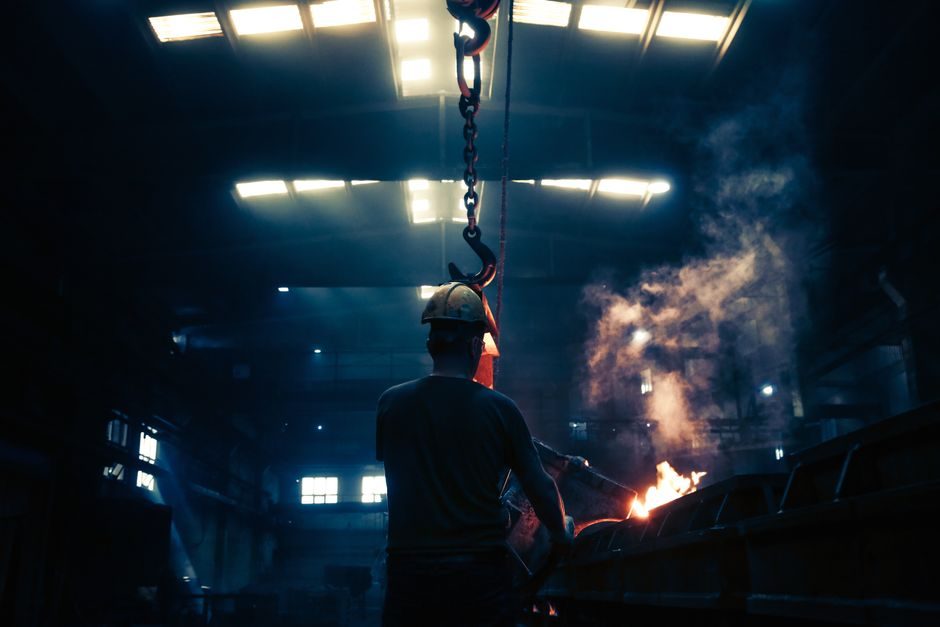
An electric vehicle manufacturing process line in 2026 is organised around four sequential shops — stamping, body-in-white welding, paint, and final assembly with battery pack build — distinguished from ICE lines by a battery pack/module assembly step that takes the place of engine and transmission machining and a simpler, shorter final drivetrain marry-up.
Source documentation from operating factories in Shenzhen and Changzhou lists the canonical shop sequence as stamping, welding, coating (e-coat + topcoat + clearcoat), and final assembly, supported by R&D and testing equipment to meet design and durability requirements [S2]. Suzhou Eagle's site documents the same upstream shops feeding low-speed electric buses, utility carts, and enclosed 2–16 seat EVs with FOB-unit pricing from roughly USD 2,900 for utility carts up to USD 9,999 for enclosed sightseeing buses [S6].
Stamping, welding and the body-in-white: what changes for an EV
Body-in-white tonnage for a typical passenger EV sits in the 200–350 kg range across aluminium-steel mixed-metal architectures, with high-strength steel and aluminium alloy sheet dominating the closure panels and crash structure [S2][S6]. Stamping is run on large mechanical or hydraulic presses with progressive dies; line builders cite press tonnage, stroke rate, and die-change time as the three specifications that govern throughput.
Welding on a 2026 EV line is dominated by spot welding, with MIG/MAG and laser welding used for tailored blanks and aluminium closures. A typical mid-volume line runs 4,000–6,000 spot welds per body; the shop floor is robot-dense, with six-axis articulated arms handling stud welding, hemming, and sealant dispense. Adhesive bonding — structural epoxy plus crash acrylic — runs alongside spot welds on most modern EV programmes to reduce weld count and improve fatigue. The drive toward mixed-metal bodies (aluminium closures over steel underbody) means EV plants increasingly run dedicated aluminium stamping cells with inert-gas-shielded MIG and laser welding, separated from the steel cell to prevent iron contamination of the aluminium weld pool.
Paint shop: e-coat, topcoat, and the rise of integrated dry-off / cure
The phosphating stage — historically zinc-phosphate at 50–60 °C — has largely been replaced by zirconium-based silane pretreatments that operate at 25–40 °C, eliminating phosphate sludge and the dedicated waste-treatment line that came with it. For battery enclosures, powder coating or e-coat plus a UV-cure topcoat is now common, replacing the wet spray previously specified for ICE fuel-tank shields.
Battery pack and module assembly: the shop that defines an EV plant
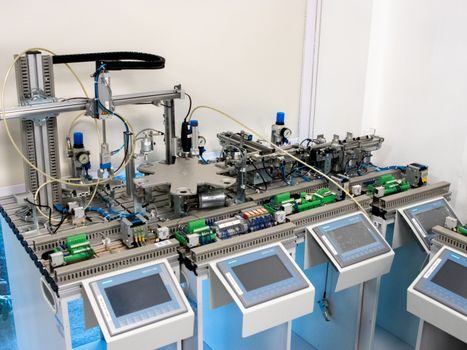
The defining process step of an EV manufacturing line in 2026 is the battery pack and module assembly, which has no analogue in an ICE plant. The cell format decision — prismatic (typical can size 148 × 100 × 30 mm or larger), cylindrical (18650/21700/4680 families), or pouch — drives the entire downstream line layout, including the cell-format-specific laser welding or wire-bonding cells, the bus-bar electric actuator routing stations, and the pack enclosure closure method. [S1]
Module-to-pack (MTM 0-module, or cell-to-pack) architectures now sit alongside conventional module-to-pack builds; the 4680-format cells used in newer programmes route laser welds at 6–10 kW peak power with vision-guided seam tracking, while prismatic cells are typically bolted or laser-welded to a current-collecting plate. Torque control on cell-to-busbar fasteners is specified to ±5% of nominal on most automotive-grade lines, with the prismatic cell compression frame preloaded to 200–600 kN depending on cell chemistry. Module-level end-of-line test cycles every pack for insulation resistance (≥100 MΩ at 500 V DC per typical ISO 6469-3 practice), isolation, and a partial-state-of-charge capacity check before pack closure. The pack itself is then married to the body in the final assembly shop on a single overhead-skid or electric pallet truck transfer.
Final assembly: pack marry-up, EDU integration, and end-of-line test
Final assembly in a 2026 EV plant runs in three sub-shops: drive-unit (EDU) sub-assembly, body-to-paint trim and chassis, and the marriage line where the battery pack, EDU, and HVAC pack are joined to the painted body. Trim and final cells install the dashboard, headliner, glass, seats, and wire harness — with most premium-segment plants running the wire-harness install off a moving skate, while mass-volume lines still use a stationary-cell layout. [S2]
EDU sub-assembly mounts the stator, rotor, inverter, and reduction gearbox into a single housing; the stator windings — typically hairpin or continuous-wave-wound — are impregnated, and the complete EDU is run on a no-load dyno test bed for NVH and insulation. End-of-line test for the finished vehicle includes an HV interlock loop check, brake bleed and ABS calibration on a roller or chassis dyno, headlight aim on a photometric tunnel, and a short road-test loop on a weather-protected track. Most 2026 plants add a software flashing station and an ADAS camera/radar calibration cell, since the option content skews toward Level 2+ driver-assist on most volume EV programmes.
Charging infrastructure built alongside the plant: the ABB highway-charger context
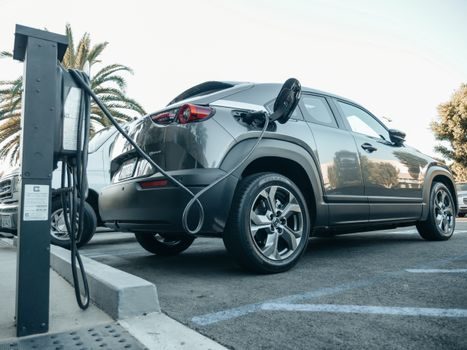
EV manufacturing capacity decisions in 2026 are tied directly to the supporting DC fast-charging build-out, since OEMs and Tier-1s size production against addressable market. ABB documents a highway and en-route DC fast-charger product family that pairs with 150–350 kW charge rates and OCPP 1.6/2.0.1 back-office integration — relevant because the same OEM power-electronics suppliers that build the off-board chargers also build the on-board chargers and DC-DC converters fitted to the vehicles coming off the line [S1].
The plant-side build also drives a parallel off-line testbed: every finished EV is plugged into a DC charging emulator to validate the CCS/CHAdeMO/NACS charge port, cable-cooling handshake, and ISO 15118 communication stack. Plants targeting the European market additionally need an EMC chamber pass for the HV system, while plants targeting the Chinese market need GB/T 27930 and GB/T 20234 charge-port compliance verified on the same end-of-line cell.
Process line layout and equipment class: press tonnage, robot count, AGV fleet
A 2026 volume EV plant (150,000–300,000 units/year) typically runs roughly 600–900 industrial robots, 4–6 large tandem stamping presses, 1,200–1,800 spot-welding guns, and an AGV/AMR fleet in the 200–600 unit range for body and battery electric ball valve subassembly transport; low-speed-EV and micro-EV lines run a fraction of that, with manual weld cells and 20–50 robots [S2][S3][S6].
The two multifunction process calibrator tools that show up most often in plant acceptance are the end-of-line HV-measurement calibration cell (for insulation testers and shunt amps) and the paint-shop conductivity/pH meter set for the pretreatment baths — both tied into a plant-wide data historian that logs torque, weld current, and paint-film thickness per vehicle. Material flow inside the body shop is overwhelmingly roller-and-skid conveyor, with chain conveyors limited to the paint-shop PT/ED carrier return; the new-generation plants being built in 2025–2026 are shifting to additive-manufactured material tooling for jigs and end-of-arm tooling on the aluminium closure cells, where lead-time compression matters more than per-part cost.
Comparison of the four EV process families by spec
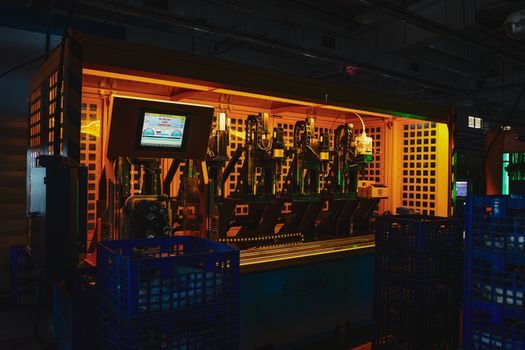
The four process families stack up against four decision criteria — typical line footprint, cycle-time governor, dominant equipment class, and energy-intensity driver — as follows. Stamping: footprint 8,000–15,000 m², cycle-time governor = press stroke rate (10–18 strokes/min for large panels), dominant equipment = tandem press line, energy-intensity driver = press motor kW. Body-in-white welding: footprint 12,000–25,000 m², cycle-time governor = spot-weld count / robot density, dominant equipment = six-axis welding robot, energy-intensity driver = weld transformer kVA. Paint: footprint 6,000–12,000 m², cycle-time governor = oven dwell time (25–35 min at 160–180 °C), dominant equipment = e-coat tank + 3-wet robot booth, energy-intensity driver = oven burner gas consumption. Final assembly including battery pack build: footprint 18,000–30,000 m², cycle-time governor = pack EOL test, dominant equipment = multifunction process calibrator test stand and AGV/AMR fleet, energy-intensity driver = HVAC for cleanroom battery cells. The pack-assembly sub-shop is the line-balancing bottleneck on most 2026 plants; capacity adds typically go into parallel pack lines rather than parallel body or paint lines, because the body and paint shops are pre-saturated on a greenfield 200,000-unit/year build. [S3]
Process standards, failure modes, and sourcing constraints
Three standards families govern the EV manufacturing process directly. ISO 6469-3 specifies the electrical safety requirements for the propulsion system, including the 100 MΩ insulation-resistance threshold and the HV interlock loop that the EOL test enforces. ISO 26262 governs functional safety of the electrical/electronic systems and drives the ASIL rating applied to the BMS and the torque-control electric actuator loops on the pack. IATF 16949 is the quality-management-system standard for the automotive supply chain that every Tier-1 and OEM plant must hold; its process-failure-mode-and-effects-analysis (PFMEA) requirement drives the control-plan documents that specify every torque, weld current, and paint-film thickness on the line. Failure modes that show up in plant P-FMEAs: weld-nugget undersize from electrode wear, e-coat film-build non-uniformity at door-frame Faraday-cage regions, cell-to-busbar laser-weld porosity on the pack line, and torque-angle-window excursion during pack closure. [S4]
Sourcing constraints that moved the most in the first half of 2026: laser-welding optics (still supply-constrained on high-power fibre-laser modules, with lead times of 14–22 weeks from European suppliers), HV cable and connector sets (extended lead times on the CCS2 / NACS charge-port assembly lines), and prismatic-cell compression frames (steel supply has eased versus 2024 but aluminium extrusion lead time remains 8–12 weeks). Battery-grade lithium and nickel pricing continues to set the pack bill-of-materials more than the cell-format decision does, which is why most 2026 plants are being quoted with multi-chemistry tooling flexibility on the pack line.
Plant categories and the 2026 build mix
EV manufacturing in 2026 sits in three plant categories by output class. High-volume passenger-EV plants (200,000–500,000 units/year): single body-in-white, single paint, two parallel pack and final-assembly lines, supported by a Tier-1 press and weld-cell supply chain. Mid-volume commercial-EV and low-speed-EV plants (5,000–60,000 units/year): manual or semi-automatic weld cells, single paint line, and a pack line scaled to 10–80 MWh/year — this is the dominant class in the Suzhou Eagle and Shenzhen Kaopu factory footprints documented for 2026 [S2][S6]. Micro-EV and electric two-wheeler plants (under 5,000 units/year): manually loaded stamping and assembly, no paint e-coat (powder-coat or anodised aluminium body in many cases), and modular battery packs built on a single workbench [S3][S5].
The build mix in 2026 is concentrated in the second and third categories in China, where the low-speed-EV and electric two-wheeler export programme is still scaling, while the high-volume passenger-EV class is dominated by the global Tier-1 OEMs with greenfield capacity in China, Europe, and North America. Material flow design differs markedly between the three classes: high-volume plants run 60–90 JPH (jobs per hour) with an offline modular-assembly pre-kit, while mid-volume and micro-EV plants run 5–25 JPH on a direct-supply line-side model.
For related coverage, see Angle Grinder Price 2026: Wheel Size, Power and Cordless Drive the Quote.