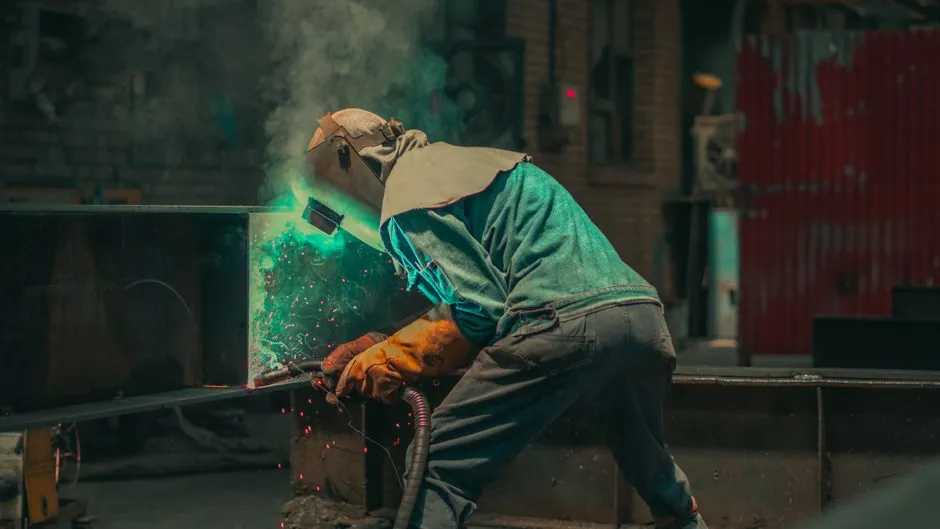
An electroslag pressure welder is the right tool for splicing vertical column rebar in electrical-installation work where cast-in-place concrete piers, equipment foundations, and substation columns run true and the crew can stage a clamp head at height.
Two numbers decide whether the machine can heat the largest joint quickly enough to avoid lack of fusion: a no-load voltage of 70-90 V to strike and sustain the slag bath, and a welding current source of roughly 1,000 A once bar diameter exceeds 32 mm, with the per-diameter current/time schedule read directly from JGJ 18-2012 table 4.6.6 for HJ431 flux [S2].
Why EPW Fits Electrical-Installation Columns, and Where It Does Not
EPW belongs in vertical or near-vertical bar runs inside a 4:1 gradient, which is exactly the geometry of a substation column cage, a transformer foundation pier, or a cable-trench retaining wall; the process joins bar diameters from 16 mm to 40 mm without a separate filler wire, producing a visible weld collar that is later ground flush before concrete placement [S1].
It is the wrong tool when the bars are horizontal, the column is too short to stage the clamp, or the steel is a quenched-and-tempered grade where the coarse prior-austenite grain and wide HAZ from the slow-cooling slag bath push hardness above sour-service or low-temperature toughness bands [S3]. Out-of-position work is mechanically impractical with a standard EPW head, and the slag bath cannot be reliably established or held on plate below roughly 25 mm, so thin-gauge stainless, aluminum, or high-alloy runs stay on conventional arc welder processes [S3].
Power-Source and Head Specs That Drive the Buy Decision
Lock four specifications before quoting: maximum bar diameter the welding head accepts (commonly 16, 20, 25, 32, or 40 mm), welding current rating and duty cycle of the power source, the upset (forging) force the head can deliver, and the control sequencing of the arc, electroslag, and upset stages [S1].
The no-load voltage must be high enough to strike the arc through the flux, typically 70-90 V, well above a general-purpose arc welder, and current capacity scales with bar diameter so that above 32 mm a 1,000 A source is needed to keep heat-up time short [S2]. A programmable arc-to-upset timer improves collar repeatability on tall piers where the worker climbs with the head, while a hydraulic upset cylinder on a 25-50 mm rig gives the best collar consistency on large-diameter bars at the cost of crane-lift logistics [S1].
Comparison of the Main EPW Options in 2026
Procurement engineers typically choose between three equipment classes, and the right pick is set by bar size, pier height, and crew size rather than by kVA alone. [S2]
Manual clamp, AC transformer welder, 16-32 mm range: lowest first cost, light head suited to small pier columns, but operator skill drives weld-collar quality. Manual clamp, inverter DC welder, 16-40 mm range with programmable arc-to-upset timer: higher first cost, more repeatable collars, preferred on tall electrical-installation piers where the worker climbs with the head. Semi-automatic dual-operator rig, 25-50 mm range with hydraulic upset: best collar consistency on large-diameter bars, heavier, needs crane lifts on every move [S1].
The Arc, Electroslag, and Upset Cycle in Practice
EPW runs as a three-stage sequence: a high-voltage strike melts granular flux into a conductive molten slag pool, current then flows by resistance through the slag at roughly 1,900 °C to bring both bar ends to a plastic, near-molten state, and the head finally drives the upper bar down under upset pressure to forge the joint and expel slag as a raised collar [S2][S3].
Current and time both rise with bar diameter on the JGJ 18-2012 schedule, and a 1,000 A class source is needed above 32 mm so the slag bath reaches working temperature before the bar ends chill; under-sized sources extend the arc stage, drive HAZ hardness up, and produce collars that fail the axial offset and visible defect thresholds in JGJ 18-2012 [S1][S2]. For related decisions on heavy-plate splices, see the fit-for-duty logic for electroslag pressure welder variants on thick plate, and the stud-side options in stud welder selection for steel construction.
Flux, Bar Grades, and Code Path
HJ431 granular flux is the workhorse for the JGJ 18-2012 schedule and is the only flux a procurement spec should accept without an explicit procedure qualification, since the schedule in table 4.6.6 was developed against that flux chemistry [S2]. On the US side, rebar EPW falls under AWS D1.4/D1.4M and ACI 318 splice provisions, which set the bar-grade and joint-strength envelope the equipment must hit [S2].
Weld-collar quality limits in JGJ 18-2012 govern axial offset, bar diameter mismatch, and visible defect thresholds, and the equipment must hit those under production rate, not just in a lab sample; plate ESW, in contrast, runs under AWS D1.5 (Bridge Welding Code) and remains constrained on fracture-critical members by the FHWA notice N 5040.23 dated 1977-02-16, which is why the modern NGI-ESW variant operates in a roughly 19 mm gap with fixed guide and travel-speed control rather than oscillating wire [S1].
Acceptance, Failure Modes, and When to Escalate
Acceptance is mechanical and visual: axial offset within the JGJ 18-2012 envelope, bar diameter mismatch inside the standard's stated tolerance, and a collar that grinds flush without exposing lack-of-fusion or oxide pockets, with tensile qualification to JGJ/T 27 [S2].
Common failure modes are under-sized power source (extended arc stage, slag chill, cold lap), wrong flux (chemistry drift away from the qualified schedule), mis-leveled bars (off-center collar, axial offset), and out-of-position work where the slag cannot be retained, which is not a repair case but a process-substitution case: switch to a TIG welder or coupler splice and stop trying to force EPW on horizontal or thin stock. For the equipment-side reference on rebar prep before the welding head ever clamps, the rebar straightener spec map covers the upstream bar-handling chain.
Track two signals in the next procurement cycle: JGJ 18-2012 revision commentary on inverter DC schedules versus legacy AC transformer schedules, and AWS D1.4M updates to the EPW procedure-qualification coupon, since both shift the current and time windows a site engineer must program into the head.