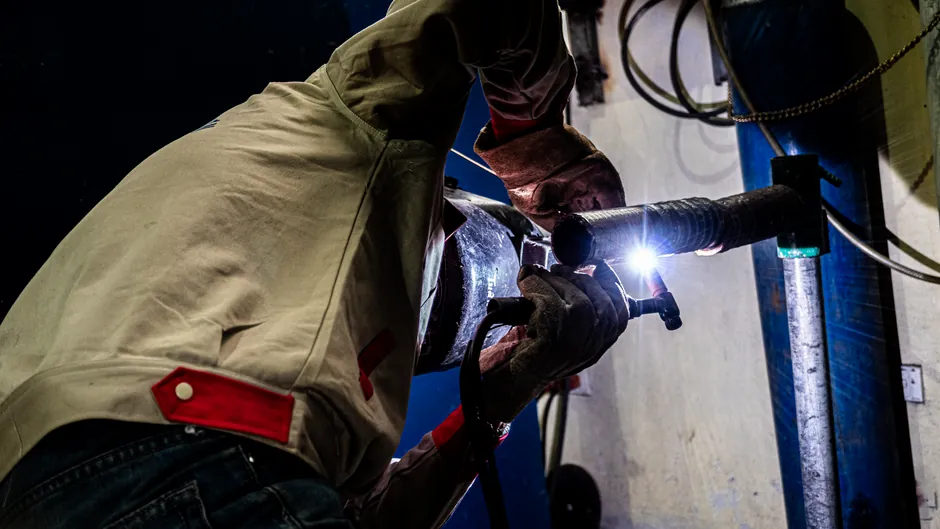
Drawn arc (DA) stud welding covers the M6 to M25+ diameter range on mild steel, stainless steel, and other ferrous base metals, and is the dominant process specified for structural and load-bearing steel construction [S2]. Capacitor discharge (CD) covers M3 to M8 thin-sheet and decorative work in 1 to 3 milliseconds per weld, with low heat input that protects painted or coated substrates [S2].
Specifying a stud welder for steel construction comes down to four coupled decisions: process (CD vs DA vs short-cycle), stud diameter, base-metal thickness, and stud alloy. Get any one of those wrong and you burn through studs, mark the plate, or under-fuse a shear connector on a composite deck. The categories below are the working buckets used by fabricators and OEMs today [S1][S2][S3].
Process Map: CD vs Drawn Arc vs Short-Cycle
Stud welding splits into two production groups, with short-cycle as a DA variant for thinner plate [S1]. CD (capacitor discharge) units complete welds in 1 to 3 milliseconds with minimal heat input, and are sized for M3 to M8 studs on mild steel, stainless steel, and aluminium sheet [S2]. Drawn arc systems deliver deeper penetration for anchors, structural plates, shear connectors, and refractory hardware, typically handling M6 to M25+ studs on ferrous base metals [S1][S2].
For steel construction, DA is the default. Weld-cycle time on a DA station is well under one second per fastener, which is why the process is used where hundreds of shear connectors per shift are routine on bridge and composite-deck work [S3]. The full cross-sectional fusion bond the arc produces is described by OEMs as "as strong as the base metal," which is the property engineers actually buy when they specify stud welding instead of drilled-and-bolted plates [S3]. The trade-off is heat: DA puts more energy into the base metal than CD, so plate thickness and ceramic-arc-guard selection matter.
Stud Diameter, Base-Metal Thickness, and Material Constraints
Rule of thumb from the fabricator side: base-metal thickness should generally be at least 1/3 of the stud diameter for a sound DA weld, and the stud alloy has to be matched to the base metal to avoid galvanic or cracking problems [S2]. Material compatibility spans mild steel, stainless steel, aluminium alloys, and limited non-ferrous work (copper, brass) on CD systems; for load-bearing steel construction, mild and stainless steel dominate the stud-and-base pairing [S1][S3][S5].
A practical sizing table for steel-construction work looks like this: M3 to M8 on CD, typically sheet under 3 mm; M6 to M12 on short-cycle/light DA for plate 3 to 6 mm; M12 to M25+ on full DA for plate 6 mm and up, including composite-deck shear connectors and bridge anchor studs [S1][S2]. Weld studs are offered in mild steel, stainless steel, and aluminium alloys by major fastener-system OEMs, and the stud material grade should be specified alongside the stud geometry so the supplier ships studs matched to the intended application [S1][S2][S3].
Power Source, Gun, and Earth-Clamp Stack
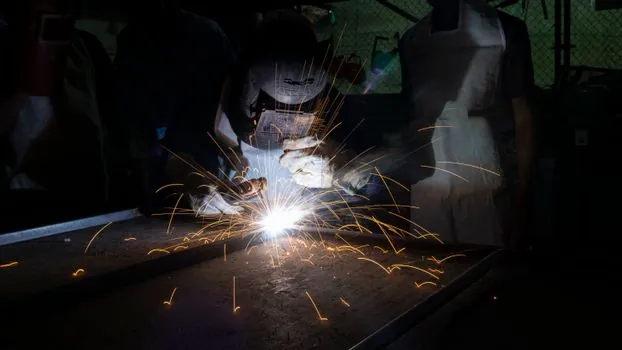
A stud-welding workstation is a four-part kit: power source, weld gun, the stud itself, and an earth clamp plus cables that complete the low-resistance return path [S2]. The power source is sized to the process and stud diameter, not to the base metal, so oversizing the kVA on a CD job just adds cost without benefit. Dual-voltage 110 V / 240 V input on entry-level CD units is common so the same machine can run on site generators or shop supply [S2].
Gun configuration separates CD from DA. CD guns are light, contact-trigger, and used for thin sheet and trim; DA guns are heavier, use a ceramic ferrule (arc shield), and lift the stud to draw the arc before plunging. For elevated-position or tight-space steel work, compact DA units let the operator complete welds remotely while keeping stable arc length and repeatable fusion [S1]. Cable cross-section and clamp bite on clean steel are the most common root causes of under-fused studs, so earth-clamp sizing belongs on the ITP, not on the operator's bench.
When Stud Welding Beats Drilling and Bolting
Stud welding removes the drill step, which means no hole-induced stress concentration, no leak path in pressure-vessel or fluid-handling plates, and no secondary fixings to lose track of during erection [S1][S3]. On production lines, attachment in under a second per fastener and the ability to weld "one side only" without back access are the productivity levers OEMs cite when they switch from bolt+nut assemblies to welded studs [S3].
The relevant comparison for a steel-construction engineer is not stud welding vs stud welding; it is stud welding vs the drilled-and-tapped alternative. On a 10 mm plate, tapping for an M12 thread eats material and concentrates stress at the hole edge; a welded M12 stud leaves the plate solid and puts the load into a full fusion collar. The same logic applies to refractory anchors, handrail stanchions on offshore platforms, and pipe-rack clips, where drilling 200 holes per shift is a measurable cost line item [S1][S3]. For a closer look at how this thinking applies to other steel-construction tools, see the marble cutter selection guide for steel construction and the impact drill spec map for bridge work.
Limitations, Failure Modes, and What to Watch On-Site

CD welds on dirty or coated sheet will mark the visible face, so cosmetic-side specifications should call CD only on clean, uncoated, or pre-masked stock [S2].
Process ceiling is real. CD tops out around M8 in production environments, and DA hits practical limits near M25 on standard shop kits without stepping up to specialty heavy-deposition power sources [S1][S2]. Base-metal conductivity matters: aluminium and copper dissipate heat fast, so DA on those materials needs a longer arc time and tighter parameter control than the same stud on mild steel. The full stud welder reference page covers the process physics and weld-cycle data behind those limits.
Sourcing, Standards, and Supplier Checklist
Major stud-welding system suppliers include Nelson (now under STANLEY Engineered Fastening) for stud-and-equipment packages, Taylor Studwelding for entry-level CD and DA machines, Tru-Weld and IWT for shop- and field-grade DA stations, plus Delta Stud Weld for refractory-grade studs and matched equipment [S1][S3][S4]. When you request a quote, send the supplier the stud diameter, base-metal grade and thickness, stud material, and the production rate (studs per shift), because that set fixes the power-source size, gun type, and ferrule stock [S1][S2][S4].
Other steel-construction spec maps worth pairing with this one cover construction tools generally and construction machinery and equipment.
For related decision maps on steel-construction tooling, the demolition hammer spec map for bridge construction and the mag base drill vs impact drill comparison round out the equipment-selection picture.