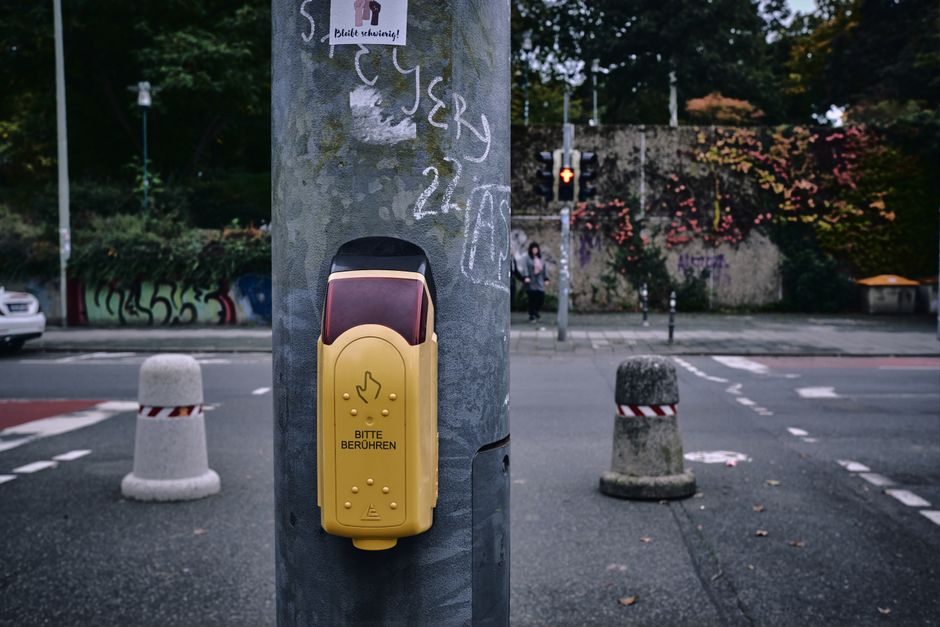
An emergency stop button is a safety-rated, normally-closed, twist- or pull-to-release actuator hardwired into a category-1 stop circuit, while a signal tower light is a non-safety, multi-colour, 24 V DC stack-light that only visualises machine status on the HMI side [S3].
Choosing one over the other is the wrong question — they sit in different functional layers of an industrial control panel: the e-stop in the safety chain, the tower light in the operator-information chain. The right decision is which to prioritise per machine, what rating to specify, and how to bridge them electrically.
Functional Scope: Safety Actuator vs Status Indicator
An emergency stop button is defined by its role as a Category 1 (Cat. 1) stop initiator per EN ISO 13850, with a red mushroom head on a yellow background, latching mechanism, and forced-break (mechanically linked) NC contacts; the standard is built around human reaction, not status reporting [S3]. A signal tower light is purely a status beacon: red/amber/green/blue/white LED or incandescent modules stacked vertically, IP-rated for panel-top or machine-body mounting, and explicitly NOT used as a safety indicator [S3].
One is a hardwired input to a safety relay or safety PLC, the other is a 24 V DC indicator output from a standard PLC. Mixing them — for example, using a tower light's red module to satisfy an e-stop visual requirement — is a specification error that will fail a CE/UL functional-safety review [S3].
Selection Criteria: Contact Blocks, IP, Mounting, Voltage
For an emergency stop button the four spec anchors are: (1) contact configuration — typically 1 NC + 1 NO or 2 NC for redundancy; (2) mechanical latching with twist-release (TR) or key-release; (3) panel cut-out — 22.5 mm or 30 mm standard; (4) ingress rating — IP65 minimum for factory floor, IP67 for washdown [S3]. Voltage rating is set downstream by the safety relay, not by the button itself.
For a signal tower light the anchors shift: (1) tier count — 1 to 5 modules; (2) colour code per IEC 60073 — red = fault/stop, amber = warning, green = normal run, blue = mandatory action, white = general info; (3) supply — typically 24 V DC at 30–60 mA per LED tier; (4) mounting — direct mount, pole-mount, or wall-mount, with optional buzzer module [S3]. The newer industrial bus variants on the Otennlux catalog include IO-Link, RS485, RS232, CAN, and Ethernet signal-tower models for direct PLC fieldbus drop-in [S3].
Comparison Matrix: E-Stop vs Tower Light Across 4 Decision Criteria

Side by side, the two devices diverge on every meaningful axis [S3]:
1) Safety function: e-stop = Cat. 1 stop initiator, safety-rated; tower light = none, indication only. 2) Contact type: e-stop = forced-break NC + optional NO, mechanically latched; tower light = solid-state LED driver inputs, no safety contacts. 3) Standard reference: e-stop sits under EN ISO 13850 with PL e / SIL 3 achievable via dual-channel wiring; tower light follows IEC 60073 colour semantics, not a safety standard. 4) Failure behaviour: e-stop must fail-safe (spring return opens the circuit on contact weld); tower light failure is non-critical and is annunciated by a missing tier, not a stop.
The matrix makes the spec rule clear: an e-stop cannot be replaced by a tower-light red LED, and a tower light cannot substitute for a safety relay output contact [S3].
Who Each Device Is FOR — and Who It Is NOT For
An emergency stop button is FOR any machine with a risk assessment that identifies a need for operator-initiated uncontrolled stop — presses, mills, robots, conveyors, packaging lines. It is NOT for: software-only "virtual e-stops" on an HMI without a physical button (some jurisdictions require the physical actuator), and NOT for routine start/stop — use a control station pushbutton for that.
A signal tower light is FOR any machine where an operator at a distance needs to read run/fault state visually — CNC cells, assembly stations, automated warehouses. It is NOT for: ATEX/IECEx Zone 1 or Zone 2 areas unless explicitly explosion-proof rated (Otennlux lists a dedicated explosion-proof signal-light family for that [S3]), and NOT for safety signalling — use an emergency light stack or beacon tied to the safety relay output instead.
Real Use Cases: Wiring E-Stop and Tower Light on the Same Safety Zone
Typical panel wiring has the e-stop's NC contacts feeding a safety relay or safety-PLC input, whose output then drops power to the contactors (Cat. 1 stop). The standard PLC monitors the same safety zone and drives the signal tower light red tier from a non-safety output, amber for warning, green for run [S3]. The two circuits share the same machine but never the same wire — separating safety and indication wiring is the standard installation practice.
For OEM skid builders, Otennlux sells an "emergency stop button" line alongside the LED signal-tower line on the same catalog, and also offers combined LED signal tower light with switch button (push-button + stack-light in one housing) for compact cells where panel real estate is limited [S3]. Industrial-bus variants (IO-Link, RS485, CAN, Ethernet) cut the tower-light wiring from 5 cores to a single 4-wire bus drop, which is a real saving on machines with 20+ status points [S3].
Limits, Failure Modes, and Common Spec Errors
The most common spec error is specifying a signal tower light as a safety indicator; the second is buying an e-stop with only NO contacts (no NC), which defeats the fail-safe principle [S3]. E-stop contact welding under inductive load is the dominant field failure mode — derate the safety relay's output to the e-stop's specified electrical rating (typically 10 A / 250 V AC resistive) and add a contact-fusing arc suppressor on DC inductive loads.
Tower-light failure modes are visual: LED burnout on a single tier is non-critical, but a water-ingressed pole-mount base (IP rating too low for the environment) can short the bus and drop multiple indicators — Otennlux's waterproof and aluminium alloy lines target this with IP67/IP69K housings [S3]. Mount an emergency stop button at operator hip-to-shoulder height (roughly 0.6 m–1.7 m) per EN ISO 13850 reach guidance, and the tower light on top of the panel where line-of-sight is unobstructed.
Sourcing and Standards Discipline

Confirm the emergency stop button is rated to EN ISO 13850 (formerly EN 418) with a red mushroom on yellow background, and that the safety relay it feeds is Cat. 1 / PL e / SIL 3 per EN ISO 13849-1 or IEC 62061 — those are the two governing standards for e-stop performance level, not the e-stop alone. For the signal tower light, reference IEC 60073 for colour semantics and check the IP rating against the actual panel environment; IP54 is a typical baseline, IP67 for washdown, IP69K for food/beverage [S3].
For hazardous areas, the explosion-proof button and explosion-proof signal-light lines on the Otennlux catalog carry ATEX/IECEx-relevant certification for Zone 1/Zone 2 — verify the certificate number against the latest issued version before procurement [S3].
For comparison context on adjacent control-panel devices, the Circuit Breaker vs Contactor: Spec-First Selection Map covers the overcurrent/load-switching pair that sits downstream of the e-stop contactor, and the Industrial Buzzer vs Counter: Selection Map by Function and Spec is the audible-cue counterpart to the tower light for noisy plants. Track two signals through the rest of 2026: UL 508A panel-shop updates affecting e-stop wiring practice, and IO-Link adoption rate on entry-level tower lights, which is currently the most visible cost-down path for retrofit indicator stacks [S3].