
Industrial buzzers and industrial counters sit in the same panel-cutout catalog family but serve fundamentally different functions: a buzzer converts an electrical trigger into sound pressure (typically 80–100 dB at 1 m), while a counter converts input pulses into a numeric tally of events, hours, or production units.
Specifying one when the application needs the other is the single most common error in low-voltage panel BOMs. The decision is governed by four concrete axes: output modality (audible/visual vs numeric), drive signal (DC voltage vs pulse input), voltage range (12–220 V for buzzers; 5–24 V DC for most electronic counters), and panel real estate (22–66 mm cutouts for buzzers; DIN-rail or 48×48 mm for counters).
Magnetic vs Piezo Buzzer: Drive-Circuit Trade-Off
Magnetic buzzers operate at 1.5–12 V and draw more than 20 mA, while piezo buzzers operate at 12–220 V and draw less than 20 mA, per buzzer-technology reference data [S3]. Magnetic units are modeled electrically as a coil in series with a resistor; piezo units are modeled as a capacitor [S3].
The audio-output curve differs sharply: piezo elements show a roughly linear relationship between drive signal strength and audio output, whereas magnetic buzzer output declines rapidly as the input drive signal decreases [S3]. In practice this means a magnetic buzzer at 3 V is noticeably quieter than at 5 V on the same coil, while a piezo buzzer tracks voltage more predictably across its rated band. Maximum SPL is generally higher for piezo designs, but the larger SPL envelope requires a larger physical footprint [S3].
Selection rule: specify magnetic where 3–5 V logic rails already exist and footprint is tight; specify piezo where 24 V DC or 110/220 V AC is the only available rail and sustained SPL matters more than PCB area.
Industrial Alarm/Buzzer dB Tiers and Mount Classes
Audible signaling devices in the industrial catalog band into three dB tiers per published series data [S2]: 100 dB wall/panel sirens (Menics MSP, equivalent to a jackhammer at 1 m), 85–90 dB panel and surface units (Kacon HRE 90 dB electromagnetic bell, KMB 85 dB dual-mode with optional flashing LED, KSP 85 dB 66 mm panel, Menics MW86 90 dB), and 80 dB compact panel units (KPL 22 mm push-button-style with LED, HRB 30 mm cutout, K16 PCB/snap-in) [S2].
Voltage options split cleanly by form factor: the 90 dB HRE bell ships in 12 V DC, 24 V DC, 110 V AC, and 220 V AC variants; the 85 dB KMB covers 12–24 V DC plus 110/220 V AC; compact 80 dB panel units span 12–220 V in a single SKU family [S2]. LED life on the KPL and HRB is rated 50,000 hours [S2]. Tone selection on the KMB, KSP, and KPL families is wiring-based with no DIP switches, meaning the audible pattern is set at the terminal block rather than via software [S2].
Engineering note carried in the manufacturer datasheet: DC versions of the KMB include a contact in series with the inductive load coil, so the device must be kept away from high-EMI sources such as VFDs and servo drives to avoid false triggering [S2].
Counter Function and Pulse-Input Specs
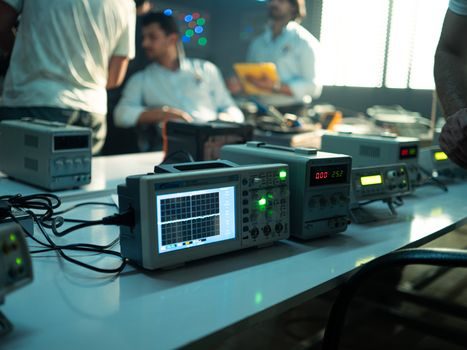
Industrial counters divide into three functional classes: production counters (count pieces, cycles, or strokes on a packaging line), time counters (accumulate machine runtime hours for preventive-maintenance scheduling), and batch/preset counters (trigger an output when a programmed count is reached). Drive inputs are typically dry-contact, NPN, or PNP pulses at 5–24 V DC, with counting speeds from 10 Hz for mechanical units to 10 kHz for high-speed electronic models. [S2]
Selection rule keyed to the application: mechanical counters survive higher electrical noise and need no auxiliary power, but top out near 10 counts per second; electronic counters need 12–24 V DC supply but resolve to 10 kHz and support reset, preset, and communication outputs. For a packaging line retrofit where cycle counts feed an MES, the relevant related reference is the buzzer selection criteria for packaging line retrofit walkthrough, which covers the audible side of the same line.
Side-by-Side Comparison: Buzzer vs Counter on 4 Decision Criteria
Output modality: buzzer produces sound pressure (dB SPL at rated distance) and optionally LED light; counter produces a numeric display (mechanical digit wheels or 6-digit LCD) and optionally a relay/transistor output [S2][S3].
Drive signal: buzzer accepts continuous DC or AC supply voltage and emits while energized; counter accepts discrete pulses (contact close/open or voltage edge) and increments per pulse.
Voltage range: industrial buzzers cover 12–220 V across the catalog [S2]; industrial counters concentrate at 5–24 V DC with 100–240 V AC supply variants for DIN-rail timers.
Mount and footprint: buzzers fit 22 mm, 30 mm, or 66 mm panel cutouts and wall brackets [S2]; counters fit 48×48 mm panel cutouts, DIN-rail (35 mm rail), or PCB mount.
Decision matrix in one line: if the operator needs to hear or see an event, specify a buzzer (80–100 dB tier matched to ambient noise); if the operator or PLC needs to know how many events have occurred, specify a counter matched to pulse rate and supply voltage.
Limits, Failure Modes, and Sourcing Constraints
Buzzer failure modes cluster around three engineering limits: SPL derating in enclosed panels (a 100 dB siren in a sealed cabinet can drop 10–15 dB at the operator's ear), voltage mismatch on electromagnetic bells (wrong AC/DC rating burns the coil on HRE-type units within minutes) [S2], and EMI-induced false trigger on DC-coil alarms near VFDs [S2].
Counter failure modes cluster around input noise (unshielded pulse wires near motor cables register ghost counts), mechanical-counter bounce (dry-contact inputs without debounce overcount), and reset-loss on power cycle for non-volatile-memory electronic models. Sourcing lead time for both families in 2026 is dominated by the 22 mm and 30 mm panel-mount form factors; the K16 PCB/snap-in buzzer is the shortest-lead catalog line, while 66 mm KSP panel units and DIN-rail preset counters carry longer factory lead times [S2].
Who Needs a Buzzer, Who Needs a Counter, Who Needs Both
Specify a buzzer when the human operator's response is the required action: machine fault, end-of-batch, door open, gas alarm, or stack-light secondary tone. Specify a counter when the data system or maintenance schedule is the consumer: piece count for OEE, runtime hours for lube intervals, or batch preset for a filler cutoff. Specify both when a single event must alert the operator and increment a tally — a packaging-line reject station, for example, pairs an 85–90 dB panel buzzer with a production counter fed from the same sensor. [S2]
Two trackable signals to watch: catalog extensions that add IO-Link or wireless commissioning to 80 dB panel buzzers (currently wiring-only tone selection [S2]), and preset-counter modules with integrated Ethernet/IP or PROFINET outputs replacing the standalone relay-output models common in 2024-vintage panels.
Component reference pages worth checking: industrial adhesive.