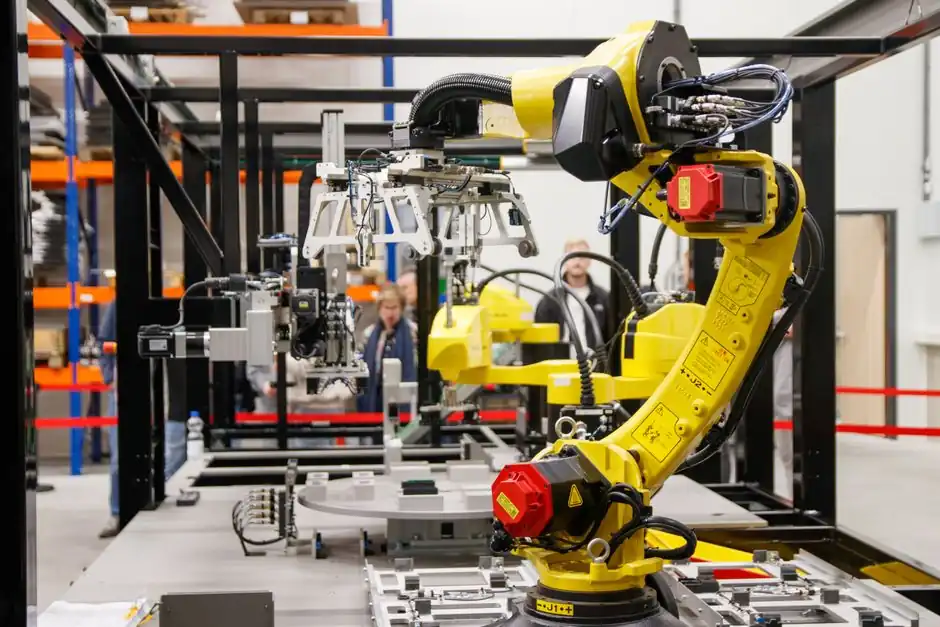
A modern end-to-end automated assembly line for smart devices is organized as a sequenced set of seven engineering stages, from planning and process design through equipment selection, integration, testing, ramp-up, monitoring, and final QA, with PLCs, SCADA, and MES orchestrating every station [S2]. Smart-device lines are not a single machine; they are a layered system of feeding, joining, inspection, and traceability modules that hand off work in a controlled takt [S3][S4].
For high-volume consumer electronics, wearables, and IoT products, this structure is now the baseline, with AI-driven vision, no-code robot programming, and collaborative robots replacing the rigid dedicated cells of the previous decade [S4][S5]. The sections below break the line into the criteria engineers actually select on, the modules that do the work, and the failure modes that decide whether a line pays back inside the typical 12 to 24-month ROI window [S5].
The seven-stage workflow that organizes every smart-device line
The end-to-end process runs through seven defined stages, each with a measurable output and a known limitation that drives the next decision: planning, equipment selection, integration, testing/validation, full operation, preventive maintenance, and final QA [S2]. In practice, planners fix the cycle-time target, the batch volume, and the acceptable quality tolerances before any machine is ordered, because the equipment list is a direct function of those three numbers [S2].
Planning covers product type, target volume, cycle time, tolerance band, and flexibility for variants; equipment selection then maps those targets to CNC machining centers, PLCs, robots, vision systems, and an MES layer [S2]. Integration ties the modules to a CAD-designed layout with conveyors, cabling, and safety circuits; testing then runs dry cycles, pilot runs, and a quality benchmark before any production-volume release [S2]. Ramp-up, monitoring, preventive maintenance, and final QA run continuously afterward, with maintenance software and diagnostics feeding the same MES that tracks units [S2][S4].
What physically sits on the line: modules, not single machines
A smart-device assembly line is a chain of five cooperating module classes: feeding and loading, assembly, inspection and testing, control, and traceability [S4]. Feeding is handled by vibratory bowl feeders, robotic pick-and-place arms, and AGVs moving totes between cells, with the AGV robot layer becoming standard for inter-station material handoff on lines longer than roughly 20 m [S4].
Assembly modules are modular and reconfigurable, built around pressing, gluing, welding, screwdriving, and insertion stations that can be swapped as the BOM changes [S4]. Inline vision and torque sensors give 100% in-process inspection rather than sampling, and the smart camera nodes feed defect images back to the MES for closed-loop tuning of upstream stations [S4]. Control sits on PLCs with SCADA and HMI for centralized visibility, and traceability is built from barcode/QR scans, real-time data capture, and ERP/MES integration that gives a per-unit birth record from raw part to ship carton [S4].
Selection criteria: picking a configuration that actually matches the product
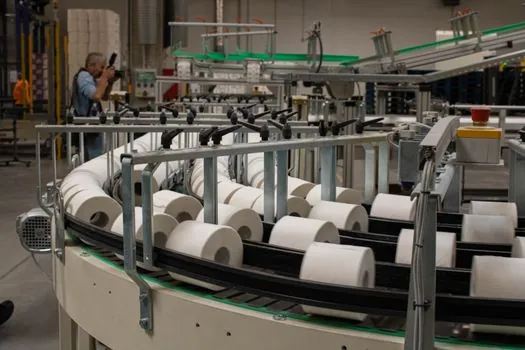
Engineers choose between fully automatic, semi-automatic, and robotic-cell configurations based on three filters: batch size, variant count, and the sensitivity of the joining process [S3][S4]. High-volume, low-variant products, such as smartphone modules, wearables, and battery packs, justify a fully automatic end-to-end line; high-variant or low-volume products are usually built as semi-automatic cells with manual kitting at the front [S3].
Robotic assembly specifically, with six-axis or SCARA arms plus vision, is the preferred option when changeover frequency is high, floor space is constrained, or the joining step is not friendly to a dedicated hard tool [S5]. Cobots extend that envelope into mixed human-robot stations where a human does a finesse step, such as a flexible cable dress, and the robot does the repetitive fastening; the locking assembly step on enclosures and lens modules is a common cobot application [S5]. Across all options, the decision criteria that survive contact with reality are: cycle time per station, first-pass yield at the vision gate, mean time between failures for each module, and total line footprint in square meters per unit of throughput.
Levels of automation, compared on the four criteria that matter
The three common line architectures, fully automatic, semi-automatic, and robotic-cell, line up against cycle time, flexibility, capex, and direct labor as follows. A fully automatic end-to-end line delivers the shortest cycle time, the lowest direct-labor content, and the highest capex, with the least flexibility for new variants [S3][S4]. A semi-automatic line has higher direct-labor content, lower capex, and better flexibility for low-volume runs, but a longer cycle time because humans gate station throughput [S3].
A robotic-cell configuration sits in the middle on capex, is the most flexible because a single arm can be reprogrammed for a new SKU, and matches semi-automatic lines on cycle time when paired with vision-guided part placement [S5]. For smart devices specifically, the practical rule is: if annual volume is above roughly 250k units and the variant count is below five, fully automatic wins; above five variants or below that volume, robotic cells win; and below roughly 50k units, semi-automatic with a few cobots is usually the lowest total cost of ownership [S3][S5].
Where the line meets the product: use cases across smart-device categories
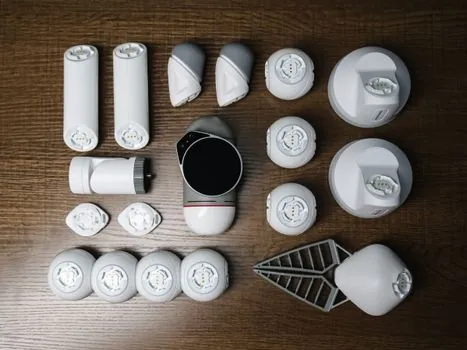
Automatic lines are now standard in five smart-device verticals: automotive electrification modules, home appliances, consumer electronics, medical devices, and energy storage [S4]. Automotive applications include stator and rotor motor assembly for EPS, oil pumps, drive motors, and ABS units, where torque-controlled screwdriving and end-of-line electrical testing are the hard requirements [S4]. Home appliances use the same architecture for fan motors, compressors, and small-motor subassemblies, while consumer electronics lean on vision-guided placement for smartphone modules, wearables, and IoT boards [S4].
Medical-device lines assemble syringes, infusion pumps, and diagnostic modules under cleanroom constraints, with vision systems verifying fill volume and label placement; energy-storage lines build battery modules and packs with cell stacking, busbar welding, and BMS electrical test [S4]. Across all five, the digital thread is the same: every station logs to MES, every unit carries a serial, and the same data feeds the pressure transmitter calibration cells, leak testers, and end-of-line electrical benches that close the QA loop [S4].
Limitations, failure modes, and the realistic ROI window
Automated lines do not remove the need for skilled staff; they relocate it, and most plants still need integration engineers, robot programmers, and maintenance technicians on every shift [S2][S5]. The first six months after a new line goes live are dominated by station-level tuning, vision-set lighting changes, and fastener-recipe rework, which is why ramp-up is treated as its own stage rather than a footnote to commissioning [S2].
Failure modes that decide line uptime are concentrated at the interfaces: conveyor-to-station handoffs, vision lighting drift, fastener-tool wear, and MES-to-PLC tag mapping [S4]. Standard guidance from 2026 robotic-assembly references puts typical ROI at 12 to 24 months when utilization stays above roughly 70%, and the same source notes that even modern AI-vision cells still need a human in the loop for exception handling, not as a fallback but as a designed checkpoint [S5]. For a deeper look at how a related process, additive manufacturing, slots into the same MES/QA stack, see how 3D printing fits into an Industry 4.0 plant; for a practical bridge plan when an existing line still runs on legacy controls, see how to keep an obsolete PLC running until migration.
The next node to watch is the convergence of AI vision and force-torque control on the same six-axis arm, which would let one robot cell replace a dedicated pressing station and a dedicated screwdriving station in the same cycle, and which several 2026 vendor guides now describe as a near-term, not theoretical, capability [S5]. A second trackable signal is the standardization of MES-to-PLC tag models (PackML and the OPC UA companion specs), which is what finally lets a planner swap an assembly module on a smart-device line without rewriting the line-level orchestration [S4].