EV battery production is a sequence of electrode-fabrication and cell-assembly steps run in dry rooms with dewpoints typically held below −40 °C, where even trace moisture reacting with LiPF₆ electrolyte degrades cell life [S4]. The market tied to that flow is large: one tracker sizes the EV battery segment at USD 168.95 BN by 2035 with a 5.6% CAGR through the forecast window [S3].
Compliance framing has hardened in parallel. EU Regulation 2023/1542 covers EV batteries explicitly, with the carbon-footprint requirement expected to start applying in late 2025 / early 2026 and a new CE conformity assessment gate attached to that product category [S1]. Production engineers spec equipment and QA gates against that regulatory clock, not just against cell performance.
Front-end electrode making: coat, dry, calender, slit
Front-end output starts as a coated electrode foil. Slurry — active material, binder (PVDF on the cathode side, CMC/SBR on most graphite anodes), and conductive carbon — is metered onto current-collector foil (copper ~8–15 µm for anodes, aluminum ~15–20 µm for cathodes) by slot-die or comma-bar coaters, then pulled through multi-zone drying ovens that evaporate the solvent (NMP for the cathode, water for most anodes) [S4]. Drying uniformity controls electrode porosity, which sets the rate-capability / energy-density trade-off a cell can ever deliver.
After drying, the web passes through calender rolls running at controlled line pressures to compact the coating to a target porosity — typically 20–35% depending on chemistry — before laser or rotary slitting cuts electrodes to the width the cell format requires [S4]. Thickness profile and areal-loading data from these lines feed the formation-cycle parameters downstream; a pressure sensor on the calender load cylinder is one of the few ways to keep that compaction repeatable cell-to-cell. Inline coating-weight gauging (β-ray or XRF) and laser-thickness sensors are the standard QC pair on a 2025-era coating line.
Cell-format choice: cylindrical, prismatic, pouch
Three cell formats dominate EV packs and each forces a different assembly layout. Cylindrical cells (the 4680 format being the most-discussed 2024–2025 standard, 46 mm diameter × 80 mm length) lend themselves to high-speed winding and laser-welded tabbing, and they manage internal pressure against a rigid steel or aluminum can [S4]. Prismatic cells (hard-case aluminum) pack more volume-efficiently into a flat module and tolerate higher-energy NCM/NCA cathodes because the case is more dimensionally stable [S3]. Pouch cells (laminate, no rigid case) deliver the highest pack-level gravimetric energy density but require strong external compression frames in the module to prevent swelling.
The format decision is upstream of the rest of the line. Cylindrical favors winding; prismatic and pouch are increasingly built by stack-and-z-fold or hot-melt stacking, processes that scale poorly with cell area and are sensitive to alignment tolerances measured in tenths of a millimetre. CATL's Cell-to-Pack (CTP) approach, which removes the conventional module stage, has been demonstrated in volume production and is one of the structural shifts pulling lines away from module-first layouts [S4].
Dry-room assembly and electrolyte fill
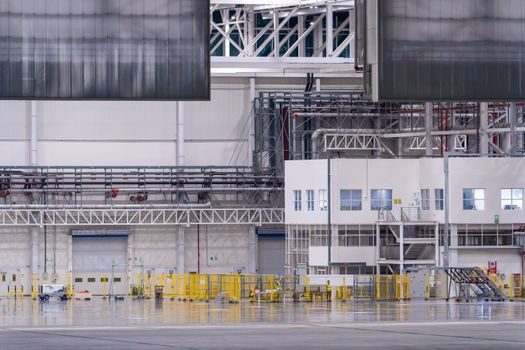
From separator stacking onward, the cell is built in a dry room. Lithium-ion chemistry uses LiPF₆ in carbonate solvents, which hydrolyses in the presence of water to form HF; dewpoints are therefore pushed below −40 °C (often to −60 °C) on formation-grade lines [S4]. Electrolyte injection is followed by vacuum sealing on cylindrical and prismatic cells, or by heat-sealing on pouches — the seal quality is a primary reject mode and is typically checked by helium leak test or pressure-decay test on every cell.
After sealing, cells enter formation cycling: a first slow charge/discharge at low C-rate (C/20 or lower) that builds the SEI (solid-electrolyte interphase) layer on the anode. Formation is the longest single step in cell production — often 7–21 days end-to-end including ageing — and is the dominant cost-and-floor-space bottleneck for new gigafactories. A 2024 product debut by CATL introduced a stationary energy-storage system branded Tianheng and built around an "ageless" cell concept designed to extend service life over a five-year window [S5]. The same engineering logic — minimising capacity fade per cycle — feeds back into the formation recipe and the upper charge-voltage ceiling the BMS enforces.
Module, pack and the cell-to-pack shortcut
Conventionally, finished cells go through a module stage (busbars, BMS tap-off, sometimes cell-level fusing) before pack integration. CTP removes the module: cells are loaded directly into a pack-level structural tray, with foam or structural adhesive providing both compression (critical for pouch cells) and vibration isolation [S4]. Ford's North American battery strategy, formalised through the BlueOvalSK joint venture with SK Innovation, scales prismatic-style cells into dedicated plants, illustrating how OEM-cell-format decisions now anchor multi-billion-dollar capex choices [S2].
Pack-level integration is increasingly robotic — laser welding of busbars, epoxy/foam dispensing, vision-based cell inspection — and is one of the cleaner use cases for the PLC-coordinated cell-assembly cells now shipping into battery plants. Vision systems catch electrode alignment and tab-weld defects that are otherwise invisible until formation. For deeper context on how those lines are wired through MES and ISA-95 stacks, see the Lithium Smart Manufacturing 2026: MES, Dry-Room Robotics and ISA-95 Stack walkthrough, and for the upstream coating-line automation picture, the Lithium Battery Smart Manufacturing 2026: Cell-to-Pack Automation, AI Inspection reference lays out the spec gates in detail.
2026 compliance gate: carbon footprint, recycled content, CE
EU Regulation 2023/1542 lays down a CE conformity assessment specific to EV batteries as a product category, on top of the carbon-footprint requirement that is scheduled to start applying in late 2025 / early 2026 [S1]. The recycled-content thresholds, the recycled-material traceability obligations, and the due-diligence rules for cobalt, lithium, natural graphite and nickel all converge on the same documentation chain — production data captured at the formation step, electrode scrap rates from the front end, and bill-of-materials discipline on cathode active material. Plants that have not wired these data flows into their MES by mid-2026 will find CE marking on EV packs harder to defend, regardless of cell performance.
Selection criteria by use case
Specifying an EV battery line in 2026 means picking along four axes: (1) cathode chemistry — LFP for cost and thermal stability, NCM/NCA for energy density; (2) cell format — cylindrical for high-speed winding, prismatic for pack stiffness and recyclability, pouch for energy density with a compression frame; (3) module architecture — module-and-pack versus CTP, where CTP trades repairability for volume efficiency; (4) throughput target — formation capacity is the binding constraint and dictates floor-space per GWh shipped. Plants targeting LFP prismatic for entry-level EVs favour CTP and water-based anode processing; plants targeting NCM cylindrical for premium long-range packs tend to keep the module stage for serviceability. The recycled-content gate under EU 2023/1542 applies to both, so a flow meter on every electrolyte-fill loop and a mass-balance audit on slurry mixing are no longer optional instrumentation choices [S1][S4].
Limits, failure modes and what's not solved

Three failure modes dominate EV-battery field returns and they each map back to a specific process step. (a) Lithium plating on the anode during fast charge — controlled by formation SEI quality and by the upper C-rate the BMS allows; (b) electrode dry-out / electrolyte depletion after high-cycle ageing — set by electrolyte fill volume and by the porosity the calender hits; (c) thermal runaway propagation between cells — addressed by cell-to-cell spacing, phase-change material, and the venting design, with the No Thermal Propagation claim from CATL being a marketing-anchored spec rather than a universal cell property [S4]. Each of these is a process parameter first and a chemistry parameter second; buying better cells does not substitute for stable electrode porosity or dry-room dewpoint.
Trackable signals over the next 6–12 months: the first EU 2023/1542 carbon-footprint declarations on EV cells landing in 2026; further Tianheng-style long-cycle stationary cells being repurposed into mobility packs [S5]; and at least one more OEM following the BlueOvalSK template of co-locating cell production with vehicle assembly [S2]. Equipment selection on the floor will follow whichever regulatory and chemistry vectors move first.