
A concrete pump truck is a hydraulically driven piston (or peristaltic) pump mounted on a truck or semi-trailer that delivers liquid concrete through steel pipelines or a remote-controlled articulating boom, with double-piston units typically capable of "hundreds of atmospheres" of working pressure [S1]. A vacuum pump, by contrast, is a gas-side device that reduces chamber pressure below atmospheric for evacuation, drying, or suction handling. The two share nothing in service, but the concrete pump truck belongs to the placing side of a job site while the vacuum pump belongs to the prep, formwork, or material-handling side.
For concrete placing, the operating envelope is set by three numbers: piston pressure class, boom reach or hose run, and rated output in cubic metres per hour. For vacuum service, the operating envelope is set by ultimate pressure (mbar or Pa), pumping speed (m³/h or L/s), and media compatibility. Mixing the two on a single spec sheet is a procurement error; this article lines them up so a project engineer can tell at a glance which device a given work item actually requires.
Definition and Operating Principle
A truck-mounted concrete pump uses a double-piston hydraulic circuit: the return stroke of one pressure cylinder creates a vacuum that draws concrete from the hopper into the cylinder, while the delivery stroke of the other piston pushes the charge through an S-valve or rock valve into the delivery pipe [S1][S3]. Output is regulated by hydraulic oil flow on a closed loop with constant-power control [S3].
A vacuum pump works on the opposite physical principle: it removes molecules from a sealed volume to lower internal pressure. The two device families are not interchangeable. The S-valve and hydraulic cylinder group of a concrete pump are designed for viscous, abrasive, aggregate-laden slurry at high differential pressure; vacuum pumps are designed for gas or vapor flow at low absolute pressure. Where concrete placing uses peristaltic (hose) pumps, the hose compresses the medium mechanically, but the pressure class and the medium differ entirely from a vacuum peristaltic pump used for gas sampling.
Core Specifications Compared
Concrete pump output is quoted in cubic metres per hour. The CIFA K42L and K56L boom pumps, for example, are rated at 180 m³/h in the Al Marwan Machinery product sheet [S2]. Concrete line or trailer pumps run lower, with practical hose-run limits at roughly 150 m vertical and over 1000 m horizontal, achieved by stringing steel delivery pipes and flexible end-hoses of 3.0, 3.8, 7.6, or 15.2 m nominal lengths (10, 12.5, 25, 50 ft) [S1][S3].
Vacuum pump specs read on a different axis: ultimate pressure in the 0.1 to 10⁻⁶ mbar range depending on technology (rotary vane, dry claw, screw, diffusion), pumping speed in m³/h or L/s, and inlet connection size. A direct numeric comparison between the two is meaningless, because a concrete pump rated at 180 m³/h of concrete at 70+ bar and a vacuum pump rated at 100 m³/h at 0.05 mbar are not competing on any shared axis. Use the concrete mixer truck feeder for placing throughput questions, and the vacuum gauge family for absolute-pressure verification on the evacuation side.
Selection Criteria: Concrete Pump Truck
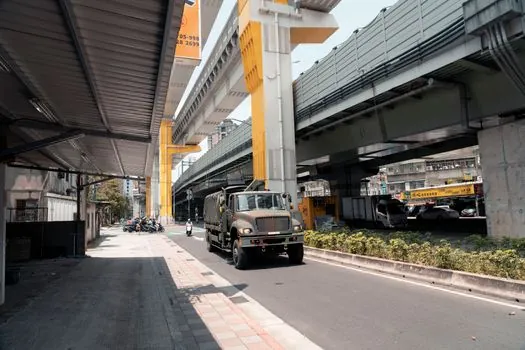
Boom versus line is the first branch. Boom pumps win on high-volume, high-rise, and bridge work because the robotic arm places concrete accurately without manual hose handling, with 365° turret rotation and per-section swing angles of 2° to 90° on the first boom, 180° on the second and third, and roughly 240° on the fourth [S3]. Line pumps win on residential slabs, swimming pools, driveways, and sidewalks because a flexible hose can snake into backyards and tight access that a truck cannot enter [S1][S4][S5].
Aggregate size is a hard gate. Line pumps handle 3/4" aggregate; grout pumps are restricted to 3/8" or pea-gravel rock [S1]. Trailer pumps are flexible and lightweight but less accurate; truck-mounted boom pumps are heavy and immobile once outriggers are set, but they are the higher-accuracy option for fine concrete placement, with smaller grout and mortar requirements downstream [S4]. Cold weather, thicker mixes, and long hose runs all raise blockage risk on line pumps, so cleaning cadence and pipeline diameter must be specified up front [S2].
Selection Criteria: Vacuum Pump
Vacuum pump selection is driven by ultimate pressure, flow media, and duty cycle. For construction-site prep work such as formwork vacuum lifting, dewatering, or slab moisture evacuation, oil-sealed rotary vane units typically cover the 0.5 to 1 mbar range with reasonable steam tolerance. For clean dry service where media back-streaming is unacceptable, dry claw or screw pumps replace the vane stage. For high-vacuum analytical or laboratory tie-ins (rare on a placing site), diffusion or turbomolecular stages follow the rough pump. [S4]
Site constraints mirror concrete-pump logic in one respect only: power. Both pump families run diesel or electric prime movers, so generator sizing and cable run matter. Unlike a concrete pump, a vacuum pump selection must also address trap, filter, and exhaust management, because the medium pulled through the pump is gas or vapor, not a sealing slurry, and any liquid carry-over destroys the pump stage. Engineers who have only specced a concrete pump truck installation sometimes underestimate the auxiliary support a vacuum pump needs on the same job.
Use Cases and Limitations
Concrete pump truck limitations are set by the medium. Concrete is heavy, viscous, abrasive, contains hard-rock aggregate, and solidifies if not kept moving, which forces the use of piston pumps at high pressure rather than centrifugal or peristaltic units [S1]. Blockage in cold weather is the dominant failure mode on line pumps; boom-pump outrigger settlement on soft ground is the dominant failure mode on truck-mounted units. For site-prep crews laying formwork, a vacuum generator driven by compressed air often handles small lifting and holding tasks more economically than a dedicated rotary-vane vacuum pump.
Vacuum pump limitations are set by vapor pressure of any entrained liquid, by particulate ingress, and by seal oil degradation. The two families share one risk pattern only: both lose performance when fed a medium they were not sized for. A concrete pump fed a mix with oversized rock blocks the S-valve; a vacuum pump fed liquid slugs destroys the vanes. This is why procurement language must lock the medium specification, not just the flow number, in both cases. The decision matrix for either device is therefore medium first, pressure class second, and prime-mover availability third.
Decision Matrix: When to Specify Each
Specify a concrete pump truck when the work item is placement of plastic concrete: foundations, slabs, walls, columns, decks, bridges, and high-rise cores. The reach decision between boom and line follows directly from access. Boom pumps handle volumes above roughly 80 m³/h with vertical reach of 30 m or more; line pumps handle lower volumes with hose runs up to 150 m vertical and over 1000 m horizontal [S2][S3].
Specify a vacuum pump when the work item is gas or vapor removal, negative-pressure forming, lifting, or drying. For typical construction prep (slab moisture testing, vacuum lifting of formwork panels, pipe testing), a 0.5 to 10 mbar ultimate pressure rotary vane or dry claw pump at 10 to 100 m³/h nominal speed is a practical baseline. Neither pump family substitutes for the other, and pairing them on a bill of materials is normal for precast yards and tunnel segments, where the concrete pump places the mix and the vacuum pump handles formwork evacuation. Engineers scaling up a placing fleet can contrast a concrete pump truck install against a rotary drilling rig deployment for foundation work, since both demand outrigger or mast verification before first pour.
Standards, Sourcing, and Acceptance
Concrete pump acceptance is governed by manufacturer pressure-test certificates, by on-site outrigger load verification on pads sized to soil bearing capacity, and by first-pour checks on pump pressure, S-valve actuation, and boom-section sequencing. Vacuum pump acceptance is governed by ultimate-pressure verification against a reference vacuum gauge, by leak-rate rise testing on the test chamber, and by trap or filter inspection after a defined duty cycle. ISO and EN standards for machinery safety (operator controls, guarding, hydraulic hose burst protection) apply to both families when installed on a site, though the specific clause references differ. [S3]
Procurement tracks to be locked at order release: for concrete pumps, rated output (m³/h), maximum concrete pressure (bar), aggregate size limit, boom section count and reach, and prime-mover emissions class; for vacuum pumps, ultimate pressure (mbar), pumping speed at a defined inlet pressure, media compatibility, and noise level at 1 m. The data sheets from CIFA on the K42L/K56L models, for example, publish 180 m³/h output alongside boom reach and fold/unfold sequencing [S2], which gives a concrete-pump buyer a comparable spec triplet; a vacuum-pump buyer should ask the same triplet of numbers and reject any quote that omits the medium list.
None of these signals changes the core split between the two pump families, but each will shift the default rental spec on cross-discipline sites.