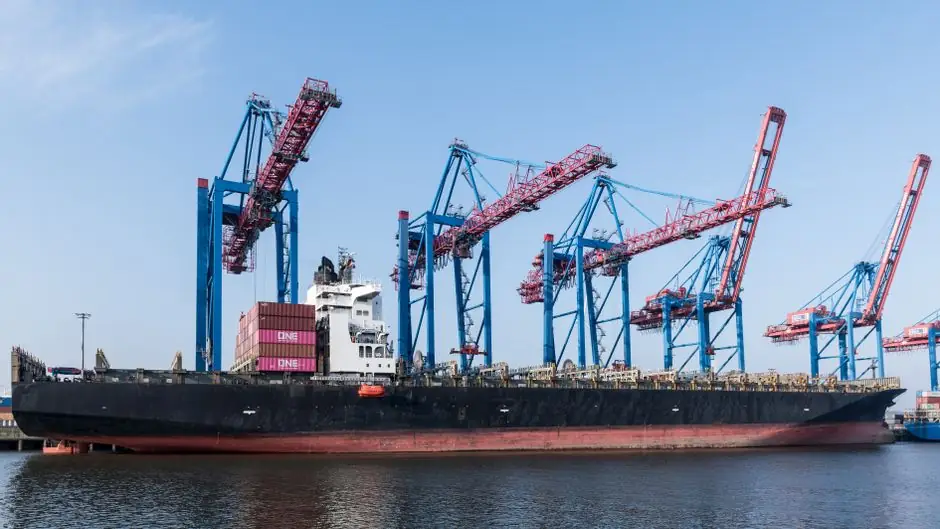
Selecting a tank container for port and terminal operations is fundamentally an exercise in matching five binding inputs to the cargo: the ISO 1496/3 frame envelope, the design code on the data plate (ASME BPVC Section VIII Division 1, EN 14025, or CODAP), the MAWP and test pressure, the wetted material and lining, and the IMDG T-code that legally defines the product family the vessel may carry [S4][S8].
Standard 20-ft chemical units in intermodal service run 21,000–26,000 L nominal capacity at 24,000 L (≈26 m³) as the most common frame size, with 3,500–3,900 kg tare for stainless-steel builds leaving 26–30 tonnes of payload depending on product density, all sitting in a 6,058 mm × 2,438 mm × 2,591 mm ISO 1496/3 envelope that is rated for 8-high stacking at 192 kN per corner post [S4].
Frame, CSC Plate and the Gross-Rating Triangulation
The ISO 1496/3 corner-casting pattern (per ISO 1161) is what makes the unit a container rather than a road tanker, and the CSC or ACEP plate riveted to the door end is what port-state control actually keys off, because that plate lists manufacturer, approval number, year of build, design code, and the next periodic-inspection due date [S4].
The baseline 1CC gross rating is 30,480 kg, but heavy-tested frames rated to 36,000 kg are now standard across Europe where road regulations permit the higher mass, which is why a buyer must always triangulate the data-plate gross rating, the vessel stowage limit, and the destination road network's axle limits; the lowest of the three governs how much cargo can actually be loaded [S8]. Treat the datasheet as binding and the marketing flyer as decoration, because mismatches between datasheet and physical plate are the single most common reason used units get rejected at survey [S4].
Design Codes, MAWP and the T-Code Schedule
MAWP for a standard chemical tank container sits around 4.0 bar with a test pressure of 6.0 bar, and the wall-thickness envelope is 4–6 mm on a 24,000 L frame, with heads running 5–8 mm depending on the rated pressure; the higher-pressure variants used for LPG, chlorine, ammonia and similar products run 17.7–22 bar MAWP per the IMDG T-code schedule [S2][S4].
The T-code assigned under the IMDG Dangerous Goods List (T1 lowest pressure/temperature capability up to T75 highest) is the master switch on what the container is legally allowed to carry, and it is the field a depot inspector verifies first when a unit returns from a chemical lease [S4]. Operating-temperature envelope across the standard fleet is −40 °C to +130 °C depending on insulation package, with 2.65–6.0 atmosphere (≈2.65–6 bar) tank operating pressure typical for the IMO 2 chemical fleet [S1][S2].
Wetted Material and Lining Selection
Wetted material for the vast majority of liquid tanks is austenitic 316L stainless steel, with SS 316 Ti and Z6CNDT 17.12 cited as alternative European designations, and 304 stainless for less aggressive service; carbon steel with epoxy, polyethylene or zinc linings is the lower-cost option for non-sensitive cargoes [S2][S8].
When the product attacks stainless (strong chlorides, hot concentrated acids, amines) the datasheet must show a rubber-lined (EPDM, butyl or natural rubber) or PTFE-lined barrel, and the lining specification (vulcanisation method, cure temperature, spark-test voltage) belongs on the same A4 datasheet, not buried in a separate coating certificate [S4][S6]. NTtank's published range covers PE, rubber, PTFE/Teflon and a generic polymer coating; PE handles dilute acids and alkalis at moderate temperatures, rubber handles abrasive slurries and HF at lower temperatures, and PTFE handles the hottest and most reactive chemistries including HF, AHF and concentrated H₂O₂, at a 30–50% cost premium over plain 316L with an impact-resistance derate [S6].
Capacity, Density and the Weight- vs Volume-Limited Decision
Tank-container capacity spans 14,000 L up to 30,000 L for standard IMO 1/IMO 2 chemical units, with 35,000 L achievable on 30-ft frames and 21,000 L on high-pressure gas frames; the working band for most port operators sits at 21–26 kL [S2][S5].
Every tank has a maximum specific-gravity rating, and exceeding it risks structural failure, which is why the loading calculation must distinguish weight-limited cargoes (SG > 1.0 drives the chassis mass limit) from volume-limited cargoes (low-SG chemicals and food oils max out the ullage before they max out the chassis); the Shiportrade reference table lists 20-ft ISO at 24,000 L / 26,000 kg / max SG 1.8, 20-ft high-pressure at 21,000 L / 28,000 kg / max SG 2.0, and 20-ft gas at 24,000 L / 24,000 kg / max SG 1.5 [S5]. Ullage is typically held to 2–5% of capacity to allow thermal expansion, and heated products need extra ullage budget for transit temperature rise [S5].
Heating, Insulation and Viscosity-Limited Cargoes
Tank containers can be equipped with a layer of insulation plus a vapour-heating system or an electrical heating system, and a reversible-coil configuration is the standard answer for viscous products that need to stay pumpable in winter; a 20-ft reversible-coil unit typically rates 23,000 L capacity, 25,500 kg payload, and max SG 1.9 [S2][S5].
Viscosity capability is up to 2,000 cP for standard lined units depending on the internal coating and pump system, which covers most heavy fuel oils, bitumens, and concentrated syrups but does not cover semi-solid or paste cargoes that need a full heated-road-tanker solution [S1]. Heating conversions (steam to glycol, electric to vapour) are routine depot work, and a documented conversion on the data plate is what keeps the unit in intermodal service rather than demoted to one-mode use [S3].
Certifications, Fittings and the Depot Acceptance Test
Compliance stack for a port-handled chemical unit is IMDG for sea, ADR for road, RID for rail, plus CSC for the container approval itself; classification-society builds run through Bureau Veritas, ABS, Lloyd's Register, DNV, SGS, Germanischer Lloyd or the Russian Maritime Register of Shipping, and each tank carries Fort Vale or Perolo drain valves as the de facto bottom-discharge standard [S1][S2].
Valve and fitting schedule is the last data-sheet field to verify: bottom-discharge valve, vapour-recovery loop, pressure-relief device set to the MAWP, and the manlid/walkway configuration, with each component traceable to its own certificate because the survey report is what the renter signs against on-hire and off-hire [S1][S2]. For broader port-equipment context, see our spec pages on tank containers and on the IBC tank alternative, and for the depot-side handling fleet that moves these units, the construction machinery and equipment spec map covers the reach-stackers and terminal tractors that the tank will ride on.
For related coverage, see Vacuum Packaging Machine Selection for Automotive Parts: 2026 Spec Map.