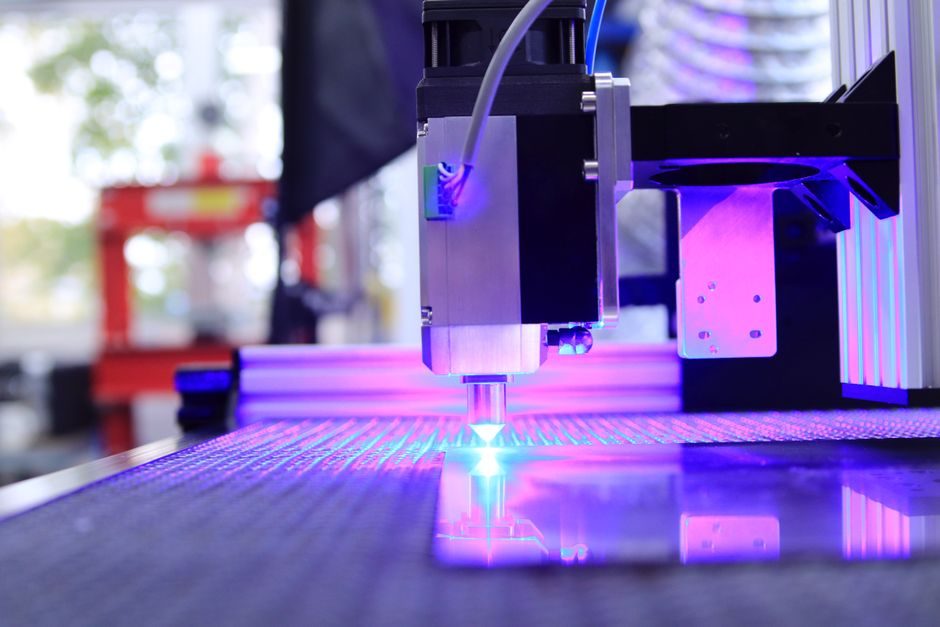
Fiber-delivered continuous-wave (CW) lasers in the 1,500 W–3,000 W class are the dominant metal-welding format listed on Chinese B2B catalogs as of 2026-07, with 2,000 W units priced US$1,999–2,186 and handheld 1,500 W units US$3,000–7,000 per set [S7][S6].
The four application clusters driving demand are sheet-metal fabrication, new-energy battery pack assembly, jewellery and electronics micro-welding, and thermoplastic joining — each with its own source type, focal optics, and seam-tracking requirement [S2][S3][S8].
Four Functional Types and How They Differ
Fiber-laser handhelds, gantry CNC welders, six-axis robot cells, and diode/IR plastic welders are the four commercially distinct machine classes; the dividing line is joint access, not wattage [S2][S9]. Handheld fiber welders — single-mode fiber cable, pistol-grip optics, 1,500 W CW — are built for lap and fillet joints on stainless steel and carbon steel sheet from ~0.5 mm to 4 mm, and dominate the low-MOQ export channel with 1-piece minimum orders [S2][S6].
CNC gantry welders pair a 200 W–2,000 W fiber source with a 3-axis or 5-axis table plus CCD vision; the CCD platform variant shows up explicitly on Made-in-China 2026 listings as "5-axis CNC metal steel alloy laser welder" [S7]. Robot-integrated cells wrap a fiber source around a six-axis arm with seam-tracking scanners — TTMC Malaysia lists "Multi-Axis Robotic System with Laser Scanning" alongside its cobot and OTC Daihen robotic welding lines [S1]. Plastic laser welders are a separate species: they use 808 nm–940 nm diode or Nd:YAG sources matched to the transmissive layer of the polymer stack, and buyer inquiries on global importer boards still specify 120 mm × 100 mm minimum processing area for prototypes [S8].
Selection Criteria: Material, Thickness, Seam Geometry
Stainless-steel, carbon-steel, and aluminium sheet under 3 mm is the sweet spot for a 1,500 W handheld fiber welder, while structural steel above 4 mm and H-beam fabrication routes to gantry or robotic cells with 3,000 W+ sources [S6][S7][S9]. Jewellery, electronics, and lithium-battery tab welding step down to 200 W–500 W pulsed or Q-switched sources, where heat input and HAZ width — not penetration — are the controlling variables [S2][S3].
For the "fiber vs handheld vs robot" trade-off, four criteria sort the choice: (1) joint access — handheld wins on awkward lap corners; (2) production volume — a robotic cell beats handheld above ~200 parts/shift because the operator no longer scales; (3) seam-tracking accuracy — CCD-on-gantry sits between handheld (manual aim) and scanner-on-robot (closed-loop tracking); (4) capex envelope — handheld 1,500 W units list at US$3,000–7,000 versus integrated 5-axis CNC CCD platforms in the US$5,000–15,000 tier and full robotic cells priced materially higher [S6][S7][S1]. The same logic drives decisions on laser displacement sensor pairing, since real-time seam tracking on a gantry typically uses a triangulation sensor ahead of the weld head.
Where Each Type Is Actually Specified
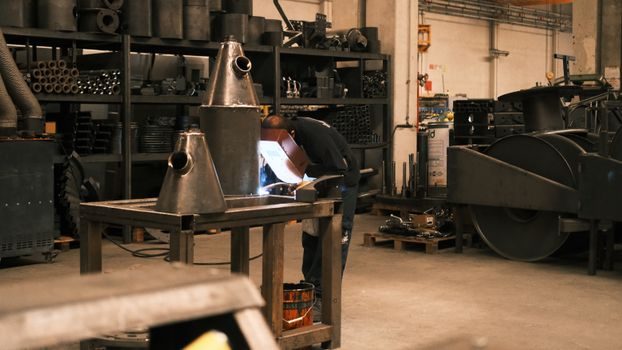
New-energy battery production — cylindrical, prismatic, pouch, and blade cells — is a discrete sub-market with its own machine family: tab-to-busbar welding, polar-ear welding, and pack-to-pack welding on automated lines [S3]. Shandong Huiyao's 2026 catalog lists eight dedicated battery-line SKUs including a "Blade lithium battery laser welding machine", a "Pouch lithium battery polar ear laser welding machine", and a "Prismatic lithium battery pack assembly line" — all 2026 listings on the supplier's storefront [S3].
Jewellery and small-parts welding sits at the opposite end of the power axis: 100 W–200 W pulsed Nd:YAG or fiber sources, gold- and silver-specific parameter sets, and — for handheld models — a red aiming "pointer" beam co-axial with the working beam is the typical build [S6]. Mobile-phone and consumer-electronics micro-welding inherits the same power band but adds vision and pick-and-place integration; the Alibaba 2026 showroom is organized explicitly as a "Laser Welding Machine for Mobile" application slice [S4]. Sheet-metal job shops — H-beam fabrication, kitchen equipment, elevator panels — land on the 1,500 W–3,000 W "4-in-1" handheld platform that combines welding, cleaning, and cutting in a single fiber delivery [S7].
Power Sources, Cooling, and Control Stack
Continuous-wave (CW) optical-fiber lasers classified as "Deep Fusion Welding" or "Heat Conduct Welding" power density regimes dominate the 2026 export catalog, with Raycus listed as a typical source on 2,000 W–3,000 W units [S7][S2]. Handheld 1,500 W units are explicitly described as "air cooled" in the Made-in-China listing, which is the practical lower bound on what you can run without a chiller; integrated gantry and robot cells step up to water-cooled heads and external chillers as standard [S7][S2].
Control stack splits into three tiers: (1) manual knob + foot-pedal on entry-level handhelds; (2) CNC HMI with 5-axis coordinated motion and CCD seam-aim on mid-range gantries; (3) full robot controller with scanner-based seam tracking, parameter recipes, and MES/ERP hooks on top-tier cells [S7][S1]. Welding-mode classification in supplier catalogs follows the physics — "Heat Conduct Welding" for low-power keyhole-free joints below boiling, "Deep Fusion Welding" once the power density crosses the vaporisation threshold and a keyhole forms [S2].
Plastic Welding: A Separate Buy Decision
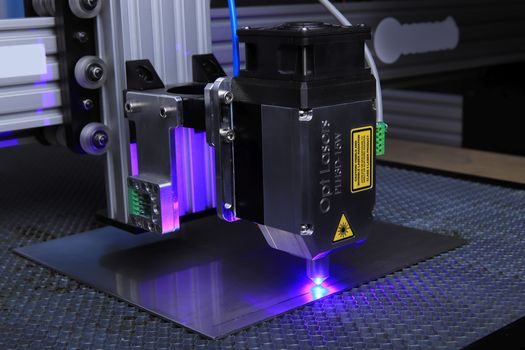
Plastic laser welding is a different procurement track and is not interchangeable with metal-fiber welders: the laser wavelength (typically 808 nm, 940 nm, or 1,064 nm) has to match a transmissive upper layer plus an absorptive lower layer in the polymer stack [S8]. Buyer inquiries on free.globalimporter.net in 2026 still request "Innovative Economical Plastic Laser Welding Machine" with a minimum 120 mm × 100 mm processing area for prototyping — a sizing constraint that pins the scanner field, not the laser power [S8].
The application is dominated by automotive sensor housings, medical disposables, and consumer-electronics enclosures where particulate-free, vibration-free joining matters more than cycle time. Compared to ultrasonic and hot-plate welding, laser plastic welding produces lower flash, lower particulate, and is friendly to 3D contours — at the cost of a transmissive/absorptive material pair that has to be designed in, not retrofitted [S8]. If your application is metal-on-metal or metal-to-coated-metal, this category does not apply and a fiber welder is the only correct tool.
Standards, Certification, and Sourcing Reality
CE marking on 2026 export listings is the baseline gate for European-bound handhelds and gantries, with the Raycus-powered 2,000 W–3,000 W "4-in-1" CE unit sitting at the entry price tier of US$1,999–2,186 [S7]. Supplier audit status on Made-in-China — "Diamond Member / Audited Supplier" — and a 2-year warranty are the practical proxies for vendor stability in the absence of a welding-specific ISO/EN machinery standard being named in the listing [S2][S6].
For OEM buyers building automated cells, the relevant cross-references are the robotic-welding integration standards (ISO 10218-series for robot safety, EN ISO 11549 for laser device terminology, and EN 60825-1 / IEC 60825-1 for laser product classification) — none of these are named in the source listings, so any claim of compliance to a specific clause should be verified against the manufacturer's Declaration of Conformity rather than the catalog text. For comparison sourcing across the broader welding market — MIG, TIG, stick, plasma — the MIG welding machine 2026 sourcing map sits next to this category and uses the same B2B catalog reading method. For handhelds that double as cleaners or cutters, the "4-in-1" cross-sell and the laser marker family share the same fiber-delivery platform but differ on focal optics and Q-switching.
Failure Modes, Limits, and What the Spec Sheet Won't Tell You
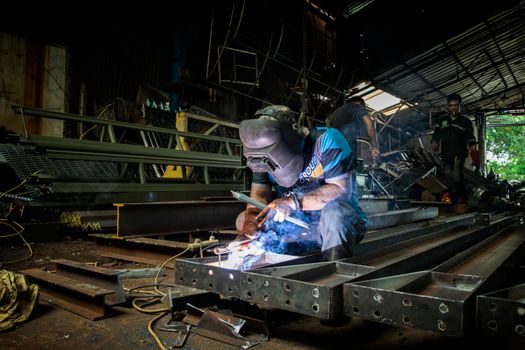
Handheld fiber welders marketed as "1,500 W" are often CW-rated at the source but derated to ~600 W–1,000 W at the workpiece after fiber and optics losses — buyers should treat the workpiece-side number, not the source sticker, as the spec that decides whether 3 mm stainless will fully penetrate [S6][S7]. Air-cooled handhelds throttle in continuous duty above ~60% utilization, so a two-shift job shop will hit duty-cycle limits long before it hits wattage limits; water-cooled heads or a chiller become mandatory around 2,000 W and above [S7].
Joint preparation is the silent gate: aluminium and galvanised steel demand different shielding-gas mixes (argon for stainless and carbon steel, argon/helium blends for aluminium, no-Zone for galvanised) and most catalog listings do not specify gas requirements — confirm before order. Reflective metals — copper, brass, polished aluminium — can back-reflect into the fiber and destroy the source module; brass welding specifically shows up as a 2026 buyer inquiry from Pakistan's Faulad Industries, and the correct answer for brass is usually a pulsed Nd:YAG or disc laser with back-reflection protection, not a handheld fiber unit [S8]. Where production volume and accuracy both matter, the laser tracker family and robot-cell integration are the right escalation path.
Trackable 2026 signals to watch: CE- and FDA-aligned handheld fiber SKUs above 2,000 W entering the US$1,500–2,500 price band; explicit EN ISO 11549 / EN 60825-1 declarations on 2026-Q3 catalogs; and the first plastic-laser-welding SKUs with built-in 3D contour scanning on Chinese B2B storefronts.