
A hydrodynamic fluid coupling transmits torque through kinetic energy in working fluid rather than metal-to-metal contact, so installation tolerances are governed by hydrodynamic balance, not gear-mesh geometry. Misalignment beyond the coupling maker's radial/axial limit produces blade-tip rubs, hot bearings, and rapid charge-oil degradation, while an under-filled coupling slips and overheats; overfilling reduces slip without raising transmitted torque to nameplate.
On belt conveyors, crushers, roller presses, and boiler feed pumps, hydrodynamic couplings from makers such as Dalian Fluid Coupling Co. — building on technology licensed from German VOITH — are specified in both constant-fill and variable-speed form factors (YOX, YOXF, YOXR, YOXE series) [S1]. The two configurations share the same shaft-prep rules but diverge on how the working-fluid charge is set and how the delay chamber is tuned to the driven machine's start-up inertia.
Pre-Installation: Shaft, Foundation, and Coupling Inspection
Clean both mating shafts to ISO 4406 21/18/15 cleanliness before mounting, and verify the foundation is grouted and cured for at least seven days, because hydrodynamic reaction torque on start-up can be 1.6–2.0× the steady-state transmitted torque on high-inertia conveyors [S1]. Confirm the input shaft end-float is within 0.05 mm of the coupling's axial face clearance, and that the coupling's blade wheel rotates freely by hand with no rub or scrape; a dry drag test is the first indicator that an internal blade has been bent in transit.
On hydrodynamic units above 400 kW, the bearing-housing temperature probe (PT100) and the thermal-protection switch wiring must be landed before the coupling housing is closed, so the first no-load run already has bearing-temperature data logged.
Alignment: Radial, Angular, and Axial Limits
Align input and output shafts with a dial-indicator or laser rig to a radial offset of 0.1 mm and an angular misalignment of 0.05 mm per 100 mm of shaft span — tighter than gear or disc coupling practice because hydrodynamic imbalance amplifies small offsets. Use stainless feeler shims under the motor feet; do not lift the motor with a chain block and re-tighten, as that introduces soft-foot distortion that reads as parallel misalignment on the dial gauge. [S1]
For long-span belt-conveyor drives where a gear coupling is paired downstream to absorb residual offset, keep the fluid coupling's own alignment as a stand-alone specification: 0.1 mm parallel, 0.1 mm/100 mm angular. Soft-foot check must precede final grout: rotate the motor one full turn and read the indicator foot-by-foot; a 0.05 mm soft-foot is acceptable, anything larger means re-shim before the coupling is touched. A common failure mode is "good enough" alignment verified only by straightedge across the coupling faces — straightedge on a hydrodynamic coupling is insufficient because blade-passing forces excite misalignment at the running speed, not at static rest.
Constant-Fill vs Variable-Speed: Charge and Delay-Chamber Rules

Constant-fill couplings (YOX, YOXF series) are filled to a fixed volume defined by the maker's dipstick or sight-glass mark, with no operator control during running; the charge volume is set once and verified by plug dipstick against the engraved mark on the coupling shell, typically between 70% and 85% of the internal cavity depending on rating [S1]. Variable-speed couplings (YOXR, YOXE series) add an external scoop tube that drains the working circuit to vary fill on the fly, and the delay chamber (or "reservoir") is sized to the driven load's GD² so torque ramps gradually over 4–15 seconds instead of slamming the belt.
Compare the four common configurations on three decision criteria:
Constant-fill YOX: low cost, no auxiliary hydraulics, but no soft-start tuning — best for steady conveyors and boiler feed pumps. YOXF: similar to YOX but with a fusible or thermal plug that vents charge on overload — used on crushers where tramp-metal jams must be cleared by slip without burning the motor. YOXR variable-speed: adds scoop-tube control, supports soft-start and load-sharing — used on long belt conveyors and bucket elevators [S1]. YOXE: variable-speed with extended delay chamber for the highest GD² drives (overland conveyors, mine mills), at higher cost and a larger footprint. Hydraulic-charge oil is typically ISO VG 32 or VG 46 mineral oil for ambient service 0–60 °C; switch to VG 68 above 50 °C ambient or to a fire-resistant fluid (water-glycol or phosphate-ester) when the coupling sits near a hot process or in a coal-handling enclosure.
Charge Verification, Venting, and the First No-Load Run
With the coupling cold and level, add working fluid through the fill plug until the dipstick mark is reached, then run the input motor uncoupled for 30 seconds to wet all internal surfaces, stop, top up, and re-check — initial fill always reads low because air is displaced from the blade passages. Vent any air pocket at the highest-point plug; an air-bound coupling will overheat in the first ten minutes because the unloaded blade-tip region cavitates instead of transmitting torque. Verify the rotation direction matches the arrow cast into the housing; reverse rotation on a hydrodynamic coupling that has asymmetric blade geometry can drop transmitted torque to 30–50% of rated. [S1]
On the first no-load run, log bearing-housing temperature every five minutes for the first hour; a stable 60–75 °C on a cold start is normal, and a rise above 90 °C within 30 minutes points to underfill, misalignment, or a blocked cooler. Slip should read 2–5% at rated speed with no load; if the tachometer shows higher slip, the coupling is under-filled or the input speed is below nameplate, and the next step is to stop and re-verify the dipstick level, not to keep running.
Common Failure Modes and When to Replace, Not Repair
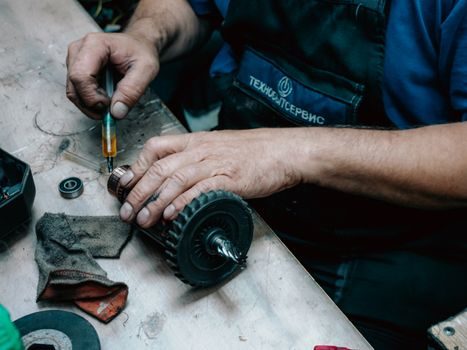
Three failure modes dominate hydrodynamic couplings in field service: bearing overheating from chronic misalignment (re-align, do not regrease — over-greasing is the second most common cause of high bearing temperature), blade erosion from contaminated or degraded charge oil (drain, flush, replace oil, install a 25 µm inline filter on the fill circuit), and fusible-plug venting that does not reset (replace the plug, then inspect the driven machine for a jammed load — a plug that blows repeatedly means a downstream problem). Seal leakage at the input shaft is rarely repaired in the field; once a lipseal has dragged and scored the shaft, the input shell assembly should be sent back to the maker. [S2]
Replace the entire coupling when the blade wheel shows visible pitting over more than 20% of the blade area or when the delay chamber on a YOXE unit has lost its calibrated volume due to erosion — at that point soft-start behaviour is no longer predictable. For context on selecting the upstream driver, the IE4 motor selection guide lays out how motor efficiency class, duty cycle, and locked-rotor torque interact with hydrodynamic soft-start to avoid nuisance trip on the first engagement. Where the coupling is mounted on a heavy conveyor line, the upstream balancing valve sizing of any hydraulic take-off still matters because pressure spikes on a coupled pump propagate through the same shaft train.
Standards, Sourcing, and Documentation
Hydrodynamic fluid couplings are not pressure-bearing vessels, so they fall outside ASME BPVC Section VIII; they are, however, covered by GB/T 5837 (China) and by maker-specific test protocols descended from VOITH and Flender working-fluid coupling practice, with nameplate ratings verified by type-test on each frame size [S1]. For variable-speed units driving equipment in explosive atmospheres, the integrated hydraulic control block — not the coupling itself — is the ATEX-relevant sub-assembly, and it must carry its own 2014/34/EU category marking independent of the driver motor's certificate. Documentation to retain in the commissioning file: alignment dial-indicator readings (both parallel and angular, before and after grout), charge volume and oil grade, first-hour bearing temperature log, and a photo of the nameplate stamped with serial number and coupling size code.
Sourcing signals worth tracking through the rest of 2026 include Dalian Fluid Coupling's continued YOX/YOXF/YOXR/YOXE family coverage in the 100–2000 kW band, the slow migration of variable-speed couplings into Chinese bulk-material-handling EPC packages, and the gradual introduction of condition-monitoring ports (vibration and oil-sample) on mid-frame YOXF units above 500 kW [S1]. For plants weighing the coupling against a fixed-ratio alternative like a jaw coupling for a low-inertia fan drive, the deciding question is whether soft-start and overload slip are worth the cost of charge-oil maintenance; for any drive over 75 kW with a high-inertia load, the hydrodynamic coupling remains the lowest-risk soft-start hardware in the lineup.