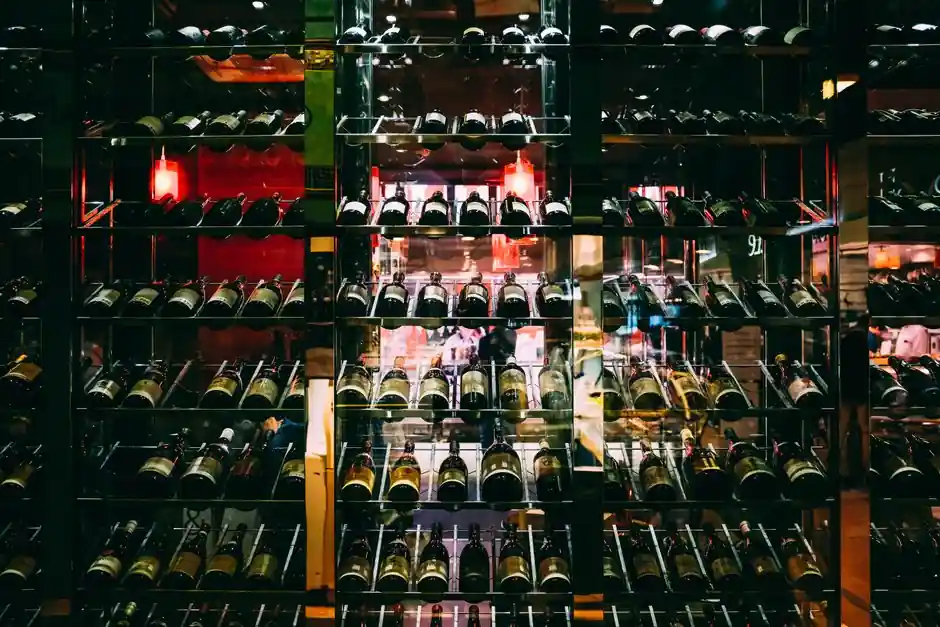
Storage cage selection for food and beverage operations is driven by four spec axes: material grade (NSF chrome wire, epoxy-coated carbon steel, 304/316 stainless), mesh opening size (typically 1"x1" to 2"x2" for bottle/can retention), load class per shelf (200-800 lb), and wash-down or corrosion rating [S3][S6].
Commercial food-service catalogs list 128 storage rack and cage SKUs across 8 brands in a single category, with 84 SKUs from Quantum Food Service and 23 from Klingers Trading, indicating a fragmented but deep supply base for back-of-house and warehouse storage [S1].
Material and Finish Grades for Wash-Down and Corrosion Resistance
NSF-listed chrome-plated wire is the baseline for dry back-of-house storage in restaurants, while 304 stainless is specified for wet or refrigerated zones, and 316 stainless for chemical wash-down or salt exposure [S1][S3]. Epoxy-coated carbon steel is common in warehouse/distribution racking where direct wash-down is not performed [S1].
A typical NSF-listed mobile security cage, 18" x 36" x 70" chrome wire mesh, is sold through major online channels and is explicitly rated for warehouse, grocery, restaurant, and dishroom service [S6]. The chrome finish tolerates routine wipe-down but is not a substitute for stainless in continuous wash-down environments.
Main Cage and Rack Types Compared
Four cage/rack archetypes dominate food and beverage spec sheets: wire security cages (liquor/chemical lockup), dunnage racks (produce/dairy case staging), sheet pan and glass racks (back-of-house prep), and selective pallet racking (warehouse/distribution) [S1][S3][S5].
Selective pallet racking is the most common storage style in food and beverage distribution because it installs quickly and tolerates repeated forklift impact; one integrator spec sheets structural uprights and bottom beam levels with roll-formed upper beams to balance durability against cost [S2]. Drive-in/drive-thru racking delivers up to 75% more pallet positions than selective rack on a per-square-foot basis, at the price of LIFO-only inventory rotation [S2].
Load, Mesh, and Footprint Specs
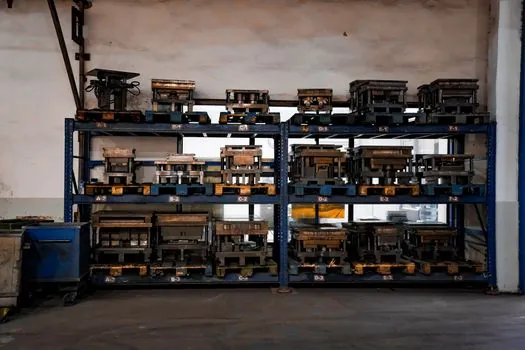
Wire shelf units in commercial food service commonly come in 24" x 48" and 24" x 60" footprints with chrome or green epoxy finishes, and NSF-Listed ratings are the dominant compliance marker for direct food-zone contact [S1][S3]. Mobile security cages at 18" x 36" x 70" are built for aisle circulation in narrow restaurant back-of-house corridors [S6].
For warehouse-scale storage, the spec sheet must call out beam capacity (typically 3,000-10,000 lb per pair for pallet rack), upright frame capacity, and deck material. A common hybrid spec uses structural steel uprights and bottom beams plus roll-formed upper beams to absorb forklift impact where it concentrates [S2].
Application Fit: Front-of-House vs Back-of-House vs Distribution
Front-of-house and merchandising favor gondola, beer, and grocery displays with slanted shelves for product visibility, while back-of-house prep favors sheet pan racks, glass/cup racks, and bus carts that move through narrow kitchen aisles [S3]. Distribution centers handling finished goods at scale run selective or drive-in pallet rack arrays measured in tens of thousands of pallet positions [S2].
For wineries, beverage distributors, and grocery stockrooms, dedicated keg dollies, keg stackers, and beer shelving round out the spec set alongside wire security cages for high-value or controlled-access SKUs [S3][S5]. Roll-out shelving and static racks serve parts and packaging staging in production-side food plants [S4].
Selection Criteria and Decision Logic

Specifiers should match the cage or rack to zone, then to load, then to cleaning regime. In a refrigerated or wash-down zone, 304 stainless minimum is the rule; in a dry ambient warehouse, epoxy-coated carbon steel selective rack is the cost-efficient default [S1][S3]. Mesh opening should be sized to retain the smallest unit (a 1"x1" mesh retains 12 oz cans, while 2"x2" is sufficient for case goods) [S6].
Compliance hinges on NSF listing for any surface in direct or splash contact with food, on local fire codes for high-pile storage (which set aisle widths and in-rack sprinkler triggers above 12 ft), and on rack manufacturer seismic anchorage for Zone 3 and 4 sites [S1][S2][S3].
Limitations, Failure Modes, and Sourcing Constraints
Chrome wire cages fail in continuous wash-down or high-chlorine environments because the plating ruptures at welds and cut edges; the failure mode is rust staining on adjacent food contact surfaces, not a structural collapse [S6]. Epoxy-coated roll-formed racking is more vulnerable to forklift impact than structural steel, which is why hybrid specs concentrate structural members at the bottom beam levels [S2].
Drive-in racking blocks FIFO rotation and inflates pick times per pallet once SKU velocity drops below one pallet per week, so it is the wrong choice for a high-mix SKU profile. In automated greenfield sites, mini-load AS/RS and pallet shuttle systems replace selective rack when labor cost per pick exceeds the infrastructure payback, typically a 3-5 year horizon for full-pallet F&B [S2].
Standards, Sourcing, and Trackable Signals

NSF listing is the dominant third-party mark for food-zone storage equipment, and a per-cage spec sheet should cite the NSF/ANSI food equipment standard or a regional equivalent (e.g., EN 1672-2 in EU installations) [S1][S3]. Warehouse racking in the US is covered by ANSI MH16.1 (steel pallet rack) and the RMI/ANSI MH16.3 for seismic design, which should appear on any selective rack submittal [S2].
Next nodes to track: NSF/ANSI 2 revisions for food equipment, ANSI MH16.1 cycle updates, and FEMA seismic zone remaps that change anchorage calcs. For related reading on cage spec in adjacent sectors, see the port logistics spec map and the e-commerce cage selection guide. For general background on cage construction and load classes, the storage cage encyclopedia entry and the storage rack overview are the right primers.
The underlying component specifications are covered under storage handling.