
A forestry-spec rough terrain forklift is most usefully picked inside a 3,000-10,000 kg rated-load window, with four-wheel drive, 250-350 mm of ground clearance, and a two-stage or triplex mast lifting 3-7 m [S9]. Outside that envelope, the machine is almost always mis-specified for log handling, slash work, and sawmill yard duty.
Forestry is a distinct duty cycle from construction, agriculture, and warehouse work: it combines soft ground, slash, bark debris, long palletised loads, and frequent attachment changes (wood grab, rotator, bale clamp). That is why rough terrain forklifts for forestry are sold with herringbone or R4-lug tyres, oscillating steer axles, and 100% differential lock rather than the smooth industrial tyres used on a standard forklift for indoor palletising.
Rated Load and Load Centre: Why the 500 mm Number Matters
Forestry load ratings are published at a 500 mm load centre, the standard reference distance from the fork face to the centre of gravity of the load [S1][S3]. Luken's 3.5 t CPCD35T-A is rated 3,500 kg at 500 mm, and the 5.0 t CPCD5.0T-A is rated 5,000 kg at 500 mm; both use forks sized 1220-1520 mm long by 120 mm wide by 45 mm thick, which is the typical envelope for green-sawn timber packs and palletised lumber [S1][S3].
If the load is longer, heavier, or shifted forward (a common case with cantilevered logs on a single fork extension), the effective capacity drops sharply, and the 500 mm number no longer applies. For forestry buyers, the practical rule is to upsize the truck one class if the average log pack exceeds 4 m, or to fit a longer 1,520 mm fork option (offered on the 5 t CPCD5.0T-A) rather than overspec the chassis [S3].
Driveline, Axles, and Tyres: 4WD, Differential Lock, and 250-350 mm Clearance
Published forestry rough-terrain drivelines are 4WD as standard, with selectable 2WD for road transit where offered (XINGHAO's 4 t unit lists 2WD/4WD as a published option) [S5]. Hecha's FD25/FD30/FD35 4WD line publishes a 2,500-3,500 kg rated capacity, 500 mm load centre, 3,000 mm standard lift, diesel-only power, and a four-wheel drive layout sized for mud, gravel, and grass [S8].
Three mechanical details separate a forestry-capable chassis from a yard-only chassis: an oscillating steer axle that allows either wheel to step over obstacles without lifting the opposite one, a 100% differential lock (auto-engaging on the Total Forklift 2.5-3.5 t series) for traction on wet slash, and a minimum ground clearance of 250 mm on the 3.5 t class and 320 mm on the 5 t class [S1][S3][S4]. Total Forklift publishes up to 270 mm of clearance on its terrain-rough series with steering angles of 43.6° to 70° to keep the turning radius tight on narrow skid trails [S4].
Tyre choice is the most underestimated spec gate: forestry work calls for herringbone or agricultural lug tyres (Luken publishes 23.5-70-16 herringbone front and rear on the 3.5 t and 5 t units) over smooth industrial tyres, with semi-pneumatic and solid-tyre options for sites with slash puncture risk [S1][S3][S4].
Mast, Lift Height, and Free Lift: 3 m to 7 m Working Envelope
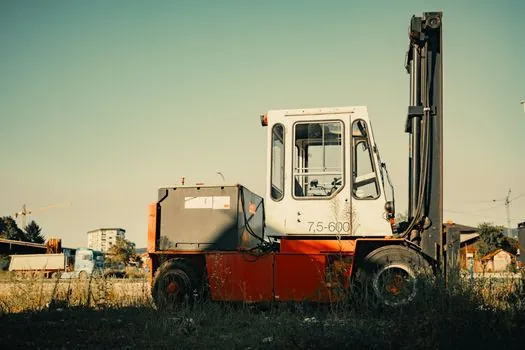
Standard two-stage masts on the 2.5-5 t forestry class are published at 3,000 mm, with optional maximum lifting heights of 3,500-7,000 mm depending on mast selection [S1][S3]. On the heavier 10 t class (GLS S10), the rated lift height window narrows to 3-6 m, the engine is a Yuchai 4105 at 121 kW, and the forklift weighs 7,000 kg unballasted with a 0.35 m ground clearance and a 4.5 m turning radius [S2].
As rated load rises, the structural envelope allows taller masts, but the heaviest machines in the segment are usually sold for low-lift, heavy-pallet yard work rather than container stacking [S7]. For log handling, the relevant mast spec is the free-lift height (100 mm on the Luken 3.5 t and 5 t) plus the tilt range (8° forward, 11° rear on both CPCD35T-A and CPCD5.0T-A), which together let the operator pick a single layer off a decked pack without driving over the load [S1][S3].
Engine, Hydraulics, and Service Refill: 42-121 kW Diesel Band
Forestry rough-terrain forklifts in the 3-5 t band use diesel engines in the 42-76 kW range, with the 3.5 t CPCD35T-A powered by a YunNei 490 at 42.0 kW and the 5.0 t CPCD5.0T-A powered by a YunNei 4102 at 76.0 kW [S1][S3]. At the 10 t end, power jumps to 121 kW from a Yuchai 4105 with a 280 torque-converter gearbox and a "Big 30" drive axle, sized for 38° climbing angle [S2].
Hydraulic tank and fuel tank capacities scale with chassis size: 80 L each on the 3.5 t, 95 L each on the 5 t, and 80 L of hydraulic oil implied on the 10 t based on the 280 torque-converter spec [S1][S2][S3]. Service brakes on the Luken forestry line are air disc brakes on both classes, paired with a 278 two-speed split gearbox; that gearbox plus an air-over-hydraulic brake system is the standard pattern across the 2.5-5 t segment and is a meaningful reliability advantage over fully hydraulic braked warehouse trucks in wet, muddy conditions [S1][S3][S4].
Attachments, Options, and Forestry-Specific Tooling
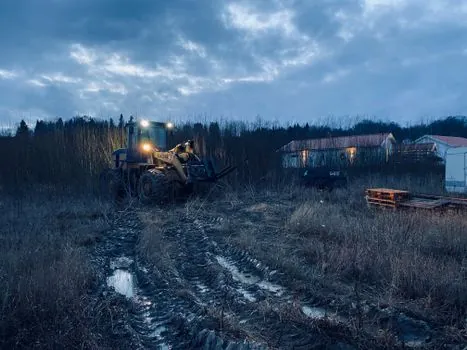
The published forestry option list is the clearest signal that a chassis is being sold into the segment rather than re-purposed from a construction SKU. Luken publishes side shifter, three-stage mast, tilting device, bucket, wood grab, snow plough, corn bale clamp, crane jib, fork extension, rotator, and air conditioner as orderable options on both the 3.5 t and 5 t forestry units [S1][S3].
For log handling, the wood grab, rotator, and crane jib are the load-bearing attachments, while the side shifter and three-stage mast are operator-productivity options. Buyers running a mixed sawmill yard plus a forwarder skid should prioritise the rotator (for turning whole logs into a stacker) and the wood grab (for picking broken or odd-length cordwood) over the cosmetic air conditioner, which adds weight and load-centre shift but no lifting function [S1][S3].
Comparison Table: 2.5 t, 3.5 t, 5 t, and 10 t Forestry Classes
The four published forestry classes line up against four decision criteria: rated load at 500 mm, ground clearance, engine power, and max lift height. The 2.5-3.5 t class is the lowest-cost entry and is correct for log-stack palletising and sawmill infeed; the 5 t class adds 320 mm clearance and 76 kW for rougher terrain; the 10 t class is a 7,000 kg unballasted machine at 121 kW and is correct for heavy timber handling, not for high-stacking [S1][S2][S3][S8].
Who a Forestry Rough Terrain Forklift is For, and Who it is Not For
It is for: sawmill log yards, pulpwood stacking sites, forwarder-relay decks, and any forestry operation that runs on unpaved, soft, or slash-covered ground and needs to lift 3-10 t at a 500 mm load centre [S1][S3][S4]. The wider context for matching driveline to ground conditions, and how 4WD rough terrain units compare with telehandlers and standard forklifts on site, is laid out in the rough terrain forklift sizing for agriculture spec map, which uses the same 3-10 t window and 4WD envelope as a reference.
It is not for: indoor warehouse palletising, container terminal high-stacking (where a standard forklift with a triplex mast is the right tool), or low-cycle construction work where a rough terrain forklift spec path for demolition projects gives the right driveline but a different attachment set (buckets, jibs for steel, not wood grabs and rotators). For low-headroom forestry sheds, the tunneling rough terrain forklift spec path covers the masted-versus-tunnel trade-off.
Limits, Failure Modes, and What Buyers Get Wrong
The most common forestry mis-spec is choosing a smooth-tyre warehouse chassis with "rough terrain" branding, which then loses traction on slash in the first week. The second is buying a 10 t class for 3 t log packs to "be safe", which adds 7,000 kg of unballasted mass, a 4.5 m turning radius, and a 38° climbing-angle chassis to a job that a 3.5 t at 42 kW handles at a third of the fuel and half the ground-pressure [S1][S2][S8].
Published failure modes to spec against: hydraulic oil contamination from bark dust (so specify a sealed hydraulic reservoir and 80-95 L tank for thermal headroom), brake fade on long descents (the air disc brake on Luken 3.5-5 t units is the answer), and mast tilt-cylinder fatigue on uneven ground (the Φ 80 mm tilting cylinder and 8°/11° tilt envelope are the published mitigation) [S1][S3]. Total Forklift's design choice to keep the layout free of "complicated electronic systems" specifically to make field repair possible without laptop diagnostics is a useful counter-signal to the otherwise-trending fully-electrified rough terrain segment [S4].
Trackable signals for the next planning cycle: whether 3-5 t forestry diesel units continue to ship with YunNei 490/4102 engines at the 42-76 kW band, and whether 10 t class forestry SKUs (currently 121 kW Yuchai 4105 with 280 torque-converter gearbox) move to a higher-power platform as log-pack sizes trend upward.
Spec-level background on the components involved: pressure transmitter.