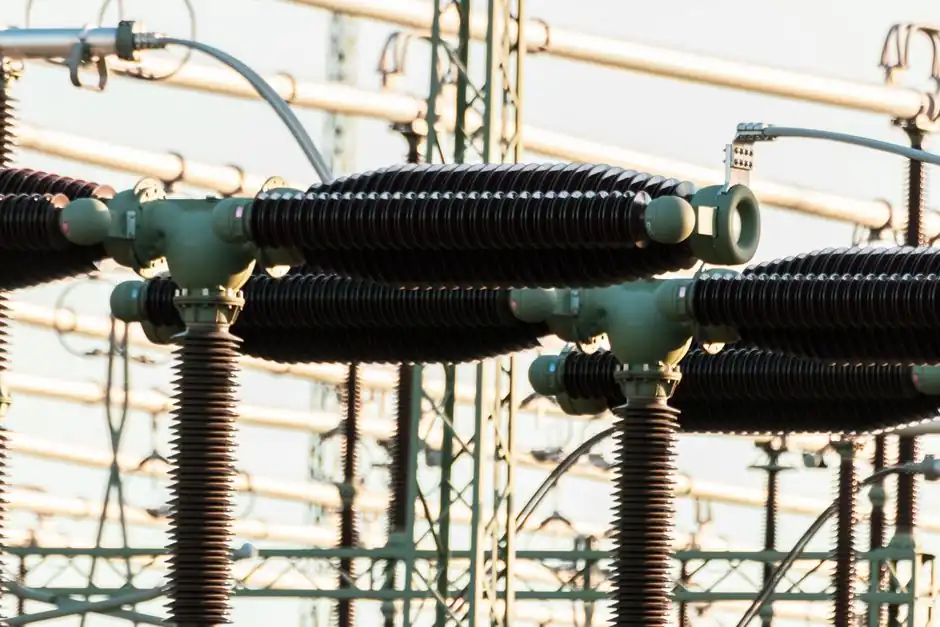
Energy-grade FRP profiles built with UV-stabilized polyester or vinyl ester resins and integrated HALS (hindered amine light stabilizers) hold flexural strength loss below 5% and color shift under Delta E 3 across 2000 hours of ASTM G154 Cycle 1 accelerated weathering, a data point that anchors FRP specification in solar farms and coastal substations [S1]. The same article frames the energy use case as a multi-stress problem: electrical conductivity, magnetic permeability, chemical corrosion, UV exposure, and thermal cycling between -40 and +85 degrees Celsius each disqualify a different conventional material, so FRP wins on the combination rather than any single property [S1].
Decision scope here covers three equipment families: power generation and T&D (cable trays, transformer spacers, substation structures, solar and wind hardware), process cooling (cooling tower structural profiles, fill, fan stacks, drift eliminators), and chemical service equipment (tanks, scrubbers, ductwork). A short internal reference on the FRP family itself is available at the FRP composite encyclopedia entry and a complementary piece on related process equipment is in FRP composite selection for automotive manufacturing.
Resin System as the Primary Selection Lever
For chemical plant equipment, FRP with a properly specified resin gives 20 to 30+ year service in corrosive media where carbon steel fails in 2 to 5 years, and the laminate is 25 to 40% lighter than an equivalent steel assembly [S4]. The resin, not the glass, sets the chemical resistance ceiling: glass fibre is moderate on its own and is vulnerable to strong acids and bases, so the matrix protects the reinforcement and the reinforcement carries the load [S4].
A graded resin map for chemical service runs from isophthalic (RPL-209) for dilute acid, alkali, and water treatment, through bisphenol A fumarate (RPL-301) for concentrated organic acids and solvents, to vinyl ester (RPL-401UV) for chlorine, hydrochloric acid, and sulphuric acid up to 50%, and finally epoxy novolac vinyl ester (RPL-403) for FGD (flue gas desulphurisation) and concentrated acid service at elevated temperature, with heat distortion above 150 degrees Celsius [S4]. A practical reference table: caustic soda up to 25% takes isophthalic or bisphenol; seawater immersion uses an IRS-approved isophthalic such as RPL-209M; potable water contact is isophthalic RPL-201 or RPL-209 subject to local regulation [S4].
UV, Weathering, and Long-Term Outdoor Performance
ASTM G154 Cycle 1, run to 2000 hours, is the typical accelerated benchmark used to qualify FRP for outdoor energy service, and the published result for energy-grade profiles with HALS plus UV absorbers is less than 5% flexural strength loss and a color shift under Delta E 3 [S1]. Field installations in desert solar farms and equatorial sites have shown stable performance under those conditions, which is the practical justification for 25+ year service life claims on solar mounting and substation structures [S1].
The competing failure mode on metal is well documented: galvanized steel mounting rails lose their zinc coat in 10 to 15 years in aggressive soil, after which the base steel begins to corrode, while FRP carries no sacrificial layer to deplete, no base metal to oxidise, and no coating system that can fail under cyclic wetting and drying [S1][S3]. The UV/weathering rule generalises: the corrosion immunity of FRP is through-material and permanent, but only the right resin system delivers the rated service life; under-specifying the resin shortens life independently of the glass reinforcement [S3].
Cooling Tower Profiles: Load, Fire, and Lifecycle Trade-Off
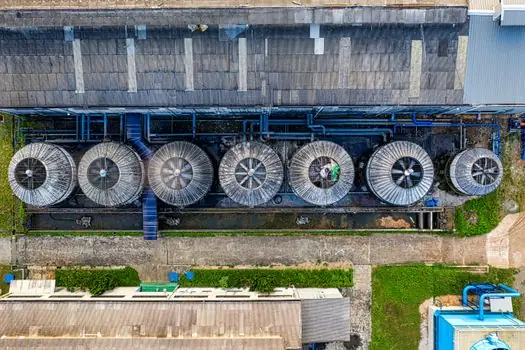
FRP pultruded profiles and grating in cooling tower service carry 2.5 to 7.5 kN per square metre in grating applications, with ASTM E84 Class 1 fire rating achievable on standard resin, against a 20 to 30 year typical service life; the steel benchmark is 8 to 15 years in the same splash and chemical zones, while CPVC reaches Class 1 only with additives and standard PVC does not qualify [S2]. The maintenance delta is concrete: steel needs painting and corrosion control after coating failure, FRP needs neither, so lifecycle cost on splash and chemical zones tends to favour FRP despite a moderate-to-high relative material cost [S2].
Thermal performance still drives the cooling tower buy decision, and the most common mistake is undersizing the unit by 10 to 15%, which raises condenser supply temperature by 2 to 4 degrees Celsius and increases compressor energy by roughly 3 to 5% per degree of elevated inlet [S5]. The typical cooling range is 5 to 10 degrees Celsius, the typical approach is 4 to 8 degrees Celsius with a high-performance target of 3 to 5 degrees Celsius, and any approach claim under 3 degrees Celsius under standard ASHRAE conditions should be backed by third-party CTI or ISO 9001 test data, not brochure numbers [S5].
FRP vs Steel vs Aluminum vs Timber: A Four-Way Criteria Map
The decision is rarely FRP versus nothing; it is FRP versus a specific alternative in a specific service. A direct comparison: FRP, galvanized steel, aluminum, and timber, on the five criteria that actually drive energy-equipment selection. On corrosion resistance, FRP is through-material and permanent, galvanized steel relies on a zinc coat that depletes in 10 to 15 years in aggressive soil, aluminum is non-rusting but suffers galvanic attack at copper contacts, and timber is organic and biodegrades [S1]. On electrical behaviour, FRP is non-conductive and non-magnetic, steel is conductive and magnetic and creates eddy current heating near high-current conductors, aluminum is non-magnetic but conductive, and timber is non-conductive but flammable [S1].
On weight, FRP is 25 to 40% lighter than steel, aluminum is roughly one-third the weight of steel, and timber is comparable to FRP on a volume basis; on UV durability, FRP with HALS plus UV absorbers holds under 5% flexural loss across 2000 hours of ASTM G154 Cycle 1, galvanized steel depends on coating integrity, aluminum forms a stable oxide layer, and timber requires preservative treatment [S1][S4]. On lifecycle cost in corrosive zones, FRP runs 20 to 30+ years, steel 8 to 15 years, aluminum 10 to 18 years, and timber 10 to 15 years depending on environment [S2].
Where FRP Fits, and Where It Does Not
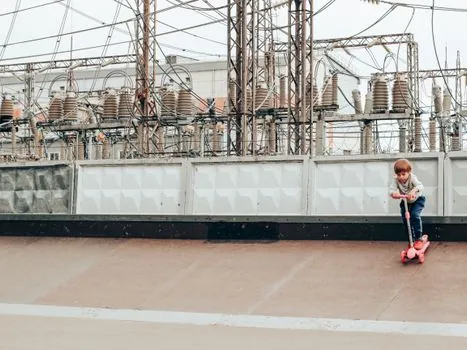
FRP is the right call for cable trays and ladder supports in substations where arc-flash and grounding complexity on steel add engineering cost, for transformer and switchgear spacers where eddy-current heating in steel shortens equipment life, for solar farm mounting structures in coastal, desert, or agricultural soil, for wind turbine nacelle interiors and blade-root components where non-conductivity avoids unintended current paths, and for cooling tower structural profiles in the wet splash and chemical zones where steel coatings fail [S1][S2].
FRP is the wrong call where high bearing loads exceed the 2.5 to 7.5 kN per square metre grating envelope and the design is primary structure rather than secondary support, where sustained temperatures exceed the resin heat distortion limit (above 150 degrees Celsius for epoxy novolac vinyl ester, lower for isophthalic), where the process fluid includes strong hydrofluoric acid that attacks the glass fibre itself even behind a resin-rich barrier, and where a Class 1 fire rating is mandatory and the resin system cannot be upgraded with additives to meet ASTM E84 [S2][S4].
Specification Checklist and Procurement Signals
A workable FRP specification for energy equipment names the resin system and grade (isophthalic, bisphenol, vinyl ester, or epoxy novolac vinyl ester), the inner corrosion barrier thickness (1 to 2 mm of resin-rich reinforced inner layer ahead of the structural laminate for chemical service), the ASTM G154 weathering data with HALS plus UV absorbers, the ASTM E84 fire rating with the exact resin formulation used to achieve it, and the load class for grating and pultruded profiles with the corresponding kN per square metre value [S1][S2][S4]. For cooling towers specifically, the spec also needs CTI or ISO 9001 thermal performance certification, drift eliminator geometry, fill type (film or splash) and material, fan blade material and motor efficiency class plus VFD compatibility, and water treatment compatibility including cycles of concentration and biocide resistance [S5].
Trackable signals to watch: standardisation of ASTM G154 Cycle 1 at 2000 hours as the procurement floor for outdoor energy-grade FRP; wider adoption of vinyl ester and epoxy novolac vinyl ester in FGD and concentrated acid service above 50% H2SO4; and continued displacement of galvanized steel cable trays in new substation builds where arc-flash mitigation, rather than corrosion alone, is the primary driver [S1][S2][S4]. Related process-equipment selection maps for adjacent energy-side instrumentation sit in the electromagnetic flowmeter spec gate piece.
Detailed specification references: energy management, and energy meter.