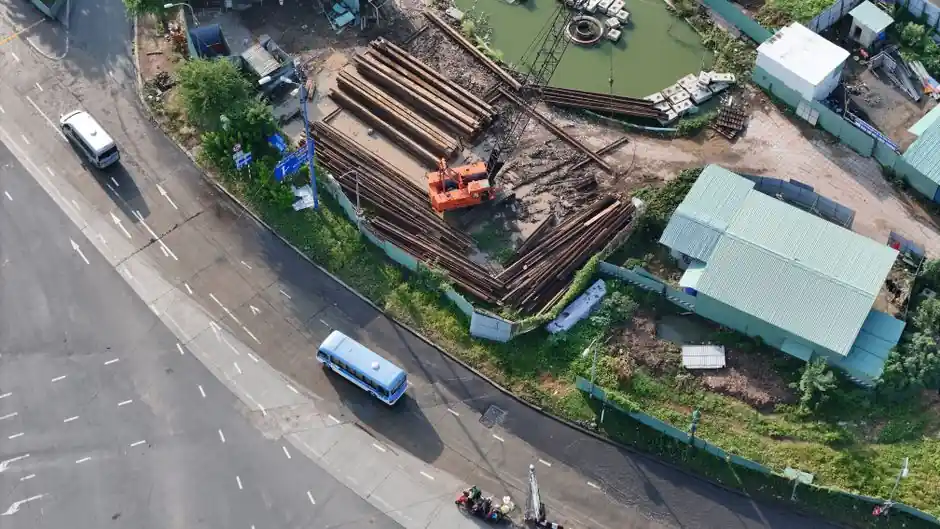
Industrial gantry cranes used in road construction typically cover 0.5-800 t capacity ranges and 6-50 m spans, with road-build applications concentrated in the 5-50 t and 10-35 m band for beam yards, bridge approaches, and rebar/formwork handling [S7].
The selection is driven by six technical parameters: rated lifting capacity, span (centre-to-centre of legs), lifting height under hook, duty class (FEM/ISO), travel type (rail vs rubber-tyred vs caster), and girder configuration (single vs double). Each parameter is set by the heaviest precast unit, the lane width or yard footprint, hook clearance to overhead obstructions, expected daily lift cycles, ground-bearing capacity, and whether the crane must be repositioned between pours [S2][S3].
What a road-job gantry crane actually is
A gantry crane is an overhead lifting system whose bridge is carried on ground-supported legs running on rails, wheels, or tracks, instead of being suspended from a building runway [S1]. This ground-supported architecture is what makes gantry cranes usable outdoors on bridge approaches, casting yards, and remote sections of highway alignment where no building structure exists to hang an overhead crane from [S3].
For road construction the typical equipment families encountered are full gantry (both legs ground-supported, four-rail travel), semi-gantry (one leg on a building column, one on the ground), and mobile/portable gantry on rubber tyres or lockable casters [S5][S8]. Cantilever gantries, where the main girder extends past the runway on one or both sides, are used where the lift point must sit outside the leg centreline, for example over a kerb line or beyond a trench [S6].
Main types lined up against road-job criteria
Selection on a road site usually narrows to four structural choices: single girder, double girder, light-duty mobile on casters, and heavy launching gantry for bridge beam erection [S1][S4][S8].
Single girder gantries suit lighter road-build tasks such as rebar bundle handling, small formwork panels, and precast drainage units, typically 1-10 t, and cost less because they need only one main beam and a lighter hoist trolley [S1][S8]. Double girder gantries are specified for higher capacities and heavier precast components: they allow heavier hoists, higher hook heights because the hoist sits on rails between the two beams, and better hook approach from the end of the bridge, which matters when lifting over a finished deck edge [S1][S4].
Mobile gantry cranes on rubber tyres or heavy-duty casters are the typical choice for short-duration, repositionable jobs such as precast yard loading, bridge-deck segment staging, and plant-yard maintenance, with capacities broadly in the 1-20 t bracket for caster-mounted units and higher for engineered rubber-tyred units [S9]. Launching gantries, a separate sub-family, are the machines that walk forward span-by-span on the bridge piers to install precast T-beams, U-beams, and steel box girders, with manufacturer-published capacity ranges from 50 t for standard beams up to 900 t for heavy box girders [S4].
Six core specifications that drive the spec sheet

Load capacity is the rated maximum lift and is the first figure locked in: it must cover the heaviest single component plus the rigging weight, and structural design, span, and hoist selection all flow from it [S3]. Span, measured centre-to-centre of the legs, is set by the working width plus the required hook approach on each side, and road-build gantries typically run 6-35 m for fixed applications and up to 50 m for special bridge works [S3][S7].
Lifting height under hook is set by the tallest stacked load, the tallest precast element, and any overhead obstruction such as an existing bridge soffit or scaffold tube. Lifting speed, trolley traverse, and crane travel speed are then selected to meet the daily cycle target, and the whole machine is assigned a duty class (FEM/ISO grouping such as A3-A5 for light/medium and A6-A8 for heavy/continuous) that defines the permissible number of starts per hour and full-load hours per day [S3].
Power and controls are specified alongside the structural picks: electric wire-rope hoists dominate above 5 t, electric chain hoists below, and control is typically pendant plus radio remote, with VFD control on the long-travel and hoist motions for precise load placement over formwork [S5]. Outdoor service adds wind-load rating, rain and lightning protection, and a structural finish suitable for the site corrosion class [S1].
Decision rules for road-construction duty
For precast beam yards and casting bays handling standard road-bridge T-beams, a 20-50 t double girder full gantry on embedded rail is the common specification, with a span matched to the yard gantry width and lifting height set by stack plus trolley clearance [S4][S7]. For bridge erection itself, the same tonnage bracket is taken by a launching gantry that walks pier-to-pier, with capacity stepping up to 100-900 t for steel box girders and long-span concrete segments [S4].
For rebar, formwork, drainage units, and small precast on a moving road formation, a 3-10 t mobile gantry on rubber tyres or lockable polyurethane casters is usually sufficient, and is preferred over rail because the rail installation cost is hard to justify on a linear worksite that shifts daily [S9]. Steel construction is the default for road work because it carries higher duty ratings, takes greater dynamic loads from outdoor wind, and accepts the larger capacities; aluminum is reserved for low-capacity, corrosion-sensitive, or frequently-repositioned jobs where its lighter self-weight is the deciding factor [S2][S7].
Fixed height is the cheaper and stiffer choice for a dedicated yard crane; adjustable height (telescopic legs or pinned bolt-on extensions) is worth specifying only when the same crane must serve loads of very different heights, for example precast culvert units one week and bridge beams the next [S2]. The gantry is not the right tool when the lift exceeds 50 t on a linear road formation, where ground conditions cannot carry the leg reactions, or where a crawler crane or truck-mounted crane can do the cycle in less rigging time.
Limitations, constraints, and failure modes

Outdoor road sites impose wind limits on gantry operation, and lightweight mobile gantries in particular have published maximum wind speeds above which lifts must stop and the crane must be parked or pinned [S1]. Ground-bearing pressure under the leg pads is often the binding constraint on a prepared road formation, and a gantry that is light enough to mobilise can still be ruled out by poor subgrade; in that case the answer is a rail-mounted gantry distributing load through sleepers, or a different machine class altogether.
Hook approach from the leg, not the centreline span, frequently limits what a gantry can lift on a constrained site: when the precast unit sits close to the leg, only a cantilever gantry, with the main girder extending past the runway on one or both sides, can reach over it without a complete re-layout of the yard [S6]. The procurement team also has to budget for the runway, the power supply along the full travel length, the earthing and lightning protection for outdoor service, and the inspection regime that follows the installed duty class [S1][S5].
A frequent mismatch is specifying a light-duty gantry for what is actually a heavy-duty duty cycle: once the daily cycles and full-load hours are tallied, the correct FEM/ISO class usually steps the structure up a size, and re-specifying it post-order is far more expensive than selecting it correctly on the first data sheet [S3].
Sourcing, standards, and what to verify on the data sheet
Road-construction gantries are commonly built to FEM 1.001 / 9.341 duty classifications, ISO 4301 crane classification, and CMAA duty service, with design verification to a recognised structural code such as AISC, EN 1993 (Eurocode 3), or the equivalent national steel structure standard [S3]. The data sheet should carry: rated capacity and the corresponding hoist group classification, span and lifting height, hook approach dimensions, trolley and travel speeds, total self-weight with leg reaction loads, power supply (typically 400-480 V three-phase), control voltage, and the stated wind speed for outdoor service [S1][S3].
Procurement should also confirm the surface preparation and paint system for the site corrosion class, the type and certification of the hoist brake, the overload limiter specification, and whether the manufacturer provides full structural calculation notes and a load test certificate before dispatch [S3][S7]. For yard use inside a fixed perimeter, a road roller or compaction unit working nearby can impose vibration on a rail-mounted gantry, and the supplier should be told so the rail fixings and bracing are sized for it.
Trackable signals to watch over the next buying cycle: vendor disclosures of FEM/ISO duty class on every quote (not just capacity), explicit wind-speed limits on outdoor mobile gantries, and verified leg-reaction loads on the foundation drawing; absence of any of these three on a road-job quote is a reason to push back before the order is released. Buyers comparing road-formation earthworks support equipment against lifting kits can cross-check the spec map for rollers and earthmoving plant to keep capacity, mobility, and ground-pressure figures internally consistent across the site fleet.
Component reference pages worth checking: gantry crane.