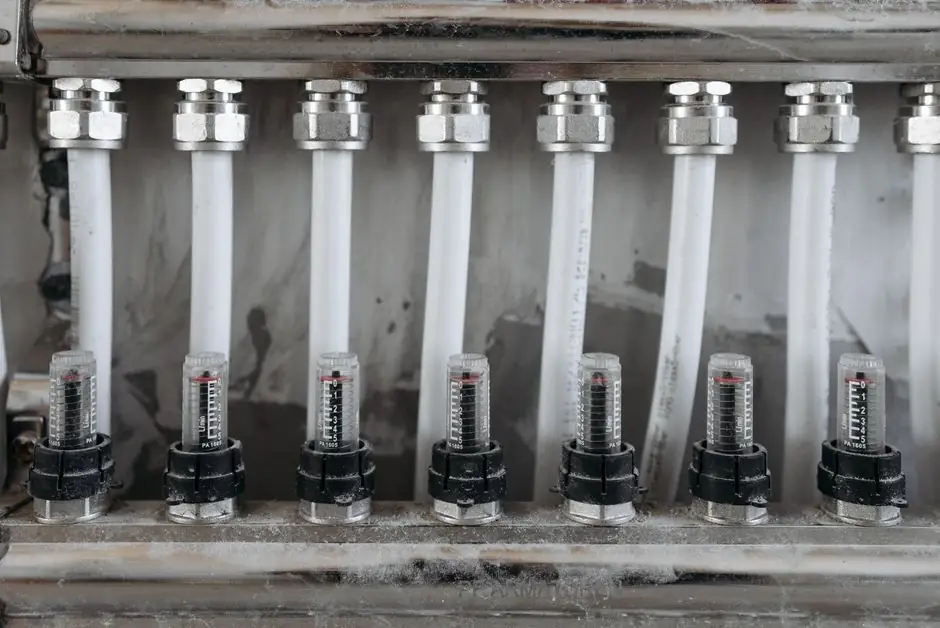
Thermal gas mass flow controllers span $1,500-3,500 list price for mainstream industrial models, with OEM secondary-market surplus units (UNIT UFC-8100, 200 sccm O2) listed at $199.95 used [S4] versus new mass-stream thermal units from $1,500 [S1].
Specification variables that move price include full-scale flow range (5 mL/min to 500 L/min), accuracy class (±0.6% to ±2.0% of set point), communication protocol (0-5 VDC, 4-20 mA, RS-485, HART), wetted materials, and integrated solenoid valve architecture. Reference designs from manufacturers like HORIBA, Azbil, Bronkhorst, MKS, and Omega anchor the published price bands.
Price Bands by Architecture and Flow Class
Entry-level thermal mass flow meters in compact inline packages start at $1,500-1,830 for the MASS-STREAM MS-105/106/108/109 series, sized for low-to-mid gas flows with manufacturer-listed price floors of $1,500-1,830 [S1].
Digital multi-range, multi-gas MFCs with piezo-actuated valves and ±1.0% S.P. accuracy occupy the $1,966-3,500 band; the Omega FMA2600/FVL2600 with 130+ gas calibrations and simultaneous pressure/temperature/volumetric outputs is listed at $1,966 [S9], while HORIBA's SEC-Z500X series with multi-range/multi-gas field reconfiguration falls in the upper part of that range [S6]. Azbil's MQV series spans 5 mL/min to 500 L/min with 300 ms high-speed control and dedicated hydrogen/helium variants [S2]. The vortex shedding comparison article Vortex vs Gas MFC flags the flow-class threshold where MFCs stop being economic.
Cost Drivers: What Moves the Quote
Sensing principle is the largest single cost lever: thermal mass (capillary-bypass or inline MEMS-style) dominates the $1,500-2,500 tier, while Coriolis-based gas MFCs for high accuracy at high flow run several multiples higher and are not represented in the surveyed price band. [S2]
Full-scale flow range sets the valve orifice and actuator size. A 1000 sccm N2-calibrated MFC with 0-5 VDC, DB15 connector, 150 psig max inlet, and ±1% of set point accuracy (GM50A series) lists with proof pressure 1000 psig and burst 1500 psig, demonstrating the pressure-rating premium [S7]. Control range ratios of 20:1 to 50:1 (e.g., 20-1000 sccm turndown) are typical at this accuracy class [S7].
Gas compatibility and wetted-material upgrades (elastomer vs metal seals, Swagelok-style fittings, hydrogen or corrosive service) add 10-30% over baseline N2/air calibration. The 0.25 in. Swagelok-style metal-seal configuration is a recurring option in the data set [S7].
Comparison Across Main Controller Types

Three architectures dominate the survey window, and they answer different spec questions. Thermal MFCs (MASS-STREAM, FMA2600, MQV) suit low-to-mid flow gas dosing with fast response and the best $/sccm ratio; Coriolis gas MFCs serve high-accuracy, high-flow, or custody-style applications at 3-8x the thermal price; differential-pressure-based MFCs remain a legacy option where existing DP infrastructure already exists. [S2]
Criteria matrix from the surveyed data: thermal digital MFC vs thermal analog MFC vs secondary-market surplus MFC. Cost: $1,500-3,500 (new digital, multi-gas) vs $1,500-2,500 (new analog, single-gas) vs $200-600 (used surplus) [S1][S4][S9]. Accuracy: ±1.0% S.P. typical on new digital [S6][S7] vs ±1-2% on analog units vs unspecified on used units. Gas flexibility: 130+ gas database on FMA2600 [S9] vs single calibration gas on most analogs vs recommissioning required on used. Lead time: weeks-to-months for new OEM vs same-week for surplus. The wider flow-meter selection primer places MFCs in the gas-specific lane of the spec tree.
Where the Money Goes Beyond the Sticker
Total installed cost typically adds 15-25% to the controller list price. Categories: calibration certificates (NIST-traceable, multi-gas, roughly 5-10% of unit price), fittings and tubing (Swagelok, VCR, compression, often sourced separately), power supplies and signal conditioners for 0-5 VDC or 4-20 mA loops, and panel/integration labor. [S7]
For hazardous-area deployments, ATEX/IECEx-certified enclosures and intrinsically safe barriers stack an additional 20-40% on top of base price, and lead times extend to 8-16 weeks versus 2-6 weeks for general-purpose units. A differential pressure transmitter pricing breakdown shows similar certification-driven cost layering on the related DP transmitter category. Long-term cost of ownership is dominated by annual recalibration (typical 12-month interval for process-grade MFCs), replacement valve seats in high-cycle dosing service, and gas-standard reference cylinders for field verification.
Selection Criteria and Common Failure Modes

Specify the MFC by four parameters in this order: (1) full-scale flow in normal units (sccm, slm, L/min) sized so the operating point lands at 30-80% of full scale for best linearity; (2) gas or gas mix (single-gas calibration is cheapest, multi-gas database adds cost) [S9]; (3) accuracy class needed at the operating point, not the full scale; (4) pressure drop budget between upstream supply and downstream process, because thermal MFCs add 0.5-40 psid across the device [S7].
Common failure modes in the field: particulate clogging of the sensor and valve (mitigated by upstream 0.5 micron filtration and pre-purified gas); moisture-induced sensor drift in unconditioned lines; thermal-mass sensor contamination from oil backstreaming in vacuum-fed systems; and valve-seat wear in high-cycle (>10 million cycles/year) fermentation or CVD dosing. Reference design point: MFCs are not differential pressure devices and do not directly replace orifice-plate metering, a comparison detailed in the orifice plate spec guide.
Who Should and Should Not Specify an MFC
An MFC is the right tool when the process needs closed-loop mass flow control, fast set-point response (sub-second class on the MQV at 300 ms [S2]), repeatable gas dosing for yield, or feed-forward control of a reaction stoichiometry. Biotech fermentation, semiconductor CVD, analytical instrument gas panels, and emission monitoring reference standards (HORIBA APDA-375A PM2.5 reference value measurement [S5]) are canonical fits.
An MFC is the wrong tool when the gas is dirty, two-phase, or pulse-flow; when only totalized volume over long periods matters (a variable area flowmeter or vortex flowmeter is cheaper); or when the operating pressure ratio across the device is below the sensor minimum differential. For pure liquid or steam service, the relevant comparison set is electromagnetic or turbine (electromagnetic vs turbine, not MFC. Foundational physics and selection breadth are covered in the gas mass flow controller encyclopedia entry, which anchors the technology taxonomy used here.
Sourcing Notes, Standards, and Watch Items
Publicly observable list prices cluster around three anchor points: $1,500-1,830 for compact thermal inline meters [S1], $1,966 for the multi-gas digital FMA2600 [S9], and OEM-quoted "contact for price" for high-spec digital MFCs in the SEC-Z500X and MQV families [S2][S6]. Used surplus offers a $200 floor for legacy UFC-8100 hardware but no warranty [S4].
Applicable standards vary by region and service. ISO 9001 governs calibration quality systems at most manufacturers; ATEX 2014/34/EU and the IEC 60079 series govern explosion-protection ratings in European and IECEx-member deployments; SEMI E12/E48 apply in semiconductor gas-panel contexts. For engineers new to instrument spec work more broadly, the temperature transmitter selection guide and bimetal thermometer buying guide provide parallel cost-driver frameworks on adjacent instrument families. Watch items for the next planning cycle: piezo-actuated valve migration replacing solenoid valves in mainstream digital MFCs, multi-gas database expansion (130+ on the FMA2600 [S9], 20-gas select on the legacy Omega line), and field-reconfigurable full-scale ranges on units like the SEC-Z500X [S6] that reduce spares inventory across a process skid.
The underlying component specifications are covered under lighting equipment and electric lamps, and linear guide.