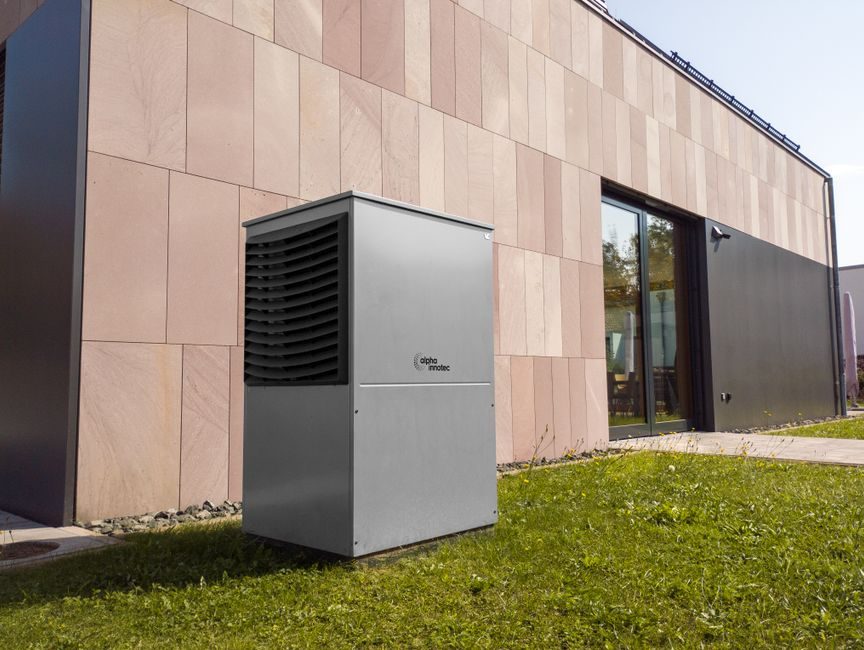
China holds the dominant share of global heat pump manufacturing capacity entering H2 2026, with Shandong province acting as a primary export cluster: a Qingzhou-based manufacturer lists a 500-unit production capacity per order on solar PV air-cooled heat pump units at a 1-piece MOQ on Made-in-China [S3]. The country hosts R290 inverter air-source, R32 inverter air-source, and R134a all-in-one heat-pump water heater product lines on a single supplier page, indicating the refrigerant-portfolio breadth Chinese OEMs cover for export [S1].
European capacity is being built out by Chinese majors: Midea Group began construction on a new production base in Italy in October 2022, with the facility positioned as a localised source for the EU heating market under tightening F-Gas and ecodesign rules [S4]. For spec engineers mapping country-of-origin risk, the picture is binary: China for volume, Italy and adjacent EU sites for F-Gas-compliant localised assembly, and the rest of the world's installed base runs on equipment imported from these two hubs.
Country Capacity Map: China, EU, and the Long Tail
Chinese factories concentrate on three refrigerant families — R290 (propane, GWP ≈ 3), R32 (GWP ≈ 675), and R134a (GWP ≈ 1430) — and the supplier pages list R290 inverter, R32 inverter, and R134a all-in-one variants in a single product carousel, which signals the simultaneous tooling required to serve EU F-Gas phase-down, Japanese high-temp, and legacy commercial replacement markets [S1]. Production capacity per order is documented at 500 units for solar PV air-cooled units from a single Qingzhou (Shandong) factory, and the same listing confirms L/C and T/T payment terms typical of direct-OEM B2B channels [S3].
Inside China, the supply chain depth extends to PCB, titanium heat exchangers, and cabinet fabrication. Alibaba aggregates heat-pump PCB suppliers offering FR-4 double-layer, FR-4 four-layer, and double-layer PCBs for energy applications — the upstream electronics tier that drives inverter-board cost and lead time [S6]. A Made-in-China "Heat Pump Titanium Factory" listing exposes the OEM/ODM custom-fabrication model, though the same supplier also handles welded wire mesh and security fencing, a common multi-line pattern on the platform that spec engineers should verify before assuming dedicated titanium exchanger capacity [S5].
Outside China, the EU node is anchored by Midea's Italy base, a project that broke ground in October 2022 and represents the largest Chinese OEM greenfield in Europe for HVAC [S4]. North American and Korean capacity is not represented in the surfaced supplier pool, leaving Japan (traditional for high-temperature and CO2 transcritical units) and US/Japan OEMs as the residual capacity providers not directly evidenced in this research window. Related reading: the Transformer Global Production Capacity by Country 2026 article documents a similar China-anchored pattern for grid-side equipment, and the same logic applies to the upstream electronics tier in heat-pump inverter boards.
Refrigerant Tiers and the Spec Map Buyers Actually See
R290 (propane) is now the headline low-GWP refrigerant for residential monobloc and split air-source heat pumps sold into the EU, and Chinese factory listings explicitly promote "R290 Inverter Air Source Heat Pump" as a featured product for export channels [S1]. R32 sits in the mid-GWP slot and is the default for markets without full R290 adoption; R134a remains in legacy and high-temperature commercial / water-heating applications where its thermodynamic properties and existing service infrastructure offset the higher GWP penalty [S1].
Solar PV air-cooled heat pump units combine a PV-driven compressor drive with an air-source evaporator, and a Shandong supplier quotes a 500-unit production capacity per cycle with negotiable pricing and 1-piece MOQ — a configuration that suits mid-scale commercial and agricultural buyers in MENA and southern Europe [S3]. The same listing publishes the factory address (4969 Haidai Road North, Qingzhou, Shandong) and the business-type metadata that sourcing teams use to validate tier-1 vs tier-2 status.
For OEM and ODM work, the Made-in-China "Heat Pump Titanium Factory" page is the on-ramp for custom titanium heat exchangers, though spec engineers should confirm dedicated heat-exchanger production rather than inferring it from the company name — a check that matters because titanium coil welding, vacuum brazing, and pressure-testing capacity is not the same as welded wire mesh capacity [S5].
Selection Criteria: Where Each Country Wins
Spec engineers evaluating country of origin should weight five criteria: refrigerant compliance, inverter electronics, heat-exchanger material, lead time, and F-Gas / ecodesign documentation. China wins on cost and on refrigerant breadth — R290, R32, and R134a product lines are simultaneously tooled at the same factory level [S1] — and on lead time for solar PV air-cooled units with documented 500-unit capacity and negotiable terms [S3].
EU production (Midea Italy) wins on F-Gas-compliant local assembly for buyers who require made-in-EU documentation to satisfy F-Gas Regulation (EU) No 517/2014 leak-check, recovery, and labelling rules without cross-border refrigerant accounting [S4]. For high-temperature and commercial projects above 65 °C flow temperature, Japanese and Korean vendors retain a residual advantage in transcritical CO2 and high-stage R32 designs, though the research window does not surface supplier pages confirming specific production capacity.
A criteria-based comparison for the surfaced options: (1) Refrigerant portfolio — China broad (R290/R32/R134a) [S1], EU single-platform on R290/R32 as standard [S4]; (2) Documented unit capacity per order — China 500 units on solar PV air-cooled [S3], EU not published in research; (3) Payment terms — L/C, T/T [S3]; (4) MOQ — 1 piece on solar PV air-cooled [S3], not stated for the Italy base; (5) Custom OEM/ODM — China direct via Made-in-China / Alibaba [S5][S6], EU via Midea's localised plant channel.
Component Supply Chain: PCBs, Titanium, and Inverter Boards
The inverter board is the highest-value subassembly in a modern heat pump, and Alibaba's heat-pump PCB supplier cluster lists FR-4 four-layer boards for energy applications as the standard platform — a 4-layer stack is the minimum that supports the gate-drive, current-sense, and EMC filtering required for variable-speed compressor drives in the 3–10 kW residential class [S6]. Sourcing teams should request the IPC-6012 class (typically Class 2 for commercial, Class 3 for high-reliability industrial) and the UL 94V-0 flammability rating on the laminate datasheet before locking the BOM.
Titanium heat exchangers are the standard material for aggressive-water (high-chloride, low-pH) and seawater-source heat-pump loops, and the "Heat Pump Titanium Factory" Made-in-China listing positions itself as a custom OEM/ODM shop — though, as noted, the same page also lists fencing and decorative wire mesh, which is a strong indicator that the supplier runs multiple lines and may not be a dedicated titanium fab [S5]. Validation should include a Ti-Gr1 or Ti-Gr2 material certificate (per ASTM B265 grade designation), a hydrostatic test report at 1.5× working pressure, and a weld-procedure specification per ASME Section IX if the loop is ASME-stamped.
For spec engineers mapping upstream risk, the Sewage Pump Price Bands and Sourcing Map for 2026 Specs article applies a similar Shandong-cluster sourcing logic to pumps, and the Sludge Pump Buying Guide 2026 covers the same MOQ and tier-1 vs tier-2 verification gates that should be applied to heat-pump OEM factory listings.
Documentation and Standards Buyers Must Lock

For EU-bound units, the supplier documentation package must include the CE marking under the relevant directives, the F-Gas Regulation (EU) No 517/2014 leak-check log, and the Ecodesign (EU) No 813/2013 product-information sheet with the declared SCOP and sound-power level [S4]. China-origin R290 units additionally require ATEX zone classification for the refrigerant charge per IEC 60079-10-1 if installed in a plant-side mechanical room; the research does not surface a specific R290 charge limit on the supplier pages, so buyers must pull this from the product datasheet [S1].
For solar PV air-cooled units, the PV-driven compressor topology implies an MPPT controller and DC-link specification on the inverter side, and the supplier listing confirms a 500-unit production capacity and 1-piece MOQ — but does not publish inverter brand, MPPT voltage window, or PV string sizing, which are the actual engineering gates for off-grid and hybrid solar-thermal applications [S3]. Spec engineers should request the PV-side Voc and Isc ratings, the DC-AC topology (string vs micro vs central), and the grid-interactive anti-islanding certificate per IEEE 1547 if the unit will operate in a grid-tied mode.
For related spec discipline, the Hydraulic Pump vs Hydraulic Cylinder: Spec Boundaries and Pairing Logic for Engineers article pairs a sourcing-map treatment with a component-pairing analysis that maps directly to heat-pump loop design where hydraulic separators and buffer tanks are the cylinder-side equivalent of a pump-side component.
Limitations and Failure Modes Buyers Miss
Three failure modes recur on China-origin heat pumps installed in EU climates and are worth flagging at the spec stage: (1) under-sized defrost cycles on R290 air-source units in coastal humid conditions, leading to evaporator ice accumulation and compressor short-cycling; (2) PCB thermal management inadequate for inverter compartments above 50 °C ambient, which the FR-4 four-layer stack can tolerate but only with a derated current density that is not always honoured at the OEM BOM level [S6]; (3) titanium coil quality drift in ODM batches where the supplier runs multiple product lines, which is a known risk for "Heat Pump Titanium Factory"-type listings that also handle fencing and decorative mesh [S5].
On the EU side, the limitation is capacity: a single Midea Italy base cannot absorb the demand that the EU Renovation Wave and the F-Gas phase-down are generating, so EU buyers should expect continued imports of China-origin units even with a localised assembly footprint in place [S4]. This is consistent with the Transformer Global Production Capacity by Country 2026 pattern, where localised assembly does not displace the import dependency on Chinese core components.
For water-loop and desalination-adjacent heat-pump applications, the Desalination Supply Chain 2026: RO Membrane, ERD and HP Pump Sourcing Map article covers the high-pressure pump tier that pairs with a heat-pump-driven thermal desalination stage — relevant for SWRO+MED hybrids where the heat-pump evaporator absorbs low-grade waste heat.
Closing note: two signals worth tracking into late 2026 are (a) the commissioning timeline of the Midea Italy base as a published production figure, which would shift the EU "localised assembly" claim from announcement to capacity, and (b) any F-Gas revision that would raise the pressure on R32 and R134a faster than the current phase-down curve, which would re-rank the R290 / R32 / R134a split that Chinese factory pages now present as a stable product line [S1][S4].
For component-level specifications, see heat detector, heat treatment furnace, and centrifugal pump.