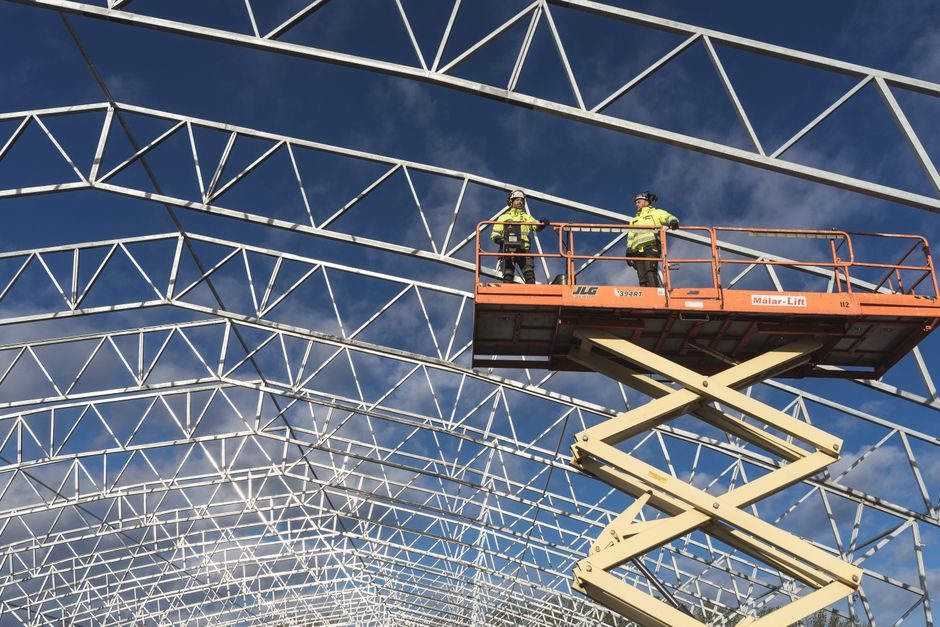
A hydraulic lift table is a scissor-geometry work-positioning platform driven by a double-acting cylinder, with stationary capacities typically ranging 500 lb (227 kg) for light carts to 5,000 lb (2,268 kg) for pallet-feed stations [S1][S2].
The DirectIndustry catalogue indexes 462 hydraulic-lift-table products across 90 manufacturers as of May 2026, confirming a mature multi-vendor market where buyers compare on published spec sheets rather than on bespoke engineering [S1]. For a process engineer, the selection is a five-variable problem: load, stroke, lowered height, scissor count, and duty cycle, and the wrong call on any one of them voids the others.
Load Class and Capacity Derating
Stationary single-scissor units cluster in the 1,100 lb (499 kg) class, as shown by the Lift Products Guardian series with 1,100 lb rated capacity and 8-9 in lowered height [S2]. Manual double-scissor carts in the consumer/prosumer tier commonly publish 500 lb (227 kg) ratings, with 50 in (1,270 mm) platform length and a $308.99 retail price point for entry-level units [S4].
For loads above 4,000 lb, fixed multi-scissor or heavy-duty tables (e.g. Morello PE 30/X heavy-load line) are the appropriate match, and these typically require in-floor mounting to absorb the bending moment that an above-floor frame cannot resist long-term [S1]. Derating the published capacity by 25% for dynamic or offset loading is standard procurement practice, even though the OEM plate is a static figure [S2].
Stroke, Lowered Height and Lifting Range
Stroke length is the second hard spec: the Guardian line offers 23.25 in, 31.5 in, and 39.38 in strokes paired with 31-48 in lifting heights, giving three distinct working-window options in one product family [S2]. Lowered height drives pit-vs-surface decisions, because an 8 in lowered table fits a shallow floor recess, while a 9 in lowered unit forces a deeper excavation or a ramp approach.
Double-scissor geometry roughly doubles stroke at the cost of reduced lateral rigidity, which is why mobile 1-ton table-trucks from Chinese OEMs such as the Niuli-class platforms target 39-50 in platform heights and short-stroke (<24 in) lift duty [S3]. The hydraulic cylinder that drives the scissors is sized by bore and stroke, and its pressure rating is what limits both top speed and maximum load, not the scissor arms themselves.
Scissor Count: Single, Double, Triple
Scissor count is the primary trade-off between stroke and closed height. Single-scissor tables give 23-39 in strokes with the lowest lowered height; double-scissor units (XH-XT-XQ series) trade closed-height compactness for ~2x stroke, useful for ergonomic load-leveling at conveyor transfers [S2]. Triple- and four-scissor geometries exist for very tall lift windows (60+ in), but they add hinge slop and accumulate tolerance stack-up at full extension, so they are reserved for low-cycle applications.
The actuation package also varies: pure hydraulic (manual pump), electro-hydraulic (HW series from i-Lift), and all-electric scissor tables from Sideros Engineering, the last of which removes the hydraulic actuator entirely in favor of a screw or belt drive for clean-room and food-grade zones [S1].
Safety Compliance: ANSI vs EN 1570
Guardian-series lift tables are explicitly stated to "meet and exceed both U.S. (ANSI) and European safety standards for lift tables," with the European reference being EN 1570 for lifting tables used in service operations [S2]. Required safety features on compliant units include an aluminum safety bar that stops descent on contact, scissor-gap geometry sized to prevent finger entrapment, a check valve that locks the table if the hydraulic hose fails, and a hinged maintenance prop for safe cylinder service [S2].
For plants shipping product to the EU, the EN 1570 gate is non-negotiable; for purely domestic U.S. installations, ANSI MH29.1 (the U.S. scissor-lift-table safety standard) is the equivalent compliance line, and procurement specs should call out the specific standard, not "meets all safety standards" [S2].
Duty Cycle, Power Pack and Control
Continuous-production applications (8+ hr/day, >10 cycles/hr) need an electro-hydraulic power pack with reservoir sized for thermal dissipation, typically 1-3 kW motor with 5-10 L tank. Light-duty mobile carts use a hand-pump or foot-pump cylinder; the 1-ton Niuli-class manual table truck shown on Made-in-China ships with a hand-pump hydraulic cylinder and prices around US$180 per piece in OEM quantities [S3].
Stationary electro-hydraulic tables (HW series, BT360-2000E) integrate a 110/220 V single-phase pack, a descent-speed control valve, and a 24 V pendant for operator control [S1]. For clean-room or washdown environments, an all-electric screw-driven scissor table eliminates hydraulic oil entirely, which is why Sideros and similar vendors sell into pharmaceutical and food lines where any oil leak is a quality-event root cause.
Sourcing, Lead Time and Price Bands
Entry-level manual 500 lb double-scissor carts list at $308.99 on eBay (refurb/secondary market), versus $343.32 as the prior price, putting the consumer-tier floor near $300 [S4]. Chinese OEM FOB prices for 1-ton manual hand-pump table trucks sit near US$180 per piece for container quantities, with video-based supplier audits (Niuli, Hangzhou Qingning) the dominant vetting channel on Made-in-China [S3].
North-American OEM stationary tables (Lift Products, Advance Lifts, Air Technical) sit in the $2,500-$8,000 band for 1,000-2,000 lb capacity, and European units (Morello, Sideros, ADE-WERK) typically price 15-25% above that for equivalent spec, justified by EN 1570 documentation and CE marking [S1][S2]. When comparing quotes, normalize on: (1) capacity, (2) stroke, (3) lowered height, (4) compliance mark, and (5) power-pack warranty; skip the marketing copy and grade the data sheet.
Selection Comparison: Manual vs Electro-Hydraulic vs Electric
Manual hand-pump carts win on price (US$180-300), lose on cycle rate (max 6-8 lifts/hr operator-fatigue-limited) and on any load above 1,000 lb [S3][S4]. Electro-hydraulic stationary tables are the default industrial choice: 1,100-5,000 lb capacity, 23-39 in stroke, 110/220 V single-phase power, and EN 1570 / ANSI compliance in one package [S1][S2]. All-electric scissor tables cost 30-50% more than electro-hydraulic equivalents but remove hydraulic oil from the work cell, which is decisive for food, pharma, and clean-room buyers.
For a procurement decision, the most common failure mode is over-spec'ing capacity (buying a 5,000 lb table for a 1,200 lb steady-state load) and under-spec'ing lowered height (forcing a deep pit where a ramp would do), both of which add cost without ergonomic benefit. Match the linear guide on sliding-top accessories to the table's scissor cycle, and confirm the hydraulic motor duty rating on the power pack against the actual lifts-per-hour profile, not the nameplate.
For comparison logic on adjacent equipment classes, the skid steer loader selection guide and track loader selection guide apply similar rated-operating-capacity vs machine-weight reasoning, useful if the lift table is being specced for machine-loading duty. Track three signals before purchase: (a) confirm EN 1570 or ANSI MH29.1 documentation by document number, not by supplier letterhead; (b) request the scissor-arm steel grade and hinge-pin hardness; (c) verify check-valve burst pressure is rated above the relief-valve setting, so a hose failure cannot bypass the safety lock [S2].