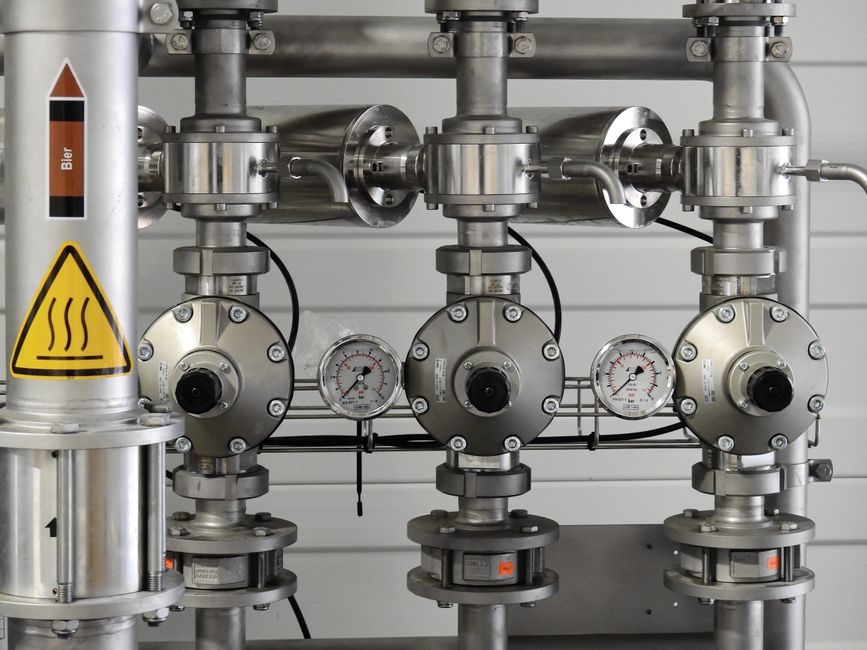
Specifying a hydraulic valve in 2026 starts with five numbers: maximum working pressure, nominal flow (L/min or GPM), port thread standard, actuation type, and media compatibility. The DirectIndustry hydraulic check-valve category now indexes 190 products across 74 manufacturers, a useful proxy for how fragmented this market is when you compare options [S1]. RS lists hydraulic valves filtered on maximum operating pressure, maximum/minimum operating temperature, connection thread standard, and number of ports as primary selectors [S7].
For mobile and industrial machinery the common pressure bands are 210 bar (3,000 psi), 350 bar (5,000 psi) and 420 bar (6,000 psi); the upper band matches the 5,100 psi dry-break flat-face couplings RS ships with 1/2 in BSP, UNO or ORFS threads, confirming where the real-world ceiling sits on standard catalog parts [S3]. Directional-control valves and manifold blocks dominate the bill of materials — Longli Hydraulic's catalog illustrates the spread from LL003-2L aluminum lifting blocks up to LL265 solenoid directional manifolds with emergency manual override [S4].
Pressure Class, Duty Cycle and Proof-Test Margins
Working pressure is set by the system relief setting, not the pump's nominal rating, and the valve's proof pressure is typically 1.5× to 2× working. Spec sheets in this class generally offer 210 bar, 350 bar, and 420 bar options, with burst ratings several times working — check the manufacturer's individual data sheet, since the ratio is not standardised across makers [S7]. Cycle life on solenoid directional valves runs 1 million to 10 million cycles depending on spool type, with wet-armature designs typically outlasting dry-armature at high cycle rates.
Duty cycle for solenoid valves is given as ED (Einschaltdauer) — typically 100% continuous, 60%, or 40% — and mobile-equipment buyers should not accept a 60% rated coil on a continuous-load circuit. For proportional and servo valves, step response (ms) and null-shift under temperature swing are the more useful comparison numbers than peak flow alone.
Actuation Methods: Manual, Solenoid, Pilot, Hydraulic
Manual ball and needle valves cover low-cycle lockout and isolation duties; solenoid-operated directional-control valves (DCV) handle the bulk of automated circuits. Pilot-operated DCVs are the standard answer above roughly 25 L/min, because a small pilot solenoid can switch a much larger main spool — this is the architecture behind Longli's LL265 manifold with its integrated emergency manual lever [S4].
For proportional control of flow or pressure, proportional solenoids with PWM drivers replace on/off solenoids, and servo valves add closed-loop spool feedback for sub-millisecond response. A common 2026 sourcing mistake is treating a proportional DCV as a drop-in for a servo valve; the dynamic response, hysteresis and null leakage are an order of magnitude apart and the closed-loop control loop is not interchangeable.
Port Threads, Connection Standards and Manifold Integration

BSPP, BSPT, NPT, UN/UNF (SAE J1926 / J1453 ORFS), and metric ISO 6149 are the threads you will see on a quote sheet, and the right one is dictated by the mating fitting, not by the valve brand. RS filters stock flat-face couplings on BSP, UNO and ORFS at 1/2 in size and 5,100 psi, reflecting where most 350 bar mobile circuits now land [S3]. DirectIndustry's check-valve filter page also breaks out connection thread standard as a top-line selector, confirming that thread spec is now a first-class filter rather than a footnote [S1][S7].
Manifold-integrated DCVs (sectional or CETOP/NG6 / NG10 / NG16 / NG25 patterns) eliminate the tubing between valves and reduce leak paths — see the parallel logic for hydraulic valve selection in mobile and press circuits. For sub-plate or inline mounting, body material (carbon steel, ductile iron, stainless) drives both pressure rating and corrosion resistance, which leads into the media question.
Media Compatibility: Petroleum, Synthetics, Water-Glycol, Fire-Safe
Mineral oil (ISO VG 32, 46, 68) remains the default hydraulic fluid, but water-glycol (HFC), synthetic esters, and even water (HFA / HFB) appear in mining, marine, and fire-risk applications. Seal material must follow the fluid: NBR (Buna-N) is fine for mineral oil to roughly 80 °C; FKM (Viton-class) extends to roughly 200 °C and resists a wider chemical set; EPDM is required for water-glycol and phosphate-ester fluids. Body material escalates from carbon steel to ductile iron, then 304/316 stainless for corrosive media — see the stainless segment on Made-in-China, where hydraulic stainless valves are quoted from roughly US$39 to US$119 per piece at MOQ 1 [S5].
Fire-resistant fluids (HFD-R synthetic esters, HFC water-glycol) require EPDM seals and may de-rate the valve's pressure class by 10–20% versus mineral oil; this is where datasheets diverge the most and the manufacturer's fluid-compatibility table, not the catalog cover, governs the spec.
Valve Type Decision Matrix: Check, DCV, Flow, Pressure, Relief

Buying by function is faster than buying by brand. Check (non-return) valves block reverse flow and are the simplest, cheapest part of the bill — DirectIndustry indexes 190 SKUs from 74 makers in this one category alone [S1]. Directional control valves (DCV) route flow between actuator ports and come in 2/2, 3/2, 4/2, 4/3 and 6/3 configurations; solenoid, pilot, manual and hydraulic actuation are all available in this family [S4].
Flow-control valves (throttle plus check) set actuator speed; pressure-control valves — relief, sequence, reducing, counterbalance — set and limit system pressure. Compare options on four criteria: (1) max working pressure (210/350/420 bar band), (2) max flow at rated pressure-drop, (3) actuation voltage and wattage for solenoids, (4) seal/fluid compatibility. Choosing across all five valve functions from one maker simplifies spares and warranty but can lock you into higher unit cost, which is the same trade-off pattern we see in Industrial Gear Buying Guide 2026 when rationalising the supplier list.
Failure Modes, Standards and Sourcing Levers
The three failure modes that dominate field returns are spool sticking from contaminated fluid (fix: filter to ISO 4406 18/16/13 or better, plus a 25 µm suction strainer), solenoid coil burn-out from voltage spikes (fix: use a suppressor diode or MOV across the coil), and seal extrusion at high pressure (fix: specify back-up rings on NBR/FKM seals above 350 bar). Industry standards to anchor the spec sheet include ISO 4401 for DCV mounting interfaces, ISO 7241 for quick-connect couplings, ISO 4406 for fluid cleanliness, and ASME B16.34 for valve design and testing. [S1]
Sourcing levers that move price in 2026: order with port thread, voltage, and seal material locked in the RFQ so quotes are comparable; consolidate by family to hit tier discounts; buy bodies in carbon steel and upgrade to stainless only where the fluid or environment forces it; for prototype runs of 1–10 pieces, Made-in-China's MOQ-1 offering at US$39–119 is workable for stainless hydraulic valves [S5]. For volume mobile-equipment runs, Chinese makers such as Longli ship manifold blocks and DCVs in volume with custom port patterns [S4]; for higher-mix industrial panels, Rekith Hydraulics and the broader DirectIndustry list of 74 check-valve makers give a benchmark for delivery and price [S1][S2].
Trackable signals to watch through the rest of 2026: port-standard harmonisation between ISO 6149 metric and SAE J1926 / J1453 ORFS on new 420 bar mobile platforms, growth in proportional-valve share of the DCV market as electrohydraulic actuation replaces on/off, and ongoing cost pressure on stainless hydraulic valves as 304/316 body pricing fluctuates with nickel. A practical next step is to lock pressure class, port thread, and seal material in the RFQ, then shortlist two or three makers from the 74-vendor DirectIndustry index rather than running a wide-open tender [S1].
For component-level specifications, see linear guide, and crossed roller guide.