
An IBC tote in the 275-330 gallon (1,040-1,250 L) range is the workhorse container for e-commerce fulfillment, chosen because it sits between 55-gallon drums and full bulk tankers and still moves on a standard forklift [S3][S6].
Three material families are actually specified on a fulfillment floor: HDPE rigid totes, HDPE-insert-in-galvanized-cage composites, and stainless steel IBCs; the right pick depends on whether the product inside is water-based, solvent-based, flammable, or a regulated dangerous good [S1][S3].
Capacity, Footprint, and Why 275 vs 330 gal Matters in a DC
Plastic IBCs are commonly stocked in 275 and 330 gallon (1,040 and 1,250 L) sizes, while stainless steel models span 350 to 793 gallons, so the e-commerce planner is really choosing between two HDPE sizes plus a stainless option for hot or flammable product [S2][S3][S6].
The 275 gallon unit (roughly 48 in × 40 in footprint, ~46 in tall) is the size that stacks cleanly on standard GMA pallets and fits two-up in a 48-inch-trailer cross-section, which is why most 3PL warehouses default to it [S2]. For high-velocity SKUs (bottled liquids, cleaning chemicals, cosmetics, liquid supplements), 330 gallon is the better $/gal; for slow-movers and hazmat, 275 gallon usually wins on handling safety [S2][S6].
HDPE vs Composite vs Stainless: Decision Criteria Compared
HDPE rigid totes are lightweight, corrosion-resistant, and the lowest-cost option for non-flammable, food-contact, and general-purpose liquids, with the standard inner bottle blow-molded from high-density polyethylene [S1][S3]. Composite IBCs pair that same HDPE bottle with a galvanized or stainless steel cage, which adds drop protection, stacking strength, and compatibility with most UN/DOT performance tests required for transporting hazardous materials [S1][S5]. Stainless steel IBCs (commonly 304 or 316L) are the right answer for flammable solvents, high-purity ingredients, and any application where temperatures or chemical resistance exceed HDPE's envelope, at the cost of roughly 3-5x the per-unit price [S1][S3].
For e-commerce ops, the practical decision matrix is: HDPE if the product is water-based and non-hazmat, composite (HDPE + cage) if the product is a Class 3 flammable or corrosive that still ships in a UN-rated package, and stainless only when temperature, purity, or repeated wash-down cycles rule plastic out [S1][S3][S5]. Reference specs for adjacent fluid-handling equipment appear in the industrial valve and flow meter encyclopedia entries, since IBC discharge valves are the most common leak point in a DC.
Forklift Entry, Valve, and Connection Specs That Actually Matter
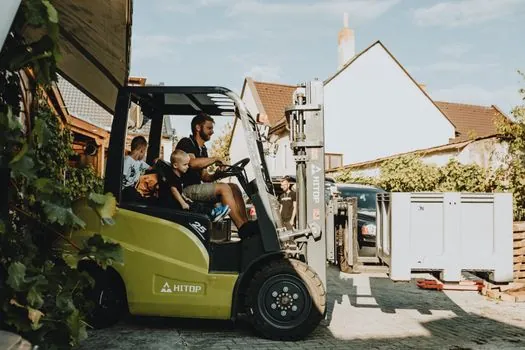
Most rigid IBCs share the same structural logic: inner vessel, pallet-style base, top fill opening with a threaded or bolted cap, and a bottom discharge valve, with forklift entry either two-way or four-way [S5].
Four-way fork entry is the non-negotiable for any high-throughput fulfillment operation, because two-way pallets force the operator to approach from a single direction, which kills slot density and slows every pick. The standard discharge valve is a 2-inch NPT or buttress-thread ball valve on a 2-inch outlet, and that size has to match the pump, hose, and batching skid spec, otherwise transfers slow down and spill risk climbs [S5]. For operations dosing into smaller e-commerce units (16 oz, 32 oz, 1 gal), a 2-inch valve with a 1-inch reducer and a drum-filler wand is the typical configuration. Related handling spec for solids, where liquid IBCs are not appropriate, is covered in the tank container reference page.
UN/DOT Certification, Stack Loads, and E-Com Hazmat Shipping
Rigid IBCs used for transport are tested and certified as complete systems, tank plus discharge components, under UN performance packaging standards, and the same UN-rated units are what the e-commerce warehouse needs for any flammable, corrosive, or toxic SKU that ships via ground or air [S5].
The relevant certification markings (UN 31A/Y or 31H/Y for the common 1,040 and 1,250 L composite designs) cover stacking, drop, leakproofness, and hydraulic pressure tests, and any IBC without that mark on the nameplate should not be used for a regulated product. Typical stack load for a UN-marked composite IBC is 4-high empty and 1-high loaded when stored in the warehouse; the rack post and beam have to be spec'd for that point load. For hazmat e-commerce, the IBC is normally paired with a top-fill cap torque spec (~20 Nm) and a tamper-evident seal, both of which are checked at the recertification interval. Related reading on UN-coded packaging patterns for dry goods appears in the FIBC bulk bag selection guide.
Cleaning, Recertification, and Lifetime Cost in a Pick-Pack Operation
Recycled and rented IBCs are common in fulfillment, with rental providers typically bundling tank cleaning, refurbishment, and recertification into the daily or monthly rate, which keeps CAPEX off the balance sheet [S3].
Service life for an HDPE composite in a clean e-com environment is typically 3-5 years with proper recertification on a 30-month cycle for hazardous use, per the UN performance packaging framework, and that timing is what drives the lease-vs-buy math for 3PLs [S3][S5]. Daily rental rates are the cheapest entry, longer terms (1-3 years) lower the per-day cost and are common for established fulfillment operations with stable SKUs. Cleaning spec for shared-pool IBCs should be traceable per batch, and the choice of cleaning agent is itself a material-compatibility question, so the IBC spec and the wash cycle have to be designed together. Adjacent spec guidance for in-house wash skids is in the tank cleaning machine encyclopedia page.
Where IBC Selection Goes Wrong on a Fulfillment Floor
The most common mis-specs in e-commerce are choosing 330 gallon where the racking is built for 275, ignoring two-way fork entry on a four-way rack, and shipping a non-UN-rated tote under a hazmat SKU because the supplier looked identical [S1][S5].
Other recurring failures: HDPE specified for a solvent that swells or stress-cracks the bottle, no reducer on a 2-inch valve so the line drips during changeover, and composite cages stored outdoors where the galvanized coating corrodes and the UN marking becomes unreadable. For a deeper look at how these same constraints play out in port and DG shipping, see the related IBC tank selection for port logistics spec guide.