IEC 61810-1:2015 is the fourth edition of the international standard for electromechanical elementary relays, valid as a consolidated text with Amendment 1:2019 and Interpretation Sheet 1 issued in January 2023 [S1][S3][S7].
Scope covers non-specified time all-or-nothing relays (the so-called elementary type, distinct from time relay and safety relay families) intended for incorporation into low-voltage equipment with circuits rated up to 1000 V AC or 1500 V DC [S1][S3].
What the standard actually covers and what it excludes
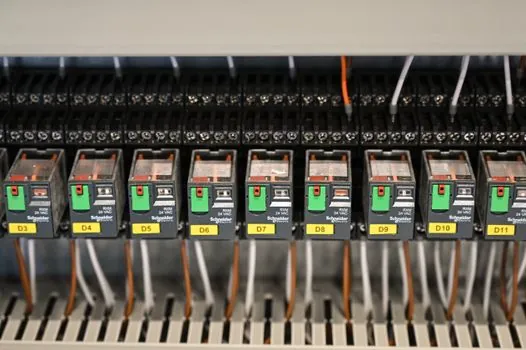
IEC 61810-1 applies to electromechanical elementary relays used in general industrial equipment, electrical machines, household and similar appliances, IT and business equipment, building automation, medical equipment, control gear, telecommunications, road vehicles, and rail transport [S1][S3]. It is the parent document for the IEC 61810 series, which drills into specific functions such as reliability, endurance testing, and even relay module packaging on printed circuit boards.
Out of scope are solid-state relays, specified-time relays (covered by IEC 61812-1 for the time relay function), and high-voltage equipment above the 1000 V AC / 1500 V DC ceiling [S1]. Protection relay assemblies for power-system switchgear follow a separate standards track and are not governed by 61810-1, even when the same electromechanical elementary relay sits on their auxiliary board.
Edition 4 (2015) technical changes worth knowing
Edition 4 introduced two parallel type-test procedures: Procedure A, which carries forward the traditional IEC regime from Edition 3, and Procedure B, which aligns with North American test expectations [S3]. The standard was structured so a single test plan can satisfy both regions, removing the historical need to run separate qualification campaigns for European and US customers [S3].
Annex D.1 was added with dedicated application tests relevant to the North American market, including fault-current performance and abnormal-condition scenarios that previously lived only in UL 508 [S3]. Edition 4 also tightened insulation requirements after endurance testing, introduced single-mounting-condition testing, and folded in the requirements from basic safety principles for electromechanical components [S3]. A consolidated Corrigendum 1 (June 2017) and Corrigendum 2 (February 2018) were later merged into the 2019 amendment text.
UL 508 to UL 61810-1 migration for North American builds
UL announced that the relay-specific requirements historically housed in UL 508 (Standard for Industrial Control Equipment) are replaced by the harmonized UL 61810-1, a US adoption of the IEC text [S2]. UL 61810-1 Ed. 1 was published on July 31, 2015, ANSI-approved on August 5, 2020, and last revised on September 3, 2020 [S4][S5].
UL 61810-1 itself cross-references fifteen UL standards, including UL 94 for flammability of plastic parts, UL 310 for quick-connect terminals, UL 746A/B/C for polymeric materials, UL 796 for printed wiring boards, and UL 840 for insulation coordination including clearances and creepage distances [S5]. UL 508 is still listed as a referenced standard for the broader industrial control equipment context in which elementary relays are embedded, but relay-specific clauses have moved to 61810-1 [S5]. For design teams who have not re-qualified, that gap is the single biggest source of audit findings during 2025-2026 factory inspections.
European adoption and CENELEC member differences
EN 61810-1:2015/A1:2020 is the European implementation, available through CENELEC member bodies and adding Amendment 1:2019 content to the base EN text [S6]. CENELEC members include Austria, Belgium, Bulgaria, Croatia, Cyprus, the Czech Republic, Denmark, Estonia, Finland, France, Germany, Greece, Hungary, Iceland, Ireland, Italy, Latvia, Lithuania, Luxembourg, Malta, the Netherlands, Norway, Poland, Portugal, Republic of North Macedonia, Romania, Serbia, Slovakia, Slovenia, Spain, Sweden, Switzerland, Turkey, and the United Kingdom [S3].
Within the IECEE CB Scheme, the IEC 61810-1:2015 reference was included in the system on January 8, 2016, with Test Report Forms IEC61810_1D and IEC61810_1E driving multi-country acceptance [S3]. An Interpretation Sheet (ISH1:2023) was issued on January 31, 2023, resolving ambiguities that accumulated between 2015 and 2022 on test sequencing, dielectric-After-Endurance judgement, and Annex D application grouping [S7]. IEC 61810-1:2008 remains the third edition and is now obsolete for new design work, though it is still referenced in some legacy procurement documents [S9].
Comparison: Procedure A vs Procedure B vs UL 61810-1 standalone
Three qualification paths exist today, and the choice is driven by where the finished product ships:
Procedure A (IEC track): Preserves the endurance, dielectric, and mechanical sequence from Edition 3; used when the relay ships only to IEC jurisdictions, and pairs cleanly with the EN 61810-1:2015/A1:2020 European text [S3][S6].
Procedure B (North American track): Mirrors UL 61810-1 standalone requirements, including the Annex D.1 application tests; a single Procedure B plan typically satisfies both US (UL 61810-1) and Canadian (via UL-cUL dual logo) needs [S2][S3].
Dual-region build: Run a combined Procedure A plus Procedure B matrix so one design qualification produces both EN and UL certificates; this is the modern default for industrial control and industrial relay suppliers shipping globally [S1][S2][S3].
For higher-current switching in motor starters, UL 61810-1 relays are referenced inside UL 60947-4-1, and for EV-specific elementary relays the cross-reference is to UL 61810-20 Outline of Investigation [S5].
Real use cases and where the standard runs out of road
Typical conforming applications: 5 V to 240 V AC/DC coil control relays on PLC output boards, 12 V/24 V automotive signal relays on body-control modules, 230 V AC switching relays in HVAC and white goods, and 24 V DC pilot relays in machine safety control circuits (where the safety relay on top still has to meet IEC 61508 / SIL requirements) [S1][S3][S8]. Mouser's energy-market terminology guide published on November 17, 2022 still references IEC 61810-1 as the defining document for elementary-relay functional and safety baselines [S8].
The standard is not a fit for solid-state relays, time-delay relays, or for installations where a power-system protection relay needs IEC 60255-grade measurement inputs. It also assumes the relay is a sub-component: end-product type tests (e.g. UL 60947-4-1 for a contactor, or an appliance standard for a finished white good) still govern the assembled equipment, with 61810-1 only certifying the relay block inside [S1][S3][S5]. Designers specifying thermal relay overload devices should note those are governed by IEC 60255-149 / UL 60947-4-1, not by 61810-1, even though both device families use bimetallic or heater elements in similar packages.
Active CSDS proposals and the next revision window
UL's Collaborative Standards Development System has logged multiple open proposals against UL 61810-1: a CSDS proposal dated July 11, 2025, a CSDS proposal dated March 21, 2025, and a CSDS proposal dated February 20, 2026, with a UL LLC Certification Requirement Decision issued on April 22, 2025 [S5]. Two redline revisions and seven CSDS proposals have been queued against the 2015 base text over the last several years [S5].
Track these signals through the rest of 2026: any new revision of UL 61810-1 flowing from the February 2026 CSDS proposal, an update to the EN 61810-1 amendment chain from CENELEC, and any new IEC 61810-1 Interpretation Sheet beyond ISH1:2023. For related protocol-level decisions that often sit downstream of elementary relay selection in substation and industrial gateways, see IEC 60870-5-101 to 104 Protocol Gateway: Spec, Select, Deploy.