
Terminal blocks and industrial relays serve different functions inside a control panel: a terminal block is a passive, insulated wire-to-wire interface; a relay is an active, coil-driven switch. Directindustry's 2026-05-30 manufacturer index lists 126 feed-through terminal-block products across 21 companies, and the same site's 2026-05-21 screwless index lists 85 products across 16 companies, with a relay sub-classification of 1 and 3 products respectively [S1][S2].
Across the 211 indexed products, general-purpose wiring dominates: 57 of 126 feed-through SKUs and 24 of 85 screwless SKUs are tagged for "general purposes," while relay sockets and dedicated switching blocks are a small minority [S1][S2]. That ratio reflects how panels are actually built — most DIN-rail positions are termination, only a fraction are logic switching.
What a Terminal Block Actually Does
A terminal block provides mechanical clamping, electrical continuity, and circuit-isolation between conductors, with no moving parts and no coil power. Degson's 2026-06-25 product page groups its terminal-block series under "reliable transmission for different devices, flexibly suitable for different application scenarios," and the same manufacturer offers PCB plug, PCB socket, and DIN-rail/panel variants for different mounting topologies [S3].
Functional variants documented in 2026 vendor catalogues include feed-through (57 SKUs, 21 companies), screwless (24 general-purpose + relay + I/O variants, 16 companies), test-and-disconnect (3 SKUs), thermocouple (3 SKUs), switching (2 SKUs), and relay (1 SKU on the feed-through index) [S1][S2]. OMRON's XW2D slim connector-terminal block conversion units shrink mounting area by 35% versus the older 40-pole XW2B, accept round or forked crimp terminals, and support DIN-track or screw mounting with a track-locking mechanism [S4, 2025-03].
What an Industrial Relay Actually Does
An industrial relay is an electrically controlled switch — coil energises, contacts change state — packaged for DIN-rail or PCB mounting, with rated contact load (A), coil voltage (VDC/VAC), mechanical/electrical endurance (cycles), and a defined socket or pin pattern. It is a switching element, not a wire-termination device, and its terminal block interface is a sub-feature (the coil and contact pins) rather than the product itself. [S1]
Relay-vs-contactor comparison data — including spec, lifecycle, and cost bands — is laid out in our contactor vs industrial relay reference. The core point: a relay is a logic/control switch, sized for signal-level and small-load contacts, while the panel wiring around it terminates on terminal blocks.
Selection Criteria: Function First, Then Spec

Use this 4-criterion check to decide whether a position in your panel needs a terminal block, a relay, or both: [S2]
1. Function — passive wire join (terminal block) vs coil-driven switching (relay). The 2026-05-30 feed-through index tags only 1 of 126 SKUs as "relay," and 2 of 126 as "switching" — confirming the default in vendor catalogues is passive termination [S1].
2. Voltage / current class — feed-through blocks span 0 A upward with user-filtered current maxima; relay contacts are usually limited to a defined A rating at a defined VAC/VDC.
3. Termination technology — screw (default on most blocks and on the 32-point 5094-RTB32V Flex 5000 removable block, Allen-Bradley, eBay listing 2026-05-27), or screwless (push-in / spring), with 24 general-purpose screwless SKUs across 16 manufacturers as of 2026-05-21 [S1][S2][S6].
4. Mounting and density — DIN-rail/panel (Degson), DIN-rail or screw-mount slim conversion units (OMRON XW2D, 35% area reduction vs 40-pole predecessor) [S3][S4, 2025-03].
Failure Modes and Constraints by Type
Feed-through and screwless terminal blocks fail by mechanical loosening, creep, or corrosion at the clamp — not by coil burnout. Mitsubishi's ASD-BM-50A servo driver ships with a 1 m CN1 relay terminal block cable (VW3M1C13, used, listed 2025-01 on eBay), and similar integrated blocks are sold as part of a motion-system kit, not as a stand-alone switch [S5, 2025-01]. [S3]
Relays fail by contact welding (overload beyond rated A), contact erosion (endurance cycles exceeded), or coil open/short. Allen-Bradley's 5094-RTB32V is a removable, 32-point screw-input block designed for the Flex 5000 platform — when the field wiring is suspect, the block is removed and replaced, not the I/O module [S6].
Compatibility is asymmetric: a screwless push-in block cannot always accept a ring lug without a ferrule; a relay socket has a fixed pin pattern that constrains the relay series you can fit. Mixing socket families across vendors is a procurement risk; mixing terminal-block families from the same vendor is usually safe.
Where Each One Fits on a Real Panel
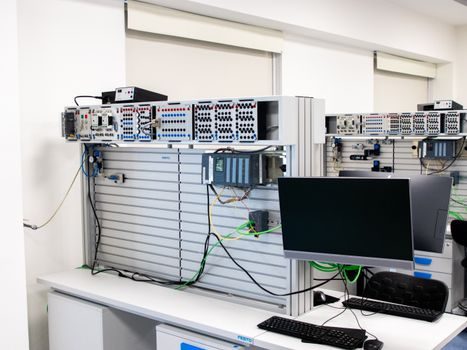
In a typical machine panel: DIN-rail positions are 60–80% terminal blocks (power distribution, signal marshalling, sensor/actuator landings), 10–20% relay sockets or industrial relays (logic, interlock, small load switching), with the remainder PLC, power supply, and breakers. The screwless index's 24 general-purpose + 3 relay + 5 I/O-module SKUs is consistent with relays being a minority, dedicated position type rather than a commodity wire-termination [S2].
For a wiring-density problem (e.g. many sensor returns), specify screwless push-in blocks with ferrule-ready clamps. For a switching problem (e.g. coil-controlled contactor interlock), specify a relay on a matched socket, and accept the wired-up terminals as part of the relay's footprint. OMRON's XW2D shows the bridging case — a connector-terminal-block conversion unit that flattens ribbon-cable wiring to a 35%-smaller panel footprint, and is neither a pure block nor a relay [S4, 2025-03].
Procurement and Sourcing Notes
As of 2026-05-30, the feed-through terminal-block manufacturer index is led by Cabur (11 SKUs), Cixi Wanjie Electronic (3), Beckhoff Automation (1), and Boot and Work Corp (1) among the named vendors; screwless is led by Autonics (5) and BEND… (truncated in the source) [S1][S2]. Degson continues to publish its full terminal-block / interface / relay / circular-connector / heavy-duty / charging-connector family from a single catalogue tree [S3].
Lifecycle parts such as the Allen-Bradley 5094-RTB32V (Flex 5000, 32-point screw, removable) flow through automation spares channels rather than the general industrial market, and the 2026-05-27 eBay listing shows the part is sold as a "remove from comparison tool"-style spare, not a new-product launch [S6]. For greenfield panels, default to a single vendor's terminal-block family and a separate, single vendor's relay family — the integration cost of mixing is higher than the unit-price saving.
Trackable signals to watch through 2026 H2: (a) any new screwless SKUs entering the 16-vendor index — a shift in the screw-vs-screwless ratio will signal a tooling change in panel building; (b) relay-socket variants appearing as their own category in the 21-vendor feed-through index rather than the current 1-SKU sub-tag [S1][S2].
For component-level specifications, see industrial adhesive.