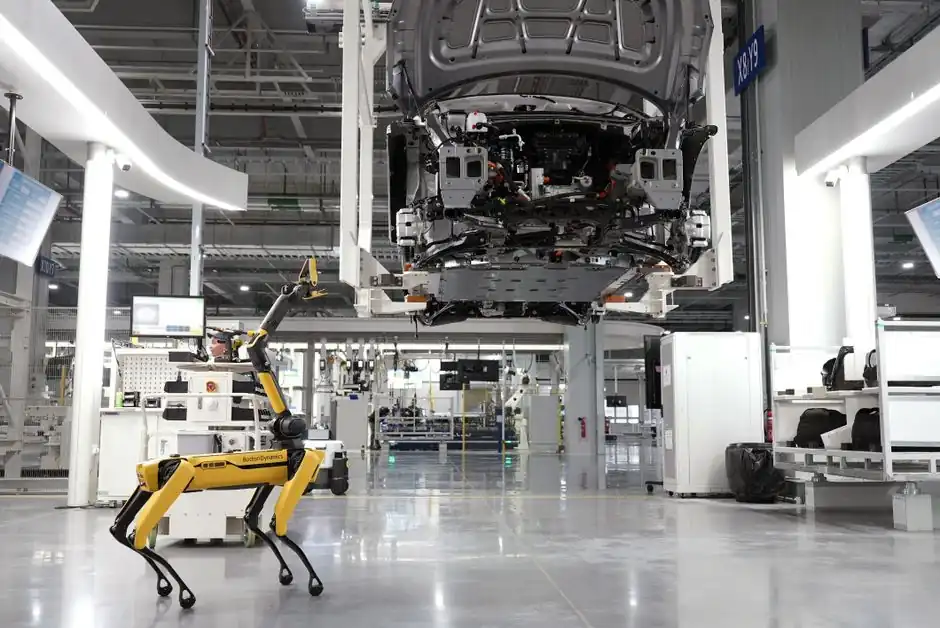
Global industrial robotics revenue is on a measured ramp: the market sat at USD 23.71 billion in 2024 and is forecast to reach USD 85.63 billion by 2034, compounding at roughly 13.7% per year between 2025 and 2034 [S6]. A separate Allied Market Research model pegs the 2020 base at USD 38 billion and projects USD 163 billion by 2032 at a 12.6% CAGR, a useful cross-check on direction even though the absolute bases differ [S3].
Concentration sits with a tight group: ABB, KUKA, Fanuc and Yaskawa dominate the heavy-payload articulated segment, while Universal Robots, Rethink Robotics, ABB, Fanuc, KUKA and Kawasaki share the collaborative-robot (cobot) field [S1]. This article lays out what each vendor cluster actually sells, where the spec bands diverge, and which application class each architecture is built for.
Market Sizing and Growth Anchors
The Zion Market Research model values 2024 global industrial robotics at USD 23.71 billion and projects USD 85.63 billion by 2034, equating to a 13.7% CAGR from 2025 to 2034 [S6]. The Allied Market Research model is more aggressive: USD 38 billion in 2020, USD 163 billion by 2032, a 12.6% CAGR over 2023 to 2032 [S3]. Both numbers point to a market roughly tripling to quadrupling over a decade, with industrial robots reframed as core automation infrastructure rather than optional capital expense.
Demand is pulled by labor cost inflation rather than curiosity. UK factory labor charges have risen by more than 12% per year, and US labor cost is estimated to climb by more than 20%, pushing plants to robotize repetitive handling tasks [S3]. North American manufacturers ordered more than 25,000 robots in 2021, up over 35% versus 2019, and the microelectronics industry, where small-payload pick-and-place units dominate, has grown by more than 10% since 2010 [S3].
Robot type selection is driven by degree-of-freedom, footprint and payload. The five standard architectures are articulated, SCARA, cartesian, cylindrical and collaborative, with payload tiers typically set at 5 kg, 5 to 10 kg, and above 10 kg for cobots [S1][S3]. For broader selection context on related motion hardware, see the industrial robot reference page.
Who Controls Market Share by Architecture
Articulated 6-axis and heavy-payload territory is held by ABB, KUKA, Fanuc and Yaskawa, all of whom sell full-stack controllers, drives and servo motors in-house. Universal Robots, ABB, Fanuc, KUKA, Kawasaki and the now-defunct Rethink Robotics are the named cobot vendors in the 2018 to 2024 tracking window [S1]. Chinese players have closed the gap on low-to-mid payload articulated arms: suppliers listed on Made-in-China include fiber-laser-cutting cells, CNC loaders and general-purpose industrial robots from factories in Shandong, signalling domestic volume capacity at price points well below European or Japanese equivalents [S4].
Component ownership is the hidden moat. RV reducers, the gear sets that determine repeatability and torsional stiffness on articulated arms, are produced by a small number of specialists, and at least one Chinese supplier, Chaifu, publicly claims a self-developed ultra-high precision RV reducer launched to market, framing it as a "Created in China" milestone for the domestic supply chain [S5]. When a vendor owns the reducer, the servo and the controller, the integration tax on the buyer is lower and the mean-time-between-failure data is tighter, which is why Fanuc, ABB and Yaskawa rarely lose head-to-head bids on automotive welding lines.
Spec Bands and Decision Criteria Across Architectures
Selection is not a brand loyalty question, it is a payload-reach-repeatability triangle. Articulated 6-axis arms dominate above 10 kg payload, especially in automotive body-in-white welding and large-parts handling, where reach extends beyond 2 m. SCARA units win at high-speed pick-and-place below 5 kg, typically on SMT lines and pharmaceutical packaging. Cartesian gantries handle long-axis material movement where stiffness matters more than dexterity, and cylindrical architectures serve niche rotary-indexed assembly. Cobots occupy the up-to-5 kg, 5-to-10 kg and above-10 kg payload bands, with safety-rated monitored stop, power-and-force limiting, and ISO/TS 15066 collaborative-mode compliance as non-negotiables for shared-workspace deployment [S1].
Compare the main options on four decision criteria:
Payload class: articulated 6-axis, 6 to 800+ kg; SCARA, 1 to 20 kg; cartesian, configurable up to several hundred kg; cobot, segmented at up to 5 kg, 5 to 10 kg, and above 10 kg [S1][S3]. Reach: articulated up to 3.1 m, SCARA typically 300 to 800 mm, cartesian custom by axis length, cobot 500 to 1300 mm. Repeatability: articulated ±0.02 to ±0.1 mm on premium units, SCARA ±0.01 to ±0.05 mm, cobot ±0.03 to ±0.1 mm. Best-fit application: articulated for welding and heavy handling, SCARA for assembly and pick-and-place, cartesian for dispensing and palletizing, cobot for mixed human-robot cells. The cobot class definition, a robot "intended to physically interact with humans in a shared workspace" and easier to operate than conventional equipment when loads between 50 and 100 kg must be handled (heavy-payload cobot sub-segment), is the direct contrast to caged industrial robots [S1].
Application Pull: Where the Volume Sits
Automotive remains the historical anchor, with arc welding and resistance spot welding driving the largest installed base of heavy articulated arms. Electronics and microelectronics are the fastest-growing application class, fueled by pick-and-place demand from cellular phone, digital camera and LCD production lines, where Cartesian and SCARA architectures dominate [S2]. Logistics is the newest growth lane: in January 2022 DHL Supply Chain committed USD 15 million to warehouse robotics, targeting lower long-term cost, higher productivity and reduced picking error, with the supply chain automation market projected to more than double by 2026 [S3].
Beyond the traditional five, food and beverage, metals, chemicals, plastics and polymers, and aerospace have all moved from pilot to production deployment [S1][S3]. In food, robots handle raw material handling, packing and quality analysis, including optics-based composition checks. In metals and machining, articulated arms with force-torque sensing take over tending of CNC cells, a task that previously absorbed a large share of skilled labor. For related factory-floor hardware selection context, the shaft coupling types and applications reference covers the misalignment and torque gates that sit downstream of any robot decision.
Standards, Safety and Sourcing Constraints
Cobot deployment in shared workspaces is gated by ISO/TS 15066 collaborative-mode requirements, including power-and-force limiting, speed-and-separation monitoring, and safety-rated monitored stop. Specifying a cobot for a human-robot cell without confirming the vendor's published biomechanical force-limit data is a procurement error, not a detail. For explosive-environment and cleanroom cells, ATEX/IECEx zone classification must be matched to the arm, the controller and the end-effector separately, and mismatches are common at integration. [S3]
Component supply is the single biggest near-term risk. RV reducers, harmonic drives, precision servo motors and absolute encoders remain concentrated in a handful of Japanese, German and a growing cluster of Chinese suppliers [S5]. Lead times for premium reducers have stretched to 6 to 12 months at multiple points in the 2024 to 2026 window, and buyers who specified single-source reducers in 2023 BOMs are revisiting dual-source strategies in 2026. For warehouse and material-handling decisions that interface with robotic cells, the stacker crane selection map is a useful adjacent reference, and the ball bearing selection guide for mining covers the duty-cycle gates that govern heavy-payload arm joints.
Who Each Architecture Is, and Is Not, For
Articulated 6-axis is for plants running high-mix welding, heavy-payload tending, or large-paint cells where reach above 1.5 m matters; it is not for benchtop assembly or shared human-robin stations where a cobot is the safer spec. SCARA is for high-speed, low-payload, vertically constrained assembly on SMT, pharmaceutical filling or small-parts packaging lines; it is not for heavy material handling or long-reach transfer. Cartesian is for linear dispensing, large-format gantry palletizing and machine-loading cells; it is not for tight, articulated motion paths. [S1]
Collaborative robots are for low-to-medium payload (under 10 kg typical, with heavy-payload cobots now reaching the 50 to 100 kg class) tasks in shared workspaces where changeover frequency and ease of redeployment outweigh raw speed; they are not for high-throughput automotive production where caged articulated arms still set the cycle-time benchmark [S1]. Chinese low-cost articulated arms, with shipping volumes documented across Made-in-China's fiber-laser and CNC-loader listings, are for cost-sensitive Tier 2 and Tier 3 suppliers who can accept longer integration cycles; they are not for OEMs under strict JIT contracts that require Fanuc- or Yaskawa-class service footprints [S4].
Robotics vendor selection in 2026 is dominated by supply chain and integration risk as much as by spec sheet. The three signals worth tracking over the next two quarters are: (1) RV reducer lead-time movement as Chinese suppliers like Chaifu scale production [S5]; (2) cobot safety incident data tied to ISO/TS 15066 biomechanical limits; and (3) the next IFR World Robotics release for the 2025 install-base numbers, which will reset the installed-base ranking and likely re-rank Chinese vendors against the ABB-Fanuc-KUKA-Yaskawa core.
Component reference pages worth checking: industrial adhesive, and industrial borescope.