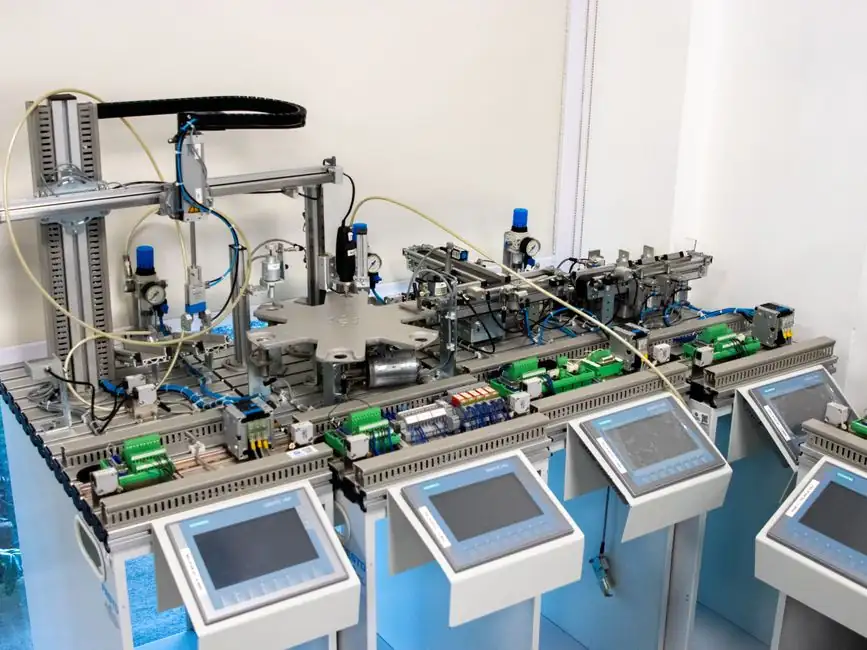
MEAN WELL, TDK-Lambda, Delta, PULS, XP Power, COSEL, RECOM, TRACO Power, Murata Power Solutions, and Advanced Energy remain the ten names buyers most often shortlist for industrial switching power supply sourcing as of 2026 [S2].
The catalog tier on offer runs from 30 W open-frame bricks at around £8.78 (RS Stock IRM-60-12ST, 12 V/5 A) up to 1008 W chassis units like MEAN WELL HEP-1000-24 at 24 V/42 A, and into multi-kilowatt 8000 W AC-DC units marketed for EV charging and electrolysis lines [S5][S6][S3].
What a switching power supply actually is, and why it spans so many form factors
A switching power supply (SMPS) is a DC source that uses a switching element, typically a power transistor, to chop the input and generate the desired output voltage, and it is the default topology in modern industrial conversion because of efficiency and weight [S1].
Common names you will see in vendor catalogs include switch-mode, switch power supply, switching mode power supply, and SMPS, all referring to the same device class [S1][S3][S9]. Compared with a linear power supply, the switched topology offers higher efficiency (commonly 88 to 94 percent at full load in the data below), smaller magnetic components, and tighter regulation across a wide AC input range of typically 85 to 264 V AC or 90 to 305 V AC [S4][S5][S6][S9]. For the architecture context behind these units, see the switching power supply entry.
Selection criteria that actually separate one PSU maker from another
Product family coverage matters more than a single model number, because the first PSU specified on a project is rarely the last: a system often moves from an enclosed unit to a DIN-rail version, then to an open-frame or configurable module, and one supplier covering all of those formats shortens the redesign cycle [S2].
Application direction is the second filter, since brands like PULS and Phoenix-style DIN-rail lines target cabinet builders, while Advanced Energy, TDK-Lambda, and COSEL are most often called out for medical, test, and precision power environments where leakage and hold-up are tightly specified [S2]. Continuity of supply, datasheet quality, and a stable part-numbering scheme become decisive once repeat orders start, because a discontinued SKU on a long-running line forces a full EMC and thermal re-qualification [S2]. For the broader category these products sit inside, see the power supply reference. Choosing purely on price typically fails on the third criterion, the mean time between failure data and the manufacturer burn-in policy: leading Asian factories quote 100 percent full-load burn-in as standard on their industrial lines [S3][S10].
Comparing the main form factors and what each one is for
Open-frame SMPS modules in the 30 to 400 W range from makers such as Starwell target integration inside customer enclosures for industrial equipment, LED lighting, communications, medical, and audio gear, and are typically certified to CE, FCC, and UL [S8]. DIN-rail SMPS units, 75 W / 120 W / 240 W / 480 W at 12 V / 24 V / 48 V, are designed for cabinet mounting and usually include short-circuit, overload, and over-voltage protection plus a built-in DC fan for forced-air cooling [S10]. Enclosed chassis units dominate the industrial mid-power tier, with examples at 800 W / 48 V from COTEK (AE-800-48) and 1008 W / 24 V from MEAN WELL (HEP-1000-24), both accepting wide-range 90 to 264 V AC or DC inputs [S5].
High-power industrial SMPS at 2 kW to 12 kW is where Chinese heavy-industrial suppliers such as Idealplusing (Guangzhou) compete, quoting 8000 W AC-DC for EV chargers, 10000 W adjustable units for laser loads, and dual 12 V / 24 V / 36 V medical-grade 2000 W SMPS with active PFC [S3]. Efficiency on these heavy units is commonly listed at 94 percent average, with the supplier's part numbers spanning 1 kW to 200 kW DC-DC and up to 500 kW DC-AC [S3]. Across the four form factors, the decision criteria line up as follows: open-frame wins on cost and integrability but loses on safety isolation, DIN-rail wins on cabinet serviceability, enclosed chassis wins on ruggedness and ingress protection (for harsher builds see industrial UPS battery-backed designs), and high-power factory modules win on voltage and current headroom for electroplating, laser, and EV charging [S3][S5][S8][S10].
Real use cases buyers are specifying for in 2026
Cabinet builders specifying 24 VDC control voltage usually pick DIN-rail SMPS at 240 W or 480 W, since the common 5 A to 20 A load of a small PLC panel is a clean match for those ratings [S10].
Industrial equipment OEMs in the 30 W to 400 W bracket commonly select open-frame or enclosed chassis units, with Starwell explicitly covering LED lighting, medical, communications, computer, and audio device end products [S8]. EV charging stations and electrolysis lines are pushing demand for 8000 W AC-DC units at output voltages such as 48 V, 60 V, 96 V, 110 V, and 150 V, all listed as standard SKUs by one major Chinese factory [S3]. For a sizing workflow that ties these wattage choices back to actual load, the Switching Power Supply Sizing and Selection Guide for 24 VDC Panels walks through the current budget and derating logic. Semiconductor fab and laboratory power sits at the precision end, where Advanced Energy, TDK-Lambda, and COSEL dominate because of tighter ripple, better line/load regulation, and documented medical or test safety approvals [S2].
Key specification ranges you will see in vendor datasheets
Output voltages cluster at 5 V, 12 V, 15 V, 24 V, and 48 V DC, with dual-output models (for example MEAN WELL RD-65B at 5 V and 24 V, 68 W) and single-output chassis units at the same voltages dominating the catalog listings on RS [S4][S6].
AC input range is most commonly 85 to 264 V AC or 90 to 264 V AC on small chassis units, expanding to 90 to 305 V AC on the HEP-1000-24 and to 127 to 370 V DC on the COTEK AE-800-48, which is useful for DC bus and battery-backed industrial applications [S5]. Efficiency figures in current datasheets sit between 70 percent on small 18 W PCB-mount bricks and 89 to 94 percent on 800 W to 1000 W enclosed chassis units [S4][S5][S6]. Operating temperature ranges are typically 0 to 40 °C for entry-level bricks and -30 °C to +70 °C for industrial enclosed supplies, and these are the derating limits to watch when mounting in unventilated cabinets [S4][S5]. The same product family can be re-used inside DC distribution for other plant equipment; the broader category is captured in DC power supply and the construction machinery and equipment reference for mobile platforms.
Standards, certifications, and sourcing realities
Industrial PSU makers typically list CE, FCC, and UL on open-frame and chassis lines, and add IEC 60601-1 on medical variants and ATEX/IECEx on specific hazardous-area lines, but those extra certifications are project-specific, not standard across the catalog [S8].
Wide-bandgap semiconductors (GaN, SiC) are increasingly the headline technology claim on Chinese heavy-industrial lines because higher switching frequency shrinks magnetics and improves efficiency above the 94 percent mark, although datasheet proof of WBG inside is still rarer than the marketing line [S3]. Sourcing channels divide into three layers: direct from the OEM factory (Idealplusing, Starwell, VOITA), through global distributors (RS Components stocking MEAN WELL, COTEK, and the IRM/RD/HEP series on regional sites in MYR, AUD, GBP, and EUR), and through regional system integrators who add warranty and traceability layers [S3][S4][S5][S6][S8][S10]. For related ecosystem coverage of Chinese supply chains in adjacent power categories, see the Battery Cell Sourcing From China: 2026 Spec And Compliance Map reference.
Limitations, failure modes, and what to derate
Entry-level PCB-mount SMPS at 18 W are typically rated only to 0 to 40 °C without derating and drop efficiency to around 70 percent, which makes them the wrong choice for any sealed enclosure above 1 m³ of internal volume [S4].
Universal-input supplies with PFC can still misbehave on heavily distorted mains or in parallel-redundant setups unless the datasheet explicitly covers current sharing, so a 1+1 redundant 24 V panel usually needs a true redundant module rather than two parallel PSU outputs [S5][S6]. Industrial buyers consistently report electrolytic capacitor dry-out as the dominant field failure mechanism on SMPS over 7 to 10 years in service, which is why brand and component traceability (not just the published MTBF number) is the more reliable indicator of long-term supply continuity [S2][S3].
Track next on: which suppliers in the 2026 shortlist publish full component derating curves at -40 °C, and how the wave of SiC-based industrial SMPS announcements from Chinese factories converts into field-proven product life beyond the 12 kW power tier. Related: grid-scale battery storage 2026 competitive landscape for DC-DC demand pull from BESS inverters.