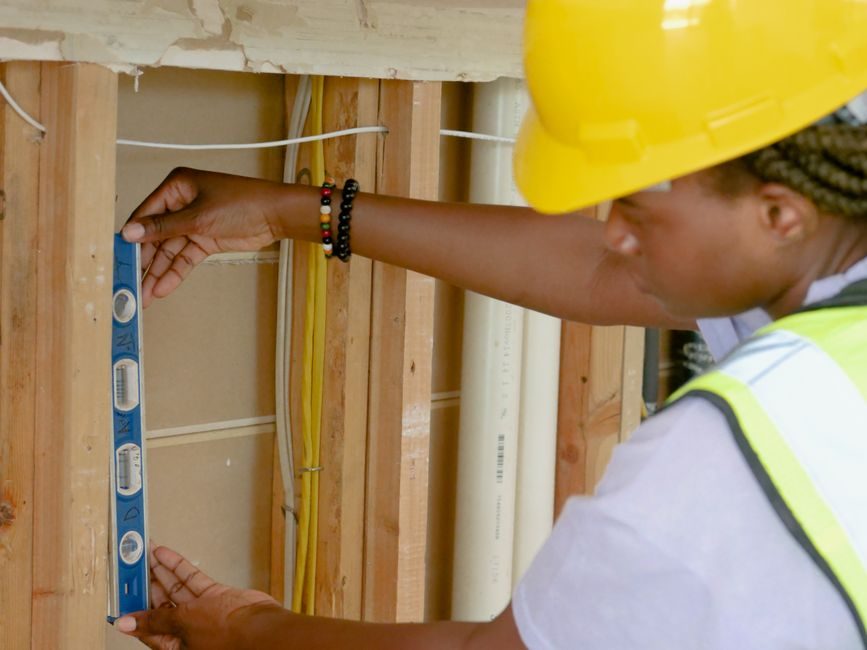
Infrared line levels for construction and interior-fitout use landed in a $23-$54/pc FOB-Ningbo price band as of mid-2026, based on 500-piece MOQ listings on Asian B2B platforms [S3].
That range covers 2-line and 3-line self-leveling rotary units with visible red or green diode sources; infrared-only models (line lasers using IR diodes for alignment where the beam itself is not visible to the eye) sit at the lower end of the band, while 3-line 360° variants with rechargeable Li-ion packs and IP54 housings cluster at the upper end [S3]. For a primer on how an infrared line level differs from a self-leveling optical/automatic level, the 2026 spec cut is the right starting reference.
Price bands and what drives them
Three procurement tiers defined the 2026 market: entry (2-line IR, plastic body, AA batteries) at $23-$32/pc; mid (3-line, 360° self-leveling, IP54, Li-ion) at $33-$45/pc; and pro (multi-line green-beam, magnetic mount, hard case) above $45/pc up to $54 [S3].
The infrared line source itself — usually an 808 nm or 850 nm IR diode paired with a cylindrical lens — is a small fraction of BOM cost; most of the price gap is optics, leveling pendulum assembly, and IP rating. For comparison data on a related instrument family, the laser distance meter 2026 price & cost guide tracks the same supplier base with overlapping spec logic.
Spec gates that gate the spec sheet
Accuracy claims cluster at ±0.2 mm/m for entry units and ±0.1 mm/m for pro units, with self-leveling range typically ±3° to ±4°; outside that range the units beep and blank the beam to flag a mis-set [S3].
Working range is the second gate: indoor line visibility is 10-20 m for red-beam and 30-50 m for green-beam; with a detector the same units stretch to 50 m and 80 m respectively. IP54 is now the de-facto floor for jobsite use — IP54 means dust-protected and splash-resistant from any direction per IEC 60529. Power is almost universally a 3.7 V Li-ion pack with USB-C charging on mid/pro tiers, and AA × 3 or AA × 4 on entry tiers [S3]. For a baseline on what these numbers mean in the field, the automatic level buying guide 2026 lays out the same accuracy and IP vocabulary for optical-automatic instruments.
Infrared vs visible-beam line lasers: who is each for

Infrared line levels are specified where the beam must not be visible to workers (camera-assisted alignment, sensor-based machine vision, photo-finishing and some film/TV production rigs) and where an IR detector or camera does the work of finding the line [S3].
Visible red or green line lasers are specified for layout, tiling, partition walls, cabinetry and ceiling-grid work, where a human reads the line by eye. Mixing the two on a jobsite causes procurement friction: an IR unit without a matched detector is functionally invisible, and a visible-beam unit cannot drive a vision system tuned to 808/850 nm. For a head-to-head on the alternative layout instrument, the infrared line level vs automatic optical level 2026 spec cut is the right contrast piece.
MOQ, payment, lead time
Standard MOQ sits at 500 pieces with a 1,000,000-piece-per-month supply capability from the major Ningbo and Shenzhen OEM lines, payment terms TT or LC at sight, and FOB Ningbo as the default incoterm [S3].
Lead time on a 500-piece OEM order runs 15-25 days for stocked SKUs and 30-45 days for custom-color, custom-logo, or private-mold runs. Sample policy is typically 3-5 sample units at cost, refundable against a PO above 1,000 pieces. For a buyer running a larger power-tool accessory procurement, the angle grinder selection 6-spec-gates guide uses the same Ningbo supplier pool and mirrors the MOQ/payment pattern.
Landed cost stack and where to push back
On a $35/pc FOB quote, the typical landed cost stack is: FOB $35 + sea freight to Long Beach or Rotterdam $0.40-$0.80/pc + 5-7.5% import duty (HTS 9015.30 for leveling instruments in the US, CN code 9015.30.00 in the EU) + 1-3% broker fee, landing most pro-tier units in the $39-$45/pc CIF range [S3].
Avoid specifying custom beam color or non-standard wavelength below 10,000 units — diode MOQ at the component level is the binding constraint, not assembly capacity.
Failure modes and what to inspect on receipt
The three most common 2026 field returns, in order: pendulum lock failure (the transport lock is not engaged, the pendulum swings during shipping, and the leveling mechanism is bent), diode degradation on green-beam units driven past 40 °C ambient, and battery contact corrosion on IP54 units stored in damp vans [S3].
For broader power-tool QA parallels, the impact drill vs sander spec cut covers the same incoming-inspection logic for adjacent categories.
For component-level specifications, see infrared thermometer, and linear guide.