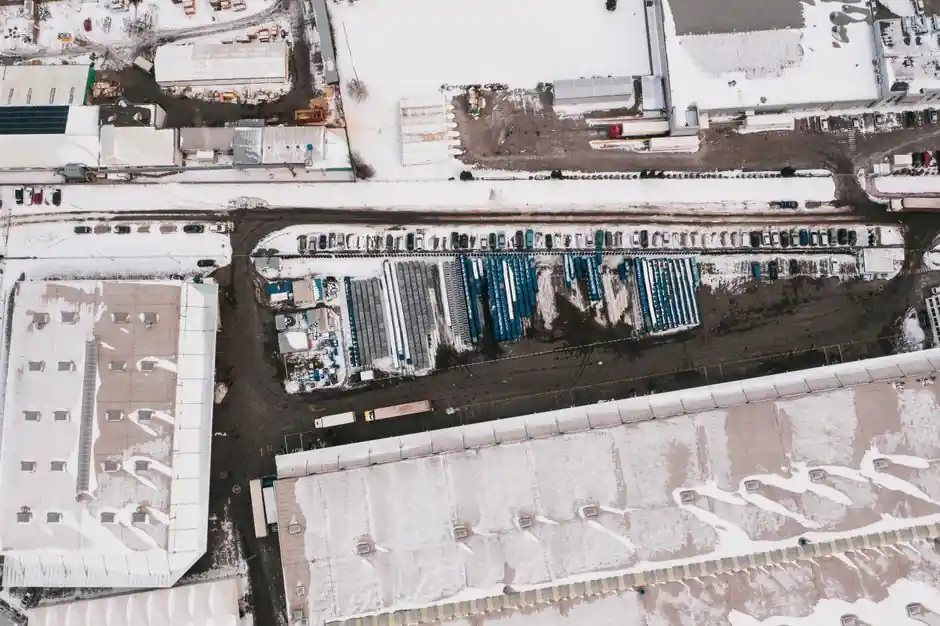
A 40ft bitumen tank container built to ISO 1496-3 / Type 70 with 65,000 L capacity (SG 0.96 at 140 °C), 0.175 MPa design pressure, and full-length heating coils is the working spec for hot asphalt delivery to road construction sites [S2].
Construction sites consuming penetration-grade bitumen, cutback bitumen, or bitumen emulsions cannot rely on ambient-temperature road tankers: below roughly 130-150 °C the cargo loses pumpability, and below 100 °C it solidifies in the line. The container spec is therefore inseparable from the tank container heating, insulation, and pressure-vessel code, and a procurement engineer must lock the cargo and the temperature window before pricing freight [S1][S4].
Why the 40ft Frame Wins for Hot Bitumen Hauls
Three ISO frame lengths dominate the intermodal fleet: 20ft (6058 x 2438 x 2591 mm shell, ~DN2380 barrel, 3700 kg tare), 30ft (9125 x 2438 x 2591 mm, ~DN2200, 5068 kg tare), and 40ft (12192 x 2438 x 2591 mm, ~DN2300, 6700 kg tare), all built to ISO 1496/3 corner-casting geometry for ship, rail, and road handling [S1]. For heated viscous service the longer barrel is not a luxury but a physics constraint: the heating-coil surface area must scale with the cargo volume, and a 20ft heated unit with insufficient coil drops below pumpable viscosity on a cold-sea voyage long before discharge, forcing costly line-flushing at destination [S1].
Henan Jushixin's 40ft bitutainer illustrates the geometry that site deliveries actually run: external 11900 x 2210 x 2390 mm, internal 11500 x 2110 x 2290 mm, 100 mm rock-wool insulation around the full shell, 100% X-ray radiographic inspection on welds, two DN500 manholes, DN80 unloading valve, and Ø60 x 3.5 mm heating tubes flanged at DN50 [S2]. The 40ft High Cube outer envelope is 12192 x 2438 x 2891 mm and total mass (MGW) reaches 60,000 kg with a 50,000 kg payload at SG 0.96 [S2].
Pressure, Temperature, and Heating Duty
Asphalt tank containers are low-pressure, high-temperature vessels, not the high-pressure T50 LPG units on the same fleet. The Jushixin design envelope is 0.175 MPa design pressure, 0.09 MPa working pressure, 0.26 MPa test pressure, 0.12 MPa airtight test, and 0.021 MPa vacuum test, with a design temperature range of -40 °C to 230 °C and 230 °C working temperature [S2]. That envelope covers hot bitumen at 140-180 °C with margin for steam-coil heating transients and bitumen-emulsion service.
Heating is delivered through Ø60 x 3.5 mm longitudinal tubes inside the barrel, flanged DN50, with quick-coupling DN80 unloading and an integral mechanical level gauge plus thermometer [S2]. Two heating architectures are common in the fleet: direct-fire (burner integrated into a dedicated fire-tube compartment, used where diesel or gas fuel is available) and electric or steam coils (used where open flame is forbidden, e.g. European road tunnels, port-side terminals, or ADR-regulated cross-border moves) [S2][S3].
Material and Lining Decisions on the Wetted Side
Most ISO tank barrels in road construction service are not the 316L stainless default seen in chemical service. Heated bitumen does not require 316L: Q235 carbon steel at 5.0 mm shell and 6.0 mm head thickness, fully welded with a 1.8 mm corrugated outer skin, is the typical construction because the cargo is non-corrosive to mild steel and the temperature window demands thermal mass over alloy cost [S2]. For food-grade or bitumen-emulsion service where stainless is specified, the default is 316L over 304 to survive chloride-bearing CIP detergents and weld-seam pitting across repeated cleaning cycles [S1][S4].
Lining choice controls the permissible next-cargo list and the depot turnaround time. A rubber-lined carbon-steel barrel will not see bitumen service: rubber linings blister above roughly 80 °C and are reserved for HCl below 38% and ferric chloride at ambient temperature [S1]. For bitumen, the practical surface treatments are bare carbon steel with periodic inspection, zinc-silicate or epoxy-phenolic coatings for fuel/lube cross-haulage, and PTFE/PFA liners only on multi-product units that alternate aggressive solvents with hot bitumen [S1].
Compliance Pathways: IMDG, ADR/RID, and CSC Together
Hot bitumen is regulated as a dangerous good at sea under IMDG Code Chapter 4.2 (elevated-temperature liquid, UN 3257) and as a road/rail dangerous good in Europe under ADR/RID, so the same physical tank must carry three independent approvals to move on a true door-to-door intermodal run [S3]. CSC (Container Safety Convention) approval is mandatory for stackability and corner-casting integrity; ISO 1496-3 and ISO 668 frame dimensions are the geometry enablers for ship cell guides, rail wagon pockets, and road chassis twist-locks [S3][S4].
Tank codes under the IMDG Code Chapter 6.7 (T1-T22 for liquids, T50 for refrigerated liquefied gases, T75 for cryogenic, T70 for non-refrigerated gases) are selected on UN number, MAWP, and design temperature before any steel is cut [S1]. A bitutainer carrying hot bitumen is typically marked T3 / T4 or, where elevated-temperature substance rules apply, flagged as UN 3257 with a temperature-control certificate; the T-code and the ADR/RID approval must agree, otherwise the unit is legal on one mode only and has to be transhipped at the port [S1][S3]. For procurement comparing units across vendors, the published datasheet must show the IMDG portable tank instruction (T-code), the ADR tank code (e.g. AT for atmospheric), and the CSC approval number [S3][S4].
Bitumen Logistics: Decision Map for the Buyer
Three decision axes separate a working bitumen spec from a depot-bound white elephant: cargo temperature window, voyage duration and ambient profile, and the multimodal chain the unit must clear. The comparison below lines up the main heated-container options road-construction buyers see in 2026 against the four criteria that actually drive acceptance or rejection at the gate. [S1]
20ft heated bitutainer (T-code with electric or steam coils, ADR/RID approved): capacity roughly 21,000-26,000 L at SG 0.96, shorter heating-coil surface area, lower payload per lift, best fit for short-haul urban plant deliveries under 4 hours where heat loss is manageable, often used by construction machinery and equipment fleets running a road roller and paver chain on the same site [S1].
40ft heated bitutainer, direct-fire (Type 70, ISO 1496-3, Lloyd's approved, 65,000 L at SG 0.96, 100 mm rock-wool, Ø60 heating tubes, 0.175 MPa design, 230 °C working): the default for cross-sea hot bitumen haulage and long overland runs in mild climates where open-flame heating is permitted, lowest cost per litre carried, but heavier tare at 10,000 kg curb weight reduces payload on weight-restricted road networks [S2].
40ft IMDG / ADR Bitutainer with electric heating and 50 mm high-performance insulation (TEC Bitutainer range, 2026 lightweight soft-clad variant): same 40ft geometry, lower tare from the soft-clad redesign, integrated electric heating eliminates the fire-tube compartment, ADR/RID and CSC dual-approved, the default for European and UK road distribution, and the unit that satisfies both sea-leg and road-leg without repackaging [S3].
For most road-construction EPC contractors, the decision collapses to two: a 40ft direct-fire unit (lowest cost per litre, sea-leg capable) for warm-climate projects where the road leg is short, or a 40ft ADR Bitutainer with electric heating (higher unit cost, broader regulatory reach) for European projects with cold winters and strict tunnel/restricted-area rules [S2][S3].
Selection Gate Stack for a Hot-Bitumen ISO Tank
The first gate is the cargo list: penetration grade, viscosity grade, or emulsion, and the corresponding UN number and required T-code. The second gate is the specific gravity at loading temperature (bitumen grades cluster between SG 0.95 and 1.04 at 140-180 °C) and the maximum payload the chassis and bridge laws allow on the delivery route. The third gate is the heating duty: direct-fire, electric, or steam, and the available power source at the loading terminal and the discharge gantry [S1][S2][S3].
The fourth gate is insulation thickness: 50 mm high-performance insulation covers temperate European winters on short road legs, while 100 mm rock-wool is the practical floor for ocean voyages and continental overland runs in cold climates [S2][S3]. The fifth gate is the lining and cleanability for the next-cargo list: bitumen-only fleets can run bare carbon steel, while multi-product fleets need a coating system that is also food-grade or chemical-grade compatible [S1]. The sixth gate is the certification stack: CSC, ISO 1496-3 frame, IMDG portable tank instruction, and ADR/RID tank code must all be present and current on the nameplate [S3][S4]. The seventh gate is the support kit: manhole size, valve size, level gauge, thermometer, and quick-coupling standard (DN80 is the de-facto fleet standard for bitumen) [S2].
Limits, Failure Modes, and Common Procurement Errors
The most expensive bitumen-spec mistake is undersizing the heating coil surface for the voyage profile: a 20ft heated unit deployed on a 14-day sea leg plus a 3-day European road leg will arrive solid, and depot hot-boxing plus line-flushing is more costly than the price difference between a 20ft and a 40ft unit [S1]. The second mistake is specifying 304 stainless where 316L is required for any bitumen-emulsion service that alternates with chloride-bearing CIP: chloride pitting at the weld seam forces a full-barrel reline, not a patch [S1][S4].
For road-construction buyers comparing 2026 construction tools and plant on the same procurement package, the working signal is that ADR/RID + electric heating is becoming the default European bitumen tank, while the lightweight soft-clad IMDG variant launched in 2026 is the unit to watch for any fleet that wants to drop tare weight without dropping insulation performance [S3]. Verification step before order: confirm the T-code on the nameplate matches the UN number of the bitumen grade, confirm the ADR tank code is current to the latest applicable ADR edition, and confirm the CSC plate has not expired.
For related coverage, see Welding first aid kit selection: ANSI Z308.1, CSA Type 2, and container choice.