
Pipeline right-of-way work in 2026 converges on a tight spec envelope: 3.0-5.0 t rated capacity at 600 mm load center, 4WD with locking differentials, 350-500 mm ground clearance, 405 mm 12-ply flotation tires, and a triplex mast reaching 6-7.5 m to clear stringing trucks and skids [S2][S3][S7].
For trenching support, pipe-string handling, sand-bag pallets, and rig mat staging, the rough terrain forklift Class VII platform outperforms both Class V pneumatics and warehouse sit-downs because of gradeability (25% laden, 40% empty) and off-road suspension that does not require a graded haul road [S2][S3].
Pipeline right-of-way load profile and the rated-capacity gate
Pipeline construction moves a predictable load spectrum: 2.0-2.5 t palletized sand bags, 1.5-3.0 t pipe joints on stringing skids, 3.0-4.5 t HDD drill-steel bundles, and 4.0-5.0 t concrete-coated pipe sections or pump skids. Rated capacity must be selected at the OEM's published load center (typically 600 mm), not at the fork face, because a 3 m pipe joint shifts the center of gravity 300-500 mm forward of the standard pallet LC and derates capacity 15-25% [S2][S7].
Specifying below 3.0 t is a recurring mis-buy on pipeline spreads: the unit cannot lift a 4 t HDD reamer crate or a coiled tubing reel cradle, forcing a telehandler or crane onto the spread and doubling the equipment bill. The 3.0-5.0 t window covers roughly 90% of pipeline right-of-way lifts without crossing into a telehandler envelope, and it matches the JCB 930 (3.0 t at 5,780 kg operating weight) and JCB 940 (4.0 t) baseline units offered with 55 kW Stage V diesel [S4].
Drivetrain, tires, and ground-clearance gate
Right-of-way gradients run 6-12% on established spreads and 20-40% on cross-country and HDD approaches, with side-slope exposures of 15-25% near trench walls. A Class VII straight-mast with full-time 4WD, locking front and rear differentials, and an oscillating steer axle (±8°) holds 25% gradeability laden and 40% empty, versus 12% for a Class V pneumatic [S2][S3].
Tire selection is the second gate: 405 mm (16-inch) flotation, 12-ply, with 350 kPa max inflation, on a 2.4-2.8 m wheelbase, gives the contact patch and ground clearance to cross a 300 mm rut without high-centering. The Dingjoin CPC-35C to CPC-60 series uses 20.5/70-16 up to 12R22.5 tires across its 4.5-7.5 t band, with 260-320 mm minimum turning radius and 30-40 km/h roading speed for spread-to-spread moves [S1]. Ground clearance should sit at 300-500 mm; below 300 mm the unit will hang on skids and reamer crates, above 500 mm the center of gravity rises and the load chart derates faster on side slope [S3].
Mast, reach, and lift-height gate
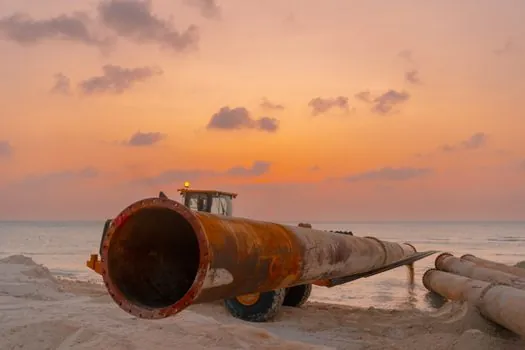
Pipeline work rarely needs more than 7.5 m of lift. Truck-bed offload is 1.3-1.5 m, double-stacked pipe cradles run 3.0-3.5 m, and HDD drill-steel rack loading peaks at 6.0-6.5 m. A 6 m duplex mast covers 80% of right-of-way duty; a 7-7.5 m triplex is the upper bound, with a closed height under 2.6 m so the unit can pass under pipe-rack gantries and low-crossing utility spans [S2][S7].
Beyond 7.5 m, the right tool is a telehandler, not a forklift, because a vertical-mast rough terrain with a 12 m triplex loses forward stability and requires a 5-6 t chassis that no longer fits a 4 m right-of-way access. Fork tilt of -10° to +6° and optional ±100-150 mm side-shift are the two mast features that materially speed pipe-handling cycle times, and they are standard or option on the JCB 926/930/940, the Dingjoin CPC series, and most Chinese OEM units in the same class [S1][S3][S4].
Engine, emissions, and fuel-logistics gate
Pipeline spreads run 8-10 hour shifts in remote areas with no shore power, so diesel remains the default. Stage V / EPA Tier 4 Final / Euro VI engines in the 55-110 kW band cover the full 2.5-10 t envelope; below 56 kW (75 hp) the engine typically escapes the after-treatment requirement, which simplifies field service but caps lift capacity at roughly 3 t [S2][S4].
JCB fits the same 55 kW (74 hp) Stage V DIESELMAX across the 926, 930, and 940 RTFL, claiming 8% lower fuel burn and 10% more torque (440 Nm) than the prior non-Stage V engine, with Autostop and gravity mast lowering to cut idle hours [S4]. On the heavier end, the Dingjoin CPC-60 ships a 110 kW diesel with 7.5 t rated load and 40 km/h roading speed for mainline spreads with longer inter-camp moves [S1]. Fuel burn lands at 6-7 L/h for a Class VII in real work, versus 3.5 L/h for a Class V, so 5-year total cost of ownership comparisons must use hours, not acquisition price, as the denominator [S2].
Class V vs Class VII vs telehandler: a 4-criteria comparison for pipeline spreads
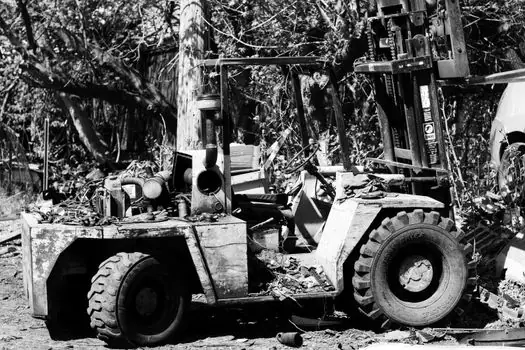
The four realistic platforms for a pipeline right-of-way line up on the four spec gates as follows [S2][S7]:
Rated capacity at 600 mm LC: Class V diesel 3-10 t, Class VII rough-terrain 2.5-5 t (with overlaps to 10 t in heavy chassis), telehandler 3-5 t at 3 m reach dropping to 1-2 t at 12 m height, electric yard forklift 2.5-3.5 t (not viable off graded surface). Max grade laden: Class V 12%, Class VII 25%, telehandler 20%. Vertical reach typical: Class V 6 m, Class VII 6-7.5 m, telehandler 6-14 m. Off-road tires/clearance: Class V 300-400 mm ground clearance with pneumatic tires, Class VII 350-500 mm clearance with 405 mm 12-ply flotation, telehandler 4WD with similar envelope but longer wheelbase. Acquisition premium: Class V is the cheapest per rated kg, Class VII typically 20-40% above Class V, telehandler 2-3x a straight-mast rough terrain [S2][S7].
For pipeline work, the matrix collapses to a single rule: a Class VII straight-mast in the 3-5 t band for any lift under 7.5 m on unprepared ground; a telehandler only when horizontal reach or 8-14 m vertical reach is required. The same logic is why rough terrain forklifts in Saudi oil and gas fields have displaced conventional handlers on desert spreads, where soft sand and 45°C ambient punish standard pneumatics [S8].
Standards, safety, and operator-protection gate
Pipeline right-of-way work sits under OSHA 1910.178 for powered industrial trucks, and Class VII units must carry the manufacturer-rated data plate, load chart, and operator manual on board. The serial number on the data plate is the legal anchor for the rated capacity at the stated load center, and any side-shift, fork tilt, or attachment change re-rates the truck [S2][S10].
Modern Class VII cabs include ROPS/FOPS as standard, with IP65-sealed electrical components for dust and water resistance, cold-start capability down to -25°C, and high-heat operation to 45°C, which covers most desert and winter pipeline spreads without derating [S3]. Operator-presence sensing and a hydraulic isolation switch are now standard fitments on JCB IndustryPlus and IndustryPro trims, and JCB Livelink telematics is fitted from the factory for fleet tracking, idle-hour reporting, and geofencing on multi-spread projects [S4]. Load-capacity indicators (LCI) and overload protection, combined with ROPS/FOPS, are the four non-removable safety items on a 2026-spec RTFL bid; anything less is a flag to question the supplier's build sheet [S3][S4].
Limits, failure modes, and when not to specify a straight-mast
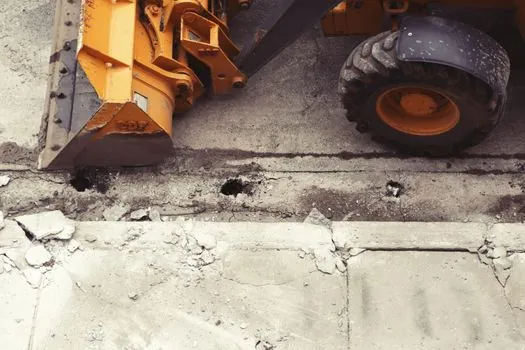
A Class VII straight-mast fails on three pipeline tasks: placing a 12 m pipe section over a trench wall (needs a telehandler or side-boom crane), working inside a 4 m diameter tunnel or caisson (the 2.4-2.8 m wheelbase and 2.6 m closed height will not clear low-headroom bores), and operating on finished concrete slab inside a compressor station where an electric counterbalance is quieter and emission-free [S2][S7].
Within its envelope the unit's main failure modes are tire cuts from reamer crates and weld-spatter slag, hydraulic contamination from dust ingestion through breathers, and load-chart derate surprises when operators pick up a 4 t load at 800 mm LC without reading the chart. Specifying a 5-year/10,000-hour service interval, daily ground-level checks (the JCB bonnet design supports this from both sides), and 500-hour engine oil changes keeps the operating cost inside the modeled band [S3][S4].
Trackable signals to watch in the next procurement cycle: OEM publication of Stage V fuel-burn curves for the 55 kW and 110 kW classes, and any update to OSHA 1910.178 operator-certification language affecting rough-terrain units on public right-of-way crossings. Buyers specifying Q1 2027 pipeline spreads should also confirm whether the supplier's cab option includes the 360-degree LED lighting array, which materially improves night-shift safety on HDD tie-in work [S4].
The underlying component specifications are covered under pipeline pump.
See also our earlier report, Aluminum Ladder Selection for Plumbing Installation: Spec Map.