
Linear actuators convert motor, hydraulic, pneumatic, piezo, or electromagnetic input energy into controlled straight-line motion, and the 2026 industrial market organises them into six functional drive classes [S7]. Force ranges span from sub-gram nanopositioning stacks to 20 kN hydraulic cylinders operating at 210 bar (3045 psi) [S1].
Specifying one is a force-stroke-speed-environment exercise, not a brand exercise; vendors such as Thomson, Oriental Motor, NB, Assun, KNR, and Baumeister & Schack all publish the same decision dimensions with overlapping but rarely identical envelopes [S1][S2][S3][S4][S6][S8]. The article that follows maps the six drive classes, lines up their typical operating envelopes, and gives the engineer a decision matrix for picking one.
Six drive classes: how energy source shapes the envelope
Linear actuators are classified first by input energy: electric, hydraulic, pneumatic, mechanical (screw / lead-screw / cam), piezo, and electromagnetic, with each class setting the force, speed, stiffness, and environmental envelope before any mechanical detail is chosen [S7]. Electric actuators dominate the 24 V DC factory-automation market, with DC stepper-driven units like the Baumeister & Schack Koax D delivering 800–1,200 N at 8–35 mm/s across a 272–317 mm stroke from a 1:35 coaxial geared spindle [S2].
Hydraulic linear actuators hold the high-force end: KNR System's double-rod compact units rate 5–20 kN (1,122–4,489 lbf) at 210 bar (3,045 psi), and pair naturally with servo valves plus pressure, force, and displacement feedback for closed-loop position control [S1]. Pneumatic units fill the high-speed, low-precision bracket typical of packaging and clamp-and-release work, while piezo and electromagnetic drives cover sub-micron and high-bandwidth nanopositioning stages where the metric is stiffness and resolution, not raw force [S7].
Electric linear actuators: stepper, servo, and brushless DC
Within the electric class, Oriental Motor's αSTEP EAC and AR series stepper-driven linear cylinders use a ball screw and are offered in 50–300 mm strokes at maximum speeds of 300 or 600 mm/s, with maximum push force near 500 N (EAC) or 400 N (AR) and maximum thrust force around 400 N [S3]. The EAC AZ variant adds a battery-free absolute encoder, removing the need for a homing sensor at power-on, and all three lines accept an optional electromagnetic brake for vertical-axis hold [S3].
Thomson positions its 50-year electric-linear line as the value-engineered general-purpose alternative, with the catalogue emphasising long-life, high-efficiency units for industrial automation [S4]. For higher force and stiffness, Assun Motor's geared linear actuators accept high input speeds and offer both ball-screw (precision, smooth motion) and lead-screw (cost-effective, higher load) options for robotics, industrial machinery, and laboratory use [S8].
Mechanical and piezo classes: the precision end
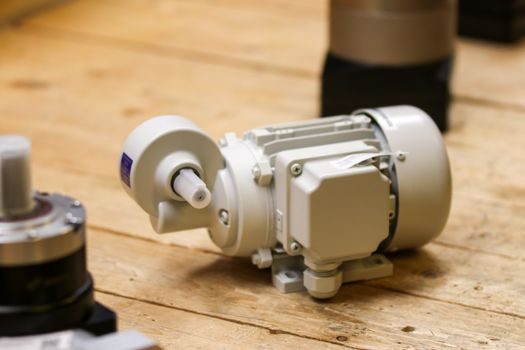
Mechanical linear actuators convert a rotary input through a screw, lead screw, cam, or ratchet into linear output, and the choice between ball screw and lead screw is the single biggest internal trade-off in the class [S8]. NB's BG type integrates a linear slide guide and precision ball screw inside a U-shaped steel housing, positioning the platform for semiconductor, measurement, and automotive applications where a single-axis compact package matters [S6].
Piezo and electromagnetic actuators are the workhorses of nanopositioning: stiffness, closed-loop linearity, and sub-nanometre resolution matter more than force output, and a piezo stack can resolve well below any ball-screw unit on the market [S7]. A linear second-order actuator model in Simulink, with natural frequency and damping parameters that the controls engineer sets, describes the dynamic behaviour of any of these electromechanical or hydraulic classes in a uniform way, which is why a single block can simulate motion for an aircraft surface or a stage [S5].
Hydraulic and pneumatic classes: high force, controlled fluid
Hydraulic linear actuators are specified where force density and stiffness dominate the design: KNR's compact double-rod design is illustrative, with a standard 5–20 kN (1,122–4,489 lbf) force envelope at 210 bar (3,045 psi), servo-valve-ready for pressure, force, and displacement feedback [S1]. Single-rod and double-rod variants are both offered to match the control law and stroke symmetry the machine builder needs [S1].
Pneumatic linear actuators are the lowest-cost, highest-speed, lowest-precision option in the six-class map, and they are typically used in clamping, diverting, and on/off end-of-arm tooling where a few millimetres of positional drift is acceptable. Their advantage over electric is a clean explosion-proof profile for hazardous areas, and their disadvantage is compressibility, which means position must be closed-loop controlled with an external position sensor if repeatability under varying load matters.
Selection criteria and a 4-axis comparison
The four criteria that decide the drive class are force (N), speed (mm/s), stroke (mm), and positioning accuracy (mm or µm), with environment (IP rating, temperature, hazardous area), duty cycle, and feedback type as tiebreakers [S7]. For a 10 mm/s to 600 mm/s speed range with sub-100 µm accuracy, electric ball-screw stepper or servo units cover nearly all general factory-automation requirements [S2][S3].
For force above roughly 5 kN, hydraulic wins on force density and stiffness, and for sub-1 µm resolution, piezo wins on stiffness and bandwidth [S1][S7]. A useful decision rule for the field: specify the smallest drive class that meets force, stroke, and speed; only step up to hydraulic or piezo when the smaller class cannot physically deliver the required force density or resolution. The trade-off inside the electric class is the ball-screw versus lead-screw choice, with ball screw vs lead screw guidance covering the internal mechanics.
Where each class is and is not appropriate
Electric ball-screw actuators are the right call for clean, indoor, 24 V DC factory-automation cells, vertical-axis pick-and-place, and semiconductor front-end motion, where a 50–300 mm stroke, 300–600 mm/s speed, and 400–500 N push force are typically enough [S3]. Hydraulic is the right call for steel-mill screw-down, forging, press automation, and any 5–20 kN (1,122–4,489 lbf) compact cylinder duty with 210 bar (3,045 psi) supply [S1].
For cleanrooms, optical benches, and metrology, piezo and electromagnetic classes are the only ones that can hit sub-µm resolution with the stiffness to support the load [S7]. Pneumatic remains correct for low-cost end-of-arm tooling, food packaging, and hazardous-area on/off motion, and mechanical (lead-screw and cam) units remain correct for hand-cranked, low-duty, or battery-driven motion where an electric drive is overkill.
Limitations, failure modes, and standards to watch

Every drive class has a known weakness: electric ball-screw units wear at the nut and fail on lubricant loss, hydraulic units leak oil and require a clean power unit, pneumatic units drift under changing load, and piezo units have a tiny stroke (typically under 100 µm) and require a high-voltage amplifier [S7]. The β-class trade-off inside the electric line is straightforward: lead screws are cheaper, quieter at low speed, and self-locking, but ball screws deliver 90%+ mechanical efficiency, higher speed, and longer life at the cost of needing a brake for vertical hold [S3][S8].
For vertical-axis holding, an electromagnetic brake option is a stock add-on for the EAC and AR stepper cylinders and is the standard method for holding position when power is removed [S3]. For hazardous-area deployment, pneumatic and hydraulic systems have a structural advantage because they have no live electrical parts in the actuator, but electric units can be specified with the right enclosure and certification. Linear motion in a multi-axis system is usually built on linear guides and may be delivered as a complete linear module with a linear encoder for closed-loop feedback, and the higher-level motion-control side of the system often uses a linear motor instead of a ball screw when the bandwidth requirement exceeds what a mechanical screw can deliver.
Sourcing signals and what to track next
The 2026 sourcing signals worth tracking are ball-screw versus lead-screw pricing and lead time, the spread of absolute-encoder options on stepper-driven units, and the growing catalogue depth in geared DC and brushless DC units for compact machine builders. For broader factory-automation context outside the actuator itself, the diesel forklift capacity-class map and the electric forklift 2026 spec map describe how mobile material-handling platforms integrate the same kind of electric-linear and hydraulic motion at the vehicle level. Track new product launches from Thomson, Oriental Motor, NB, Assun, and the German mid-size electric-actuator makers, since vendor catalogue refreshes typically include updated force-stroke-speed tables that reset the spec envelopes above [S1][S2][S3][S4][S6][S8].