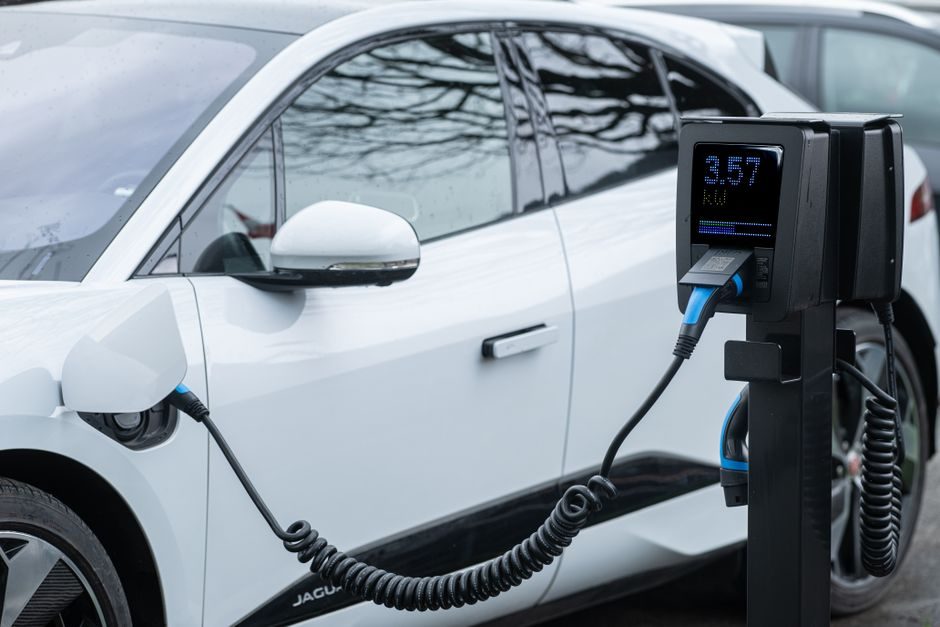
Three cell formats — cylindrical (18650/21700/4680), prismatic (hardcase) and pouch — share roughly the same upstream electrode process but diverge sharply in stacking, formation and pack integration; in 2026 most new gigafactory capacity targets prismatic LiFePO4 for ESS and large cylindrical 4680 for high-power EV applications [S1][S2][S4].
Cell-format choice dictates the entire line layout: a 4680 cylindrical line needs spiral-wound winding, laser welding of full-tab current collectors and a high-tonnage (200–600 t) electrode press, while a prismatic line uses stacked electrodes, laser-cleaned tab welding and a stacking fixture set sized to the cell footprint [S2][S4]. Pouch lines add a hot/cold lamination step and a 1 mPa-class vacuum-sealing chamber that cylindrical and prismatic hardcase lines do not require [S2].
Upstream Electrode Process: Slurry, Coating, Calendaring and Slitting
The first 12–15 stations of every Li-ion line — regardless of cell format — are dominated by the same four machines: a vacuum slurry mixer, a comma-bar or slot-die coater, a continuous drying tunnel (NMP recovery for NMC, water-based for LiFePO4) and a calender rolling press, followed by electrode slitting and vacuum drying [S2][S4].
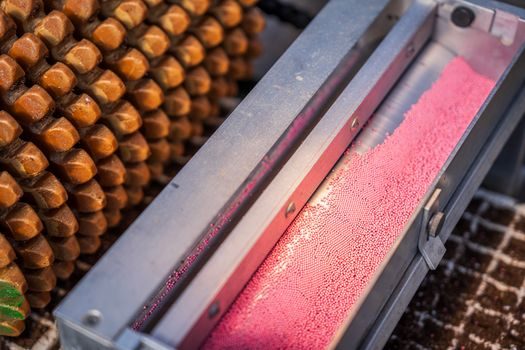
Typical production-line equipment published by turnkey suppliers in 2026 lists slurry mixers from 30 L lab scale to 1,500 L production planetary mixers, slot-die coaters with 600–1,500 mm web width, and electrode rolling presses rated 20–200 t with ±2 µm thickness control [S2]. Coating accuracy is the first process gate: density variation above ±0.5 g/cm³ on a 120–160 g/m² cathode foil pushes the cell into formation-cycle scrap, so production lines usually install a 100% in-line X-ray or beta-gauge coat-weight scanner before calendering [S2][S4].
Cell-Format Specific Assembly: Winding vs. Stacking
Cylindrical production lines center on a high-speed winder (4–12 m/s), automatic tab welding, and a rotary insertion step that drops the jellyroll into a nickel-plated steel can; turnkey vendors in 2026 ship full cylindrical lines for 18650, 21700 and the larger 4680 format at throughputs of 60–200 ppm [S4]. The 4680 tabless design replaces single tab welding with full-body laser patterning of the current collector, which adds a 1 kW-class fiber-laser station but eliminates one of the highest-resistance interfaces in the cell [S2].
Prismatic and pouch lines pivot on stacking instead of winding: a Z-stack or hot-stacking station with ±0.3 mm alignment tolerance feeds foil rolls, and prismatic hardcase lines add an additional laser-cleaning station before aluminum-lid welding [S2][S4]. Prismatic hardcase production also requires a leak-test (helium mass-spectrometer) station rated to 1×10⁻⁸ Pa·m³/s, which cylindrical and pouch lines usually meet with simpler pressure-decay checks because the metal can absorbs the leak budget [S2].
Dry-Room, Electrolyte Filling and Formation
All three cell formats require a dry-room assembly area maintained at −40 °C to −60 °C dewpoint (roughly 10–100 ppm moisture) to keep residual water in the cell below 200 ppm before electrolyte dosing — a threshold above which LiPF₆ salt hydrolyses and the cell fails cycling [S2][S4].
Electrolyte filling for cylindrical cells is a vacuum-pulse injection step (typically 1–3 cycles to <100 Pa), while prismatic and pouch cells use a larger-volume one-shot injector with a 0.5–2 L reservoir and a precision gear pump [S2]. Formation (the first slow charge/discharge cycle) is run at 0.1–0.5 C with current accuracy ±0.5% and voltage window resolution down to 1 mV; full formation racks at gigafactory scale now run 200–500 A per channel and include inline EIS to weed out cells with abnormal impedance before they reach aging racks [S2].
Chemistry Split: LiFePO4, NMC, and the Solid-State Curve
LiFePO4 (LFP) lines dominate ESS and entry-level EV capacity in 2026 because the cathode chemistry tolerates a water-based binder slurry (PVDF-free), a cheaper current collector set, and a wider state-of-charge operating window (typical cycle range 10–90% SOC) at the cost of lower cell-level energy density (160–180 Wh/kg at the cell) compared with NMC (240–280 Wh/kg) [S1][S6].
NMC lines add an NMP-recovery (closed-loop distillation at 80–90 °C, ≥99% solvent recovery) loop, a glovebox-coupled cathode area, and stricter formation cycling because residual moisture generates HF that etches the aluminum current collector [S2]. Solid-state lithium batteries (ASSLBs) — using inorganic sulfide or oxide solid electrolytes, or solid polymer electrolytes — remain a research and pilot stage: a 2025 review of interface chemistry concludes that the Li-anode / solid-electrolyte contact resistance and dendrite suppression at ≥3 mA/cm² cycling are still the two gating problems blocking gigafactory deployment [S6]. Practical impact in 2026: a sulfide-ASSLB line requires an inert-atmosphere (<1 ppm O₂, <1 ppm H₂O) dry room and a hot-press lamination step (100–200 MPa, 80–120 °C) that no commercial liquid-electrolyte line currently ships as standard [S6].
Pack Finishing: BMS, Module Assembly and End-of-Line Test
Downstream of formation and aging (typically 7–28 days of cycling at 25–45 °C), cells move to pack assembly: module trays with laser-welded busbars, BMS integration, and an end-of-line test that includes a 1 C capacity check, an AC-IR measurement at 1 kHz (target typically 0.2–0.5 mΩ for a 50 Ah prismatic cell), and a high-pot test of the pack enclosure to 2,500 V AC for 1 s [S2][S4].
Module pack lines are increasingly automated with vision-guided robotic stacking, automatic torque-controlled bolting (4–8 Nm with ±5% tolerance), and a PLC-driven MES handshake that gates each cell to its formation data and rejects packs whose weakest cell deviates more than 2% from the string average [S2]. A 2026 turnkey pack line for prismatic cells ships at 10–30 packs/hour for stationary BESS and 5–15 packs/hour for EV packs because the latter require more torque-controlled steps and a coolant-leak pressure test at 350 kPa held for 10 minutes [S2][S4].
Decision Criteria: Which Process Stack Fits Your Build
Selection on a new 2026 production line hinges on chemistry, cell format, and downstream application, not on individual machines — the upstream electrode process is broadly interchangeable. Use the four-criterion comparison below to shortlist: [S1]
• LiFePO4 prismatic (hardcase) — best for ESS / entry-EV: water-based slurry (lower CAPEX on NMP recovery), 160–180 Wh/kg cell energy density, 6,000+ cycle life at 80% DoD, prismatic hardcase simplifies pack integration with industrial valve-style liquid cooling plates, but requires laser-cleaned tab welding and helium leak test [S1][S2].
• NMC cylindrical (21700/4680) — best for high-power EV / power tools: 240–280 Wh/kg cell, requires NMP-recovery loop, tabless 4680 design lowers DCR by ~20% but adds a 1 kW laser station; format is well understood by pressure sensor-driven leak test and high-speed winding [S2][S4].
• Solid-state pilot (ASSLB) — best for R&D labs and 2027–2029 pilot: solid-electrolyte interface resistance is still a gating problem at ≥3 mA/cm²; full inert-atmosphere dry room (sub-1 ppm O₂/H₂O) and 100–200 MPa hot-press lamination step push CAPEX 2–3× above equivalent liquid-electrolyte pilot lines [S6].
Sourcing and Standards Discipline
Turnkey line buyers in 2026 should anchor on three sourcing signals: published station-by-station equipment list with rated throughput, an installed reference line in the same chemistry and format, and a documented formation / aging recipe matching the cathode binder system [S2][S4]. Battery-cell vendors with on-site BESS integration capability (e.g. WINA, BSLBATT, ALE) typically publish cycle-life data against a stated DoD and temperature envelope rather than against a specific standard, so process engineers should map those envelopes to the UN 38.3 transport test and the IEC 62619 stationary-battery safety series before signing off [S1][S3][S5].
For a 2026 cell-line CAPEX review, expect the electrode front-end (mixing, coating, calendering, slitting) to consume 45–55% of equipment cost, cell assembly 20–25%, formation/aging 15–20%, and pack finishing 8–12% on a greenfield gigafactory line; the dry-room and HVAC envelope typically adds another 8–12% to the building-MEP budget [S2]. Buyers specifying LiFePO4 prismatic lines in 2026 should also benchmark the supplier against a published 1 C/1 C cycle count ≥6,000 at 25 °C, 80% DoD, with end-of-life defined at 80% capacity retention [S1]. Process engineers evaluating turnkey suppliers can cross-check the 2026 landscape covered in this Hydrogen Fuel Cell Smart Manufacturing 2026 piece for adjacent stack-build and leak-test methods, and review the PV Smart Manufacturing 2026 article for shared AI-vision and MES gating ideas that are migrating into Li-ion pack lines as 2026 progresses.