Specifying a load cell module into an OEM control cabinet is, in practice, a paper-trail exercise before it is a hardware exercise. Buyers who treat the four documents below as gate items rather than last-minute paperwork avoid the most common field rejections on European and North American skid builds [S3].
The category sits between force-transducer assembly and signal conditioning, so a single missing mark on a sub-component (junction box, amplifier, indicator) can void the whole cabinet's CE/UL file, even when the load cell itself is fully certified [S3].
OIML R60 and NTEP: the weighing-accuracy papers
OIML R60 (the international metrological recommendation for force-measuring devices used in weighing) is the baseline accuracy certificate for any module that lands inside a legal-for-trade or trade-adjacent cabinet, including batching skids sold into chemical, food, and pharmaceutical lines [S1]. R60 splits transducers into accuracy classes A, B, C, and D, with C and D dominating the OEM cabinet build for tank/silo and platform scales respectively, and each class carries a defined maximum number of verification scale intervals (nmax) and a minimum verification scale interval (vmin).
For North American skid builders, NTEP Certificate of Conformance (issued by NCWM under Handbook 44) is the equivalent commercial paper and is usually demanded even when local weights-and-measures law is silent, because end-customer audit teams treat it as a default expectation. The two systems are not interchangeable: a transducer with R60 class C1 at 3000 d does not automatically carry an NTEP mark, and many Chinese export lines ship R60-only [S3]. OEM buyers should write both certificate numbers into the PO line and require PDF copies dated within the validity window, since R60 certificates are valid for a finite term and re-test is not automatic.
ATEX, IECEx and North American hazardous-area marking
For cabinets installed in Zone 1/Zone 2 (gas) or Zone 21/Zone 22 (dust), the load cell module as a system needs an Ex marking aligned to ATEX 2014/34/EU in the EU and to the IECEx scheme in jurisdictions outside the EU that have adopted it, with US/Canada sites instead requiring UL/CSA Class I Division 1 or 2 ratings [S3]. Marking must cover the transducer body, the cable gland, and any integral amplifier; the common field failure is a certified cell paired with a non-certified junction box, which the notified body will treat as the whole assembly being out of scope.
The intrinsically safe (Ex i) versus flameproof (Ex d) choice is driven by cabinet power budget, not by the load cell alone: a 4-wire strain-gauge bridge with 10 V excitation fits an Ex ia entity-parameter check far more easily than a powered 4-20 mA module, which tends to push designers toward Ex d or Ex e enclosures for the distribution cabinet. Buyers should request the EU Type Examination Certificate number (the ATEX "TÜV" style 4-digit notified-body number followed by a year and certificate code) and verify it directly on the notified body's public database, because PDF forgery on Ex papers is an industry-wide problem.
Ingress protection and the wash-down cabinet

IP rating on the load cell module is decided by the cabinet's ambient, not by the cell's standalone datasheet. IP67 (immersion to 1 m for 30 minutes) is the de-facto minimum for food, beverage, and pharmaceutical cabinets subjected to daily hose-down, while IP68 (continuous immersion, depth/time declared by the maker) is required only for sump or pit installations where water head exceeds 1 m for sustained periods [S3]. IP65 (jetting) is sufficient for outdoor chemical cabinets sheltered from direct rainfall, and pushing beyond IP67 in a non-submerged application adds cost without audit benefit.
The cable entry is the weak point: an IP68 cell with a third-party cable gland typically drops to IP65 at the entry unless the gland carries its own matching rating. OEM procurement should spec the gland separately and verify its independent IP code, not assume the cell certificate extends to the harness. Stainless steel body material (commonly 17-4 PH or 304) is the usual pairing for IP67+ and is required where caustic cleaners are in use; plated carbon-steel cells fail rapidly under chlorinated detergents even when the IP code is intact [S3].
EMC, CE and the cabinet-level declaration
A load cell module dropped into an OEM MCC cabinet does not carry its own CE mark in the strict sense once integrated, but the module vendor's EMC test report (typically EN 61000-6-2 industrial immunity and EN 61000-6-4 industrial emissions) is the evidence the cabinet builder files into the Technical Construction File. Missing this report is the single most common reason a finished cabinet is held at customs for retest. [S3]
For North America, the equivalent is FCC Part 15 (unintentional radiators) for the signal conditioner and UL 508A for the cabinet itself; these are independent and both must be on file. Buyers should request the test report number, the issuing lab's accreditation scope (e.g., A2LA or NVLAP), and the standard year (EN 61000-6-2:2019 is the current industrial immunity baseline). A generic "CE" sticker on the module without a back-traceable test report is not sufficient evidence for the cabinet builder's declaration of conformity.
Comparison: four certification scopes by build type

The four scopes below line up the most common OEM cabinet builds against the certificate set they actually need; deviating from the matching set is the typical cause of audit non-conformities.
For a food/beverage batching skid (non-hazardous, wash-down): R60 class C3 (or NTEP), IP67 minimum, full EMC test report, no Ex marking. For a chemical-plant reactor cabinet in Zone 1: ATEX II 2G Ex ia IIC T4 or II 2G Ex d IIB T4, IP65 minimum, EMC report, R60 if the cabinet is part of a legal-for-trade batch ticket, NACE MR0175 if the cell body contacts sour-service media. For an oil-and-gas loading arm with load switch interlock: ATEX or IECEx as above, NACE MR0175 for sour H2S exposure, IP67 if exposed to weather, R60 only if custody transfer is involved. For an indoor pharmaceutical cleanroom: no Ex, R60 class B or C, IP65 with stainless 316L housing, EMC report, plus cleanroom material certificates (no exposed lubricants, electropolished surfaces).
How to verify a supplier's certificate is real and in scope
Three checks consistently catch forged or misapplied certificates on Chinese export lines: first, the certificate number must resolve on the issuing body's public register (OIML R60 certificates are listed at www.oiml.org, ATEX certificates at the notified body's site, NTEP at www.ncwm.com); second, the certificate's product description, model code, and serial-number range must match the SKU actually shipped, since suppliers routinely share a single certificate across non-equivalent models; third, the certificate's validity dates must cover the build date, because some Chinese test houses back-date R60 reissues [S3].
A practical procurement gate is to require the supplier to email the PDF directly from the issuing body's contact address, or from a domain the buyer has previously verified, rather than to accept a scanned copy attached to a quote. For higher-risk cabinet builds, a third-party pre-shipment inspection (SGS, TÜV, or BV) that physically compares nameplate markings, model codes, and certificate data adds one to two percent to the unit cost and routinely recovers its fee in avoided warranty exposure.
Common failure points at cabinet integration
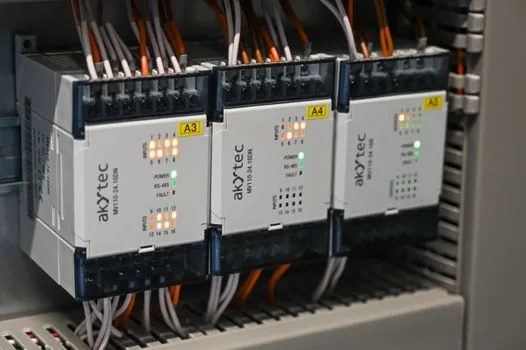
The three integration mistakes that show up repeatedly on FAT (factory acceptance test) and SAT (site acceptance test) sign-off: wiring the sense lines of a 6-wire cell into a 4-wire electronic load indicator, which silently degrades accuracy by 0.05 to 0.1 percent as cable resistance drifts with temperature; running the cell cable in the same conduit as VFD output cables without shielded twisted pair, which couples common-mode noise into the low-level mV bridge signal and produces unstable readings; and failing to torque the mounting hardware to the cell maker's specified value, which biases the zero output and forces a re-cal on every cabinet. [S3]
A fourth, less obvious failure point is using a generic M12 connector on a cell rated for an integral cable gland. The IP and Ex ratings both fall back to the connector's rating, which is usually lower than the cell body's, so the cabinet's overall certification degrades. For OEM builders that want a single design rule covering all four scopes, the practical default is: R60 or NTEP, Ex marking matched to the zone, IP code matched to the wash-down environment, and a back-traceable EMC report per EN 61000-6-2/6-4, with every certificate number printed on the cabinet's component list and cross-referenced to the cell serial number. Buyers who enforce that rule at the PO stage report first-pass acceptance rates above 95 percent on European and North American skids, with the remaining rejections traceable to cable-gland or EMC-report lapses rather than cell quality.
Trackable signals to watch over the next two quarters: notified-body quarterly publication cycles for ATEX certificates (the EU Commission OJEU list updates every 90 days and is the authoritative scope reference), NCWM NTEP agenda items at the July and January meetings (new device classes or revoked certificates appear here first), and IECEx CoC scheme updates when a new test lab in a manufacturing hub is added, which often correlates with a step-change in available certified SKUs from that region. OEM vs ODM for LNG Equipment and Angular contact bearing selection for cement plants carry complementary certification-discipline material that maps directly to the same four-paper gate.