
New industrial machine vision controllers from brands like Cognex, Basler, and Gardasoft cluster in a $3,000–$10,000 band for typical multi-camera inspection cells, while used or compact FPGA boards appear on the secondary market from roughly $500 to $1,500 [S5]. The widest swings are caused by four variables: the imaging protocol stack (GigE Vision vs USB3 Vision vs Camera Link), the number of synchronized lighting and lens channels, FPGA vs x86 SoC compute, and whether the software licence ships perpetual or subscription [S1][S5].
A vision controller is the embedded or PC-based board that triggers cameras, fires strobes/lights, reads encoders, and runs inspection logic — distinct from a generic PLC or industrial PC because it guarantees deterministic trigger-to-image latency (often sub-100 µs) and tight synchronization with a machine vision system. That real-time behaviour, not raw CPU throughput, is what justifies the price premium over a $400 panel PC [S1].
What Drives the Price: Five Hard Cost Variables
Imaging protocol tier sets the floor. GigE Vision and USB3 Vision controllers (PoE+ powered, 1–4 ports) ship in compact housings starting near $1,200 for OEM quantities, while 10GigE or CoaXPress 2.0 boards with frame grabbers and FPGA pre-processing jump to $4,000–$8,000 at single-unit list [S1]. Camera Link is the historical high-end interface; new Camera Link HS boards sit at the top of the range, with a single-board list often above $6,000 because of the licensing paid to the interface consortium and the need for shielded cabling. Channel count scales roughly linearly: a 4-channel lighting pulse controller from a specialist such as Gardasoft lists in the low-thousands, and an 8- or 16-channel configuration (the kind used to drive vision light source arrays in line-scan food or print inspection) can run 1.8–2.5× the 4-channel price [S1].
Compute silicon is the second variable. Entry-tier controllers use ARM SoCs or mid-range x86 with on-board FPGA glue — adequate for barcode, presence/absence, and 2D code reading. Mid-tier adds a discrete FPGA for sub-pixel measurement and encoder-locked triggering; high-tier moves to a GPU-accelerated x86 box (often a rugged industrial PC) running CNN-based defect classification, where the GPU alone (RTX-class or equivalent) can be $1,500–$3,000 of the BOM.
Spec Tiers and Indicative Price Bands
Tier 1 — Compact/embedded (single camera, fixed lighting, ~1–2 trigger inputs). Typical use: part-presence checks, simple code reading on a conveyor. Indicative new price: $1,200–$2,500 from vision-specialist vendors; used/Cognex VC-class boards have cleared at roughly $700 in working-pull condition on secondary channels [S5]. Tier 2 — Multi-camera GigE Vision controller (4–8 PoE ports, 4–8 lighting channels, encoder input). Typical use: multi-station assembly verification, dimensional gauging. Indicative new price: $3,500–$7,500 depending on lighting-channel count and software bundle. Tier 3 — High-speed line-scan / 3D / GPU-accelerated (10GigE or CoaXPress, FPGA pre-processing, GPU inference, 16+ lighting channels). Typical use: web inspection, semiconductor, pharma vial inspection. Indicative new price: $8,000–$15,000+ for a fully configured industrial PC-class unit.
The same tier ladder applies when a controller is integrated with a vision measuring machine for shop-floor metrology: expect to add 30–60% over a bare controller price once optics, lighting, precision linear guide stages, and calibration software are bundled. For 2D surface inspection that needs XY raster scanning, a crossed-roller guide stage paired with a mid-tier vision controller typically anchors the system around the $6,000–$9,000 mark before optics.
New vs Refurbished vs Used: Where the Spread Comes From
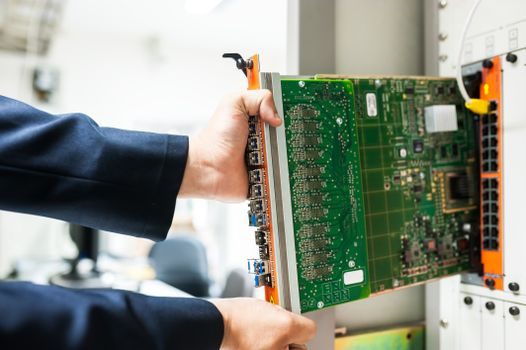
New units from authorized channels carry full warranty (usually 2–3 years), the latest firmware, and current software entitlement. Refurbished units from the OEM's own remanufactured programme typically run 40–60% of new list, with a 1-year warranty and verified calibration. Used pulls from the secondary market — for example, a working-pull Cognex VC7-480 listed at $716.97 on eBay — exist as a sourcing channel [S5]. For a plant running an inspection line on a 10-year depreciation cycle, the typical decision point is at year 5–7: keep the original OEM service contract, or migrate to a newer controller and absorb the software re-licence.
Lead time on new units is currently the dominant non-price friction: industrial PC-class vision controllers with 10GigE or CoaXPress are quoting 14–22 weeks from specialist vendors, versus 4–8 weeks for GigE Vision units in the mid-tier [S1]. That gap pushes some European buyers toward refurbished inventory even when new-equivalent pricing is acceptable, because the production-line downtime cost of waiting can dwarf the savings.
Hidden Costs: Cabling, Optics, Software Renewal, and Downtime
Total cost of ownership over a 7-year lifecycle is typically 1.6–2.4× the purchase price. Add a 3–5% annual spares allocation for I/O boards and trigger modules, and the seven-year TCO envelope is set. [S1]
Energy and cooling are small but non-zero: a GPU-accelerated Tier 3 controller can pull 250–400 W continuous, so a 24/7 line at $0.10/kWh adds $220–$350 per controller per year. By contrast, a Tier 1 embedded unit often runs under 25 W — roughly 10× cheaper to keep powered, which over a 10-year life recovers several hundred dollars per station.
Who Should Buy What: A Decision Map

Single-station barcode / presence-absence verification on an existing line: Tier 1 compact controller, $1,200–$2,500 new, or a verified used unit in the $500–$900 band [S5]. Multi-camera dimensional gauging or 100% inline inspection at modest line speeds: Tier 2, $3,500–$7,500. High-speed line-scan, 3D, or AI-defect classification on a continuous web: Tier 3, $8,000–$15,000+. Skip a Tier 3 GPU box if the inspection problem can be solved with classical rules-based vision — a Tier 2 unit running a well-tuned toolset will out-perform an under-trained CNN on a Tier 3 box, and at one-third the capital. Conversely, do not deploy a Tier 1 board on a 50 kHz line-scan application; the trigger-to-image latency budget will be violated regardless of software tuning.
For plants weighing supply-chain risk in 2026, the working signals are lead-time (track published distributor stock for Tier 2 GigE Vision boards, the segment with the most alternatives) and software licence transferability on used equipment — both of which decide whether a 60% saving on a used unit is real or just deferred cost.
See also our earlier report, Abrasives Manufacturing Process: Grain, Bond, and Backing Spec Map.