
A modular PLC station is priced as a stack: CPU + I/O bases + specialty modules + power supply + programming software + documentation, and the single most expensive line on that stack is almost never the CPU. CLICK PLUS stackable micro-modular CPUs from AutomationDirect illustrate the cost pattern: the CPU head unit holds the processor, memory, and built-in I/O, and additional discrete or analog modules are stacked beside it to grow the system [S2].
Across the 2024-2026 market window, the practical buying question is not "what does a PLC cost" but "what does a configured station cost, and what is the five-year cost of ownership once programming, spares, and safety hardware are added". The plc reference page frames the same decision tree: a CPU is a platform, not a finished controller.
Modular PLC Cost Drivers and What Moves the Number
Four cost drivers dominate a modular PLC bill of materials and each one shifts the price independently of the others. First, the CPU class: micro-modular CPUs (CLICK PLUS, Productivity1000, BRX M-series) typically list in the $99-$400 range for the processor, mid-range modular CPUs (CompactLogix 5380, S7-1500, Productivity2000) sit in the $700-$3,000 band, and high-availability or safety-rated CPUs reach $4,000-$8,000 before any I/O is attached [S2]. Second, I/O density and type: a 16-point discrete input or output module adds roughly $80-$250 per module, analog I/O (4-16 channel, voltage or current) lands in the $250-$600 range per module, and specialty modules (high-speed counters, RTD/thermocouple, load-cell, motion) push $400-$1,200 each. Third, protocol and communication modules (EtherNet/IP, PROFINET, Modbus TCP, BACnet, serial gateways) add $150-$700 per port, and a station that needs both a programming port and a plant-network port will buy two. Fourth, certification: a standard CE/UL-rated station and an ATEX/IECEx Zone 2 station carry different component costs, and a safety PLC station (SIL 2 / SIL 3 per IEC 61508) typically doubles the I/O line cost because the redundant architecture requires dual inputs, dual outputs, or dedicated safety modules.
Volume tier and lead time move price quietly beneath the line card. Distributor stock (AutomationDirect, RS Components, Phoenix Contact, Wago) usually returns a 10-25% discount at 5-10 unit quantities and 20-40% at OEM-tier 50+ unit annual volumes, with lead time dropping from 6-10 weeks to 2-4 weeks once a stocking agreement is signed [S2]. Software licensing is the silent driver: many micro-modular lines bundle free programming software, but mid-range lines commonly separate the programming license ($300-$2,500), the runtime license for tag counts above a threshold, and the option library for advanced function blocks.
Price Bands by Modular PLC Family
Three tiers cover roughly 90% of the modular PLC stations being specified in 2026, and the bands below reflect CPU + I/O + power supply for a typical configured station rather than the headline CPU price. Tier 1, micro-modular and stackable, targets machines with 16-128 I/O and a single program scan under 2 ms: CLICK PLUS, Productivity1000, BRX M-series, LS Electric XGB, IDEC FC6A, and Click-style micro stacks from Asian OEMs. A 32-point discrete station typically lands at $400-$800, and a 64-point mixed discrete/analog station reaches $900-$1,600 including power supply and basic Ethernet. Tier 2, mid-range modular rack or backplane, targets 128-1,024 I/O and multi-protocol networking: CompactLogix 5380, S7-1500, Productivity2000, Schneider M340/M580, and Omron NJ/NX. A 256-point station typically lands at $1,800-$4,500, and stations that include motion, safety, and redundant power can pass $8,000. Tier 3, high-end modular with safety and redundancy, targets process skids, turbine control, and safety instrumented functions: ControlLogix, S7-1500F/FH, Siemens ET 200SP HA, and ABB AC500-S. A configured redundant station with safety I/O commonly lands in the $6,000-$20,000 band before engineering hours are added [S2].
The line between Tier 1 and Tier 2 is not CPU speed alone but tag count, scan determinism, and supported protocol stack. CLICK PLUS is positioned by AutomationDirect as a stackable micro-modular line where the CPU "contains the processing, memory and I/O interface" and additional I/O modules are stacked beside it; this is the textbook micro-modular value proposition, and it is the reason a 32-point station can be quoted under $800 [S2]. Mid-range modular systems use a backplane or slice-bus architecture that costs more per slot but supports hot-swap, redundancy, and high-speed deterministic scanning that micro stacks cannot match.
Selection Criteria: Who Modular PLCs Are For, and Who They Are Not For
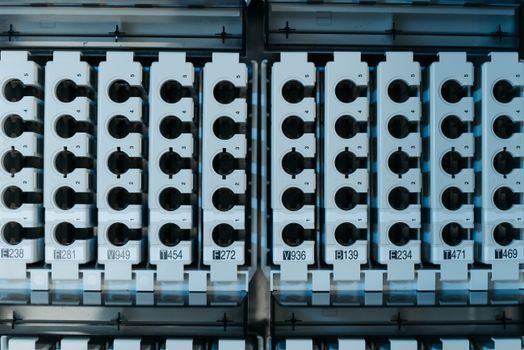
Modular PLCs are specified when the I/O count, protocol mix, or future expansion is uncertain. A standalone packaging machine with 24 I/O points, one Ethernet port, and no expected growth is almost always cheaper on a fixed brick PLC or a smart relay; the modular overhead (base, power supply, separate I/O modules) is wasted budget. Modular is the right answer when any of four conditions is met: I/O count exceeds roughly 40 points, the system needs more than one protocol on the plant network, future expansion is expected within the asset's life, or the application carries a safety function that a safety PLC is the cleanest way to satisfy. Modular is also the right answer when the user needs hot-swap or redundant CPUs; neither is offered on a micro stack. [S2]
Modular PLCs are NOT the right answer for three common situations. First, sub-16-point OEM applications where a panel-mount micro brick or a smart relay fits the BOM and the price target. Second, motion-heavy applications with 8+ servo axes where a dedicated motion controller or a PC-based controller drives lower cost per axis. Third, ultra-low-cost single-board PLCs (relay-logic replacements, IoT edge controllers) where a $30-$80 controller is the engineering target. In all three cases, modularity is a cost the application does not need.
Comparison: Tier 1 vs Tier 2 vs Tier 3 Modular PLC on Four Decision Criteria
The four decision criteria that almost always drive the tier choice are I/O scale, scan determinism, safety/safety-bus support, and per-station cost. On I/O scale, Tier 1 covers 16-128 points, Tier 2 covers 128-1,024 points, and Tier 3 covers 512-8,000+ points with distributed I/O. On scan determinism, Tier 1 typically delivers 1-5 ms program scan at full I/O, Tier 2 delivers 0.1-1 ms with deterministic Ethernet, and Tier 3 delivers sub-millisecond scan with redundant CPUs and bumpless transfer. On safety/safety-bus support, Tier 1 generally relies on a separate safety relay or a stacked safety PLC, Tier 2 supports integrated safety I/O and PROFIsafe/CIP Safety on the same backplane, and Tier 3 supports full SIL 3 with redundant safety CPUs and certified function blocks. On per-station cost for a representative configuration, Tier 1 lands at $400-$1,600, Tier 2 at $1,800-$8,000, and Tier 3 at $6,000-$20,000+ before engineering hours. The right tier is the one whose weakest criterion still meets the application; over-specifying on scan determinism is the single most common way modular stations go over budget. [S2]
Total Cost of Ownership: Programming, Spares, and Energy
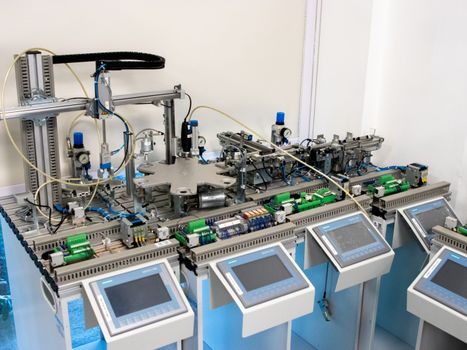
Purchase price is roughly 35-55% of a modular PLC station's five-year cost; the rest is engineering hours, spares, and energy. Engineering hours include program development, HMI screen build, network commissioning, and documentation; a Tier 2 station typically consumes 40-120 engineering hours at $80-$150/hour fully loaded, while a Tier 1 station consumes 8-30 hours because the program is smaller and the protocol stack is simpler. Energy cost is a small but trackable line: a Tier 1 CPU plus 64 points of I/O draws 8-15 W, a Tier 2 station with 256 points draws 25-60 W, and a Tier 3 redundant station draws 80-200 W; over a five-year duty cycle at $0.10/kWh that is $35-$880 per station, which is rarely a deal-breaker but should be visible on the cost sheet. [S2]
For a working cost model, a buyer can price a Tier 1 station at purchase + 1.2x purchase in engineering + 0.5x purchase in five-year spares + $50-$150 in energy; a Tier 2 station at purchase + 1.0x purchase in engineering + 0.4x purchase in five-year spares + $150-$500 in energy; a Tier 3 station at purchase + 0.8x purchase in engineering (programs are smaller as a percentage of hardware) + 0.3x purchase in five-year spares + $400-$900 in energy. These multipliers are not vendor-specific quotes; they are the typical pattern the plc reference page implicitly assumes when it treats the CPU as a platform rather than a finished product.
Standards, Sourcing, and What to Verify Before Purchase
Three standards and certifications govern most modular PLC purchase decisions, and a station that does not carry the right combination is the wrong station regardless of price. First, the safety standard: IEC 61508 governs functional safety, and a safety PLC station must be specified to a SIL level that matches the Safety Instrumented Function's required Probability of Failure on Demand. Second, the hazardous-area standard: ATEX 2014/34/EU for EU installations and IECEx for global installations, with Zone 2 modules carrying Ex ec marking and Zone 1 modules carrying Ex db or Ex eb. Third, the industrial Ethernet conformance: PROFINET, EtherNet/IP, and Modbus TCP each have a conformance test program, and a non-conforming module can pass bench test and fail plant commissioning. Module-level datasheets should be checked for these three marks before the order is released, not after the panel is built. [S1]
For broader cost context on industrial instrumentation budgets, a parallel breakdown of temperature monitoring device cost drivers walks through the same purchase vs total-cost pattern, and the temperature-side selection guide shows the analogous logic of choosing by sensor class and output protocol rather than by headline price. Buyers comparing the PLC station cost against field-instrument cost often discover that the PLC is the smaller of the two lines once commissioning and integration hours are added.
Trackable signals to watch over the next two quarters: silicon supply for mid-range CPUs, distributor stock on Tier 1 stackable modules, and any new SIL 3 / PROFINET / CIP Safety combination modules released by mid-range vendors. A sudden drop in distributor lead time on Tier 1 CPUs usually precedes a 5-10% price move within 60-90 days.
Spec-level background on the components involved: linear guide.