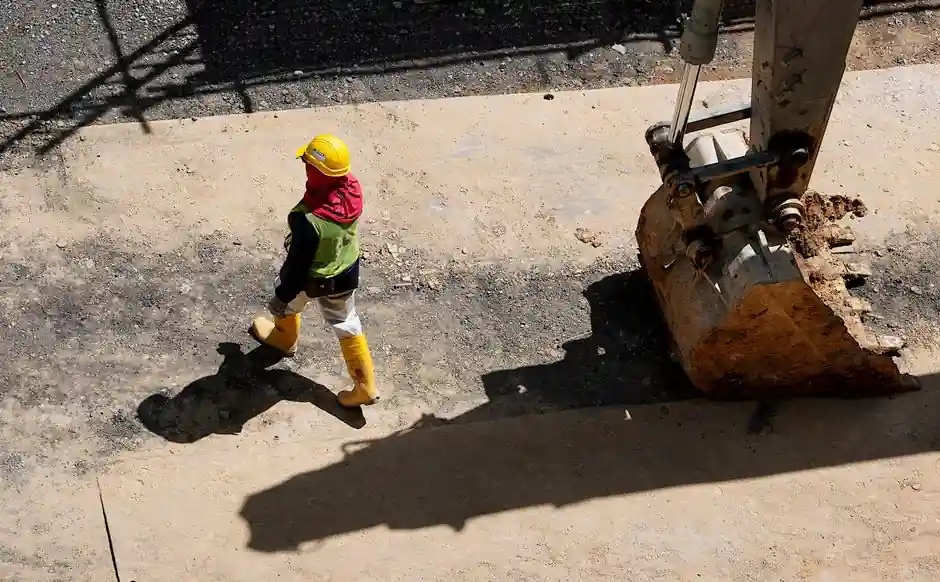
A motor grader and a backhoe loader are both wheeled construction machines, but they solve different problems: the grader's mid-frame moldboard fine-grades surfaces on 80-300+ HP chassis, while the backhoe loader pairs a front loader bucket with a rear excavator arm for digging plus loading in a single compact unit [S1][S2].
Specifying the wrong one costs time and money. Graders are typically 10,000-70,000 kg units optimised for finish work; backhoe loaders are usually compact tractors (commonly 6-10 t class) with two work tools fitted to one chassis [S1][S4]. The decision usually hinges on whether the dominant task is fine grading over distance or repeated dig-and-load cycles in a confined area.
Function, Frame, and Blade Geometry
A motor grader uses a long adjustable moldboard mounted between the front and rear axles, giving the operator fine control over surface flatness, cross-fall, and ditch profile [S1]. Standard moldboards run 10-14 ft wide, and large-project blades can extend up to about 24 ft, with the working tilt set to 30 to 45 degrees to keep aggregate rolling along the curve rather than spilling off the moldboard toe [S1].
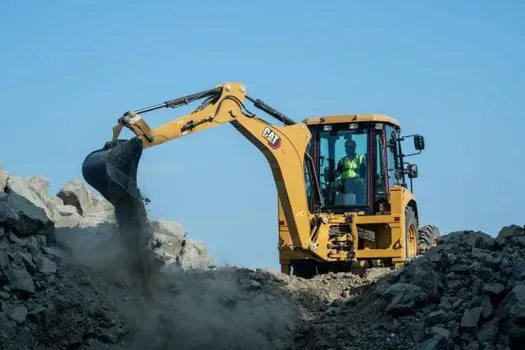
A backhoe loader is a tractor with a front loader bucket and a rear backhoe arm, built as a versatile single-chassis tool carrier for small-to-medium sites [S4]. The front bucket handles loading and material movement; the rear arm handles trenching, foundation excavation, and utility work, which is why backhoe loaders are traditionally used on residential construction, road repair, and utility jobs rather than finish grading [S2][S5].
Power, Weight, and Mobility Bands
Motor graders are power-banded by application: 80-150 HP covers landscaping and light grading, 150-300 HP covers heavy infrastructure and highway work, and units above 300 HP serve mining and large land development [S1]. Operating weight tracks the same tiers, from roughly 10,000 kg up to 70,000 kg for the largest machines, with small urban-suitable units at 3.4-7 t where surface damage is a concern [S1].
Backhoe loaders sit in a much narrower envelope. Representative units such as the CG MG1320C are around 16,400 kg total mass with a 220 HP engine and a 6,290 mm wheelbase, illustrating that even "large" graders can share weight class with mid-size backhoe loaders, but the centre of gravity, axle lead, and tool geometry are very different [S4]. A backhoe loader is built to be one truck-trailer-load for transport, while a 30+ ton grader usually needs special hauling [S1][S2].
Drivetrain, Hydraulics, and 2WD vs AWD
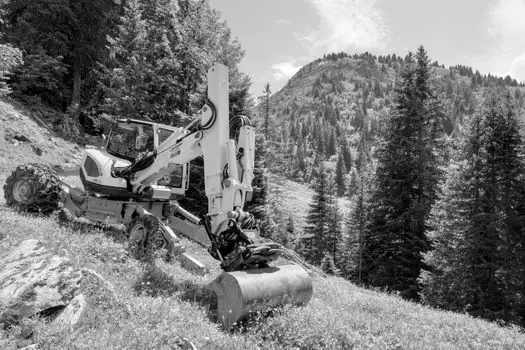
Motor graders are commonly offered in 2WD (tandem drive) and AWD configurations; AWD justifies its cost on soft, wet, or steep terrain where the front wheels must pull the machine through resistance the moldboard is generating [S1]. High-end machines add load-sensing hydraulics with proportional priority pressure-compensating valves, which adjust flow to demand, cut wasted pumping heat, and let the operator make small moldboard adjustments without stalling the blade [S3].
Backhoe loaders are typically 4WD wheeled machines with a torque converter and powershift, sized for short-cycle digging and loading rather than sustained fine grading [S2][S4]. They trade the grader's long wheelbase and precise blade geometry for compactness and the ability to dig, swing, dump, and load without repositioning. A useful related read on steel-site equipment selection is covered in plasma cutter spec gates for steel construction sites, where matching tool to job is the same decision logic.
Decision Matrix: Grader vs Backhoe Loader by Site Task
For a direct comparison, four decision criteria line the two machines up clearly. On finish quality, a motor grader wins because the mid-frame moldboard with 30-45 degree tilt and 10-24 ft coverage produces a level surface a backhoe loader cannot match with its front bucket [S1][S2]. On digging depth and trenching, the backhoe loader wins: the rear hoe arm is built for excavation, while a grader has no excavator function [S4][S5].
On transport and urban access, the backhoe loader wins because its compact tractor footprint typically travels on a standard lowboy, whereas graders above the small class (3.4-7 t) usually need special trailers and permits [S1][S2]. On multi-tool versatility per machine, the backhoe loader wins with two work tools on one chassis, while the grader wins only if the project is dominated by surface finishing, ditching, or slope work over long runs [S2][S4]. For broader fleet-decision context across machines, bulldozer vs backhoe loader: 2026 spec cut and job-site match applies the same matrix logic to another common pairing.
Use Cases and Limits on the Job
Motor graders fit road base course preparation, gravel road maintenance, ditch cutting, slope shaping, and snow removal on long rural routes, because the long wheelbase keeps the blade stable at speed and the central blade can be repositioned continuously [S1][S4]. Their limit is excavation: a grader cannot dig a foundation or open a trench efficiently, and on tight urban sites under 3.4 t, the small class trades blade down-pressure for manoeuvrability [S1].
Backhoe loaders fit residential construction, utility trenching, small road repair, and landscaping where one machine must dig, load, and place material without support equipment [S2][S5]. Their limit is fine grading: the front bucket has neither the width nor the precision of a moldboard, and a long-haul finish-grade pass is slow and uneven compared with a dedicated grader [S1][S2]. For buyers also weighing a compact loader alternative, bulldozer vs skid steer loader: 2026 spec cut and job-site match covers the small-frame side of the same fleet decision.
Procurement Signals and Standards to Track
Procurement teams comparing grader and backhoe loader line items should look for published total cost of ownership (TCO) data, not just sticker price; LiuGong D-Series and CAT 140-series comparisons published in 2026 frame the trade-off as mechanical simplicity plus Cummins or Shangchai powerplants versus premium hydraulics plus integrated GPS grade control [S3]. Manufacturer certification to ISO 9001:2000, CE, TIER III, and GOST is a current baseline for grader OEM documentation, as published in OEM spec sheets [S4].
Trackable next signals for 2026 procurement include: OEM-published fuel-burn deltas between load-sensing and fixed-displacement grader hydraulics, and any second-hand market spread between mid-size 150-300 HP graders and equivalent-age backhoe loaders, since resale value is a meaningful TCO component for fleet operators [S1][S3].
The underlying component specifications are covered under wheel loader.