NEC 2026 consolidates medium-voltage data center rules into a new Article 270, with the prior Article 235 deleted and replaced by Articles 265-268 for systems above 1,000V AC or 1,500V DC [S1].
For buyers and EPC teams, two parallel pressures are defining the 2026 supply picture: a code overhaul that tightens listing and labeling on Information Technology Equipment cabling under Article 645 (aligned to NFPA 75), and a manufacturing-side cost stack where setting up a mid-sized power-cable factory runs between $3.5 million and $7 million USD in 2026, with core machinery alone at $1.5-3.5 million [S1][S2].
NEC 2026: What changed in data center power cabling
Medium-voltage requirements for data centers, previously fragmented across the code, are now grouped under Articles 265-268 plus a new Article 270 covering grounding and bonding guidance for systems over 1,000V AC / 1,500V DC [S1]. Engineers specifying MV-105, MV-90, 15kV, 25kV, and 35kV feeders should expect a more dedicated framework but also a mandatory review of existing MV design templates [S1][S3].
Article 645 was tightened for Information Technology Equipment: cable management, listing requirements, and environmental conditions all received stricter language, with explicit alignment to NFPA 75 for fire risk and mission-critical reliability [S1]. For distributors stocking THWN-2, XHHW-2, XLP USE, RHH RHW-2, UF-B, and Type MC copper building wire, this means more granular submittal packages and listing evidence per circuit run [S3].
Arc-flash labeling: Section 110.16 gets specific
NEC 2026 Section 110.16 now requires arc-flash labels to carry four data points: nominal system voltage, the specific arc-flash boundary, available incident energy or required PPE level, and the date the assessment was performed [S1]. The 2026 ESTA Protocol summary also flags a new production-related requirement in the 2026 NEC affecting multicable power distribution for live events, indicating the change reaches beyond data centers into entertainment and stage-power installations [S5].
For data centers with oversized overcurrent protective devices, incident energy can rise sharply, so the new labeling rule materially changes what a compliant facility looks like on day one of inspection [S1].
Factory cost stack: what $3.5-7M actually buys
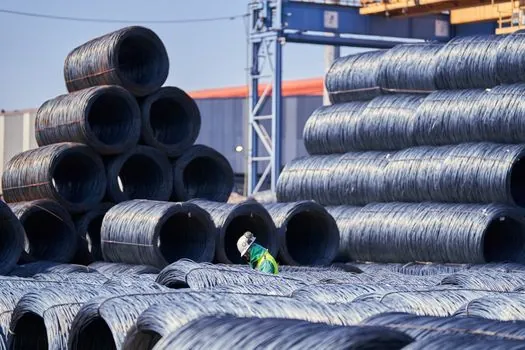
The 2026 HONGKAI breakdown allocates 40-50% of a mid-sized plant budget to machinery: wire drawing ($200,000-500,000), bunching/stranding ($300,000-800,000), primary XLPE/PVC extruder ($400,000-1,000,000), sheathing extruder ($300,000-700,000), high-voltage hipot test gear ($200,000-500,000), and auxiliaries ($100,000-500,000) [S2]. Installation runs 4-6 weeks at $50,000-100,000 including travel, and emerging-market import duties of 15-25% push landed cost up sharply versus a domestic greenfield [S2].
For a lean LV/MV plant, plan around $2 million in core machinery; upgrading to 35kV capability lifts the machinery line item, and operator training is a separate $20,000-50,000 per group [S2]. Buyers sourcing from newly built capacity should expect a 4-5% annual escalation on equipment quotes through 2026 driven by servo drives, automation retrofits, and electronics inflation [S2].
Demand side: 10-12% growth and a copper-linked price spike
India's power cable market is projected to grow at 12% annually for copper and 10% for aluminium between 2025 and 2030, even as global manufacturers chase the same copper rod supply [S8]. The US distribution channel is broad: Nassau National Cable lists Belden, Alpha Wire, AFC Cable, Southwire, Okonite, HELUKABEL, Lapp, and Draka alongside aluminum URD direct-burial, ACSR/AAC/AAAC, and MV-105/MV-90 in 15kV/25kV/35kV ratings [S3].
For context on commodity linkage, copper cathode volatility is feeding finished-cable pricing, and power-cable list prices have climbed 27% year-on-year into Q3 2026 as covered in this copper-cable price analysis. Procurement teams should expect revised quotes on THHN, XHHW, and MV feeder runs every 30-60 days through 2026, not the quarterly cadence of prior cycles [S8].
Selection criteria: copper vs aluminium, LV vs MV
Copper building wire (THWN-2, XHHW-2, XLP USE, RHH RHW-2, UF-B, SEU SER, NM-B Romex) remains the default for branch circuits and any run where termination space, ampacity per circular mil, or flexibility dominates the spec [S3]. Aluminium wins on aerial service drop, URD direct burial, and large feeder runs where weight and material cost per ampere beat termination concerns, with alloy options ACSR, AAC, AAAC, and the newer aluminium XHHW/SEU/RHH RHW-2/XLP USE-2 constructions [S3].
For medium-voltage feeders into data centers, MV-105 and MV-90 EPR/XLPE constructions at 15kV, 25kV, and 35kV are the workhorses, and these are exactly the products the new NEC 2026 Articles 265-268 and 270 reorganize the rules around [S1][S3]. A practical decision matrix: choose copper for LV building wire and any run under ~4/0 AWG where terminations and vibration matter; choose aluminium for URD, service drop, and large feeder runs where ampacity-per-kg and cost dominate; choose EPR/XLPE MV-105/MV-90 for 15-35kV utility or data center feeders. Further reading on adjacent 2026 capacity tightens is in transformer slot allocation and lead times, since transformer and cable delivery are increasingly co-dependent on the same heavy-lift slots [S2].
For whom this 2026 supply picture is a problem, and for whom it is not
Smaller electrical contractors on fixed-price 2026 retrofit work will feel the squeeze: NEC 2026 listing evidence, the new Section 110.16 label content, and copper-cable repricing all land on jobs that were bid before the code revision [S1][S8]. Data center hyperscalers with frame agreements signed in 2024-2025 are largely insulated on price but exposed to Article 270 MV design rework if their MV specs were templated against the old Article 235 framework [S1].
Distributors carrying deep SKUs across Belden, Alpha Wire, Southwire, Okonite, HELUKABEL, Draka, and Lapp lines have the most flexibility to absorb NEC 2026 listing transitions; thinner distributors relying on a single house brand face the steepest re-listing work [S3]. The HONGKAI cost guide is most useful for entrepreneurs evaluating greenfield entry in emerging markets, not for buyers choosing between existing suppliers [S2].
Sourcing signals to track into Q4 2026
Three verifiable signals to watch: (1) IAEI and NFPA interpretations of Article 270 grounding and bonding language, since the new article replaces the deleted Article 235 with no carry-over commentary published; (2) Q4 2026 copper cathode LME settlements, which historically lead finished THHN/XHHW price moves by 6-10 weeks; and (3) whether ESTA's Protocol coverage of the new NEC 2026 production-related multicable power distribution rule produces a formal TSC guidance document for stage-power installers [S1][S5][S8].
For the relevant spec sheets and selection criteria, see power supply, dc power supply, and switching power supply.