
A needle valve and a solenoid valve sit on the same piping isometric but answer different questions: the first controls how much flow passes, the second decides when flow is allowed to pass at all. Sourcing-side catalogs from ISO 9001 manufacturers continue to publish needle valves with sub-1.0 Cv ratings for instrument and gauge isolation, while pneumatic-actuated solenoid controllers such as the FineTek AEX6 are documented with 10/20-point bases expandable to 620 points for dust-collector pulse trains [S1][S2].
The two are routinely confused in procurement RFQs because both are small-bore, both thread into instrument manifolds, and both can carry a "valve" tag number. They are not interchangeable: a needle valve is hand-set and stays at the last operator position, whereas a solenoid valve snaps between discrete states on coil energisation. Mixing them up costs flow accuracy on day one and trips a process loop the moment a coil is de-energised.
Operating Principle and Body Geometry
A needle valve closes flow with a slender, tapered stem — typically a 30° to 60° cone — seated against a matched orifice, and the fine pitch of the stem thread (commonly 32 TPI on 1/4″–1/2″ instrument valves) is what gives it resolution. NTGD's product line covers needle globe valves, thermal-instrument valves and valve groups, with bodies in carbon steel, stainless 304/316 and special alloys for sour-service and pharmaceutical service [S2]. The same catalogue lists "novel structure, good strength and sealing" as the engineered selling points — i.e. tight shutoff at low Cv, not high flow.
A solenoid valve replaces the handwheel with an electromagnetic coil driving a plunger or pilot stage; the coil is the actuator, the body is a 2-way or 3-way on/off element. The AE series from FineTek is a controller, not a valve body: AEX6 sits on a dust-collector manifold and uses a microprocessor plus logic circuit to fire 10 or 20 solenoid outputs, expandable to 620 points with extension boards, in pulse-jet cleaning cycles [S1]. The Chinese-language SolenoidValve.cn catalogue lists the same family of body types — general-purpose, steam, high-pressure, miniature, cryogenic — with two-position two-way direct-acting and step-by-step diaphragm variants on the same page [S5].
Flow Characteristic: Throttling vs On/Off
The Cv band is the cleanest differentiator. Instrument-grade needle valves from NTGD-class manufacturers are quoted with Cv values typically below 1.0 — commonly 0.05, 0.2, 0.5 and 0.9 — which is exactly the resolution needed for a gauge root, a level bridle, or a chromatograph sample line [S2]. At those Cv numbers a handwheel turn of 1/8 changes flow by single-digit mL/min, which is the engineering point of the device.
Solenoid valves are sized for full-bore flow. The SolenoidValve.cn product family explicitly covers "General Purpose, Steam, High Pressure, Miniature, Cryogenic" with "numbers of patents" backing the line; the typical Kv envelope on a 1/4″ general-purpose solenoid is several times higher than the largest needle valve in the same port size, because the body is a port-matched poppet or diaphragm, not a needle-and-seat throttle [S5]. Specifying a needle where a solenoid is needed gives a process that drifts; specifying a solenoid where a needle is needed gives a process that cannot be trimmed.
Actuation, Response and Control Signal
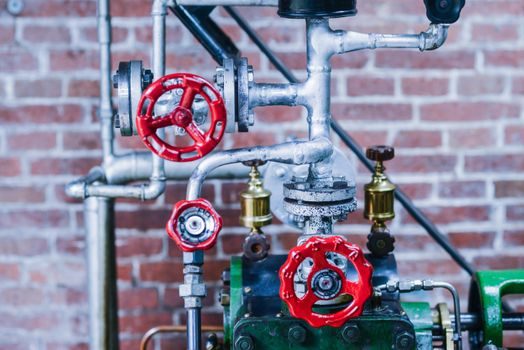
Needle valves are manually actuated, with optional lockable handles, bonnet extensions for cold-service, and packings rated for the line fluid. They have no electrical interface, no coil, and no IP rating in the usual sense — the failure mode is "stays where the last operator left it." That is a feature in sampling circuits where you want predictable restriction during a calibration and full lockout during maintenance. [S1]
Solenoid valves are wired devices: a coil (commonly 24 VDC, 110 VAC or 220 VAC, with ATEX/IECEx options for hazardous area) drives the plunger; response time for a direct-acting 2/2 is typically 5–50 ms, and for a piloted diaphragm 20–200 ms. The AEX6 controller in [S1] is the upstream intelligence — it sequences up to 620 outputs in a pulse-jet cleaning cycle rather than driving one coil. Where you need remote, repeatable, PLC-coordinated on/off, you need a solenoid valve; where you need stable, low-Cv, operator-tunable restriction, you need a needle valve.
Application Fit: Where Each One Earns Its Tag
Needle valves earn their tag on instrument air, gauge lines, level bridles, chemical injection skids, and impulse lines to DP transmitters. NTGD's catalogue explicitly groups "needle valve, needle globe valve, thermal instrument valve and valve group" together, signalling that the family is for sampling, isolation and fine throttling in instrument loops, not for main process block valves [S2]. A common pairing in 2026 skid builds is a stainless needle valve on the high and low side of a DP cell, then a ball valve for full isolation further upstream — needle for trim, ball for block.
Solenoid valves earn their tag on anything that has to switch on a control signal: pneumatic actuator air supply, burner fuel shut-off, dust-collector diaphragm valve pilots, coolant or drain dump valves, and safety interlock dump lines. The AEX6 reference in [S1] targets dust-collector pulse cleaning, where 10 to 620 solenoids fire in sequence to blow filter bags clean; this is a textbook solenoid application because the action is binary, fast, repetitive, and coordinated by a controller. SolenoidValve.cn's high-pressure and steam variants target similar on/off service at higher pressure and temperature envelopes than any needle valve would survive [S5].
Standards, Materials and Sourcing Anchors
Both device families are covered by overlapping but not identical standards. Needle valves on instrument service typically reference ASME B16.34 (valve specification) and MSS-SP (instrument valve standards), with body materials 316 SS being the default for chemical service and carbon steel for general utility. NTGD markets itself as an ISO 9001 certified manufacturer and offers customised materials, which is the floor expectation for a serious needle-valve vendor in 2026 [S2].
Solenoid valves stack additional electrical and hazardous-area standards on top of the pressure-containing body code: coil insulation classes, IP65/IP67 enclosure ratings, and for hazardous area the ATEX 2014/34/EU directive with IEC 60079-series construction standards, or IECEx for non-EU markets. The AEX6 controller in [S1] is sold for dust-collector service where combustible dust atmospheres apply, which is the same trigger zone for ATEX category ratings. The fine engineering point is that a solenoid valve carries two compliance stacks — pressure-side and electrical-side — and a needle valve carries only the pressure-side one.
Failure Modes and Maintenance Windows
Needle valves fail by seat erosion (from throttling dirty service), packing leakage (from cycle-fatigue or chemical attack), and stem galling (from infrequent operation in corrosive service). The fix is rebuild: repack, reseat, sometimes replace the stem. Because the device is mechanical and hand-operated, mean time to repair is short and the spares kit is a handful of parts. [S2]
Solenoid valves fail by coil burnout (from voltage spikes or duty cycle overshoot), plunger sticking (from scale, debris, or sticky deposits), and diaphragm rupture (from water-hammer or chemical incompatibility). The fix is usually a coil or diaphragm kit swap, with the body staying in line. Where the application is safety-relevant — burner shut-off, ESD dump — the solenoid needs a periodic proof test and a documented failure mode (typically fail-closed on de-energisation for fuel, fail-open for cooling). Pairing a balancing-valve upstream of a solenoid on a heating loop is a common 2026 hydronic pattern: balance for steady-state distribution, solenoid for on/off sequencing.
Selection Decision: A Direct Comparison
For procurement, the four hard criteria are: (1) control mode — manual throttling vs electrical on/off; (2) Cv band — needle valves cluster below 1.0, solenoids sized for full pipe flow; (3) actuation source — a hand versus a coil and a control signal; (4) standards stack — pressure-side only versus pressure plus electrical plus hazardous-area. A needle valve wins when the operator sets the flow once and walks away; a solenoid valve wins when the PLC sets the flow every cycle. [S3]
The wrong-spec penalty is concrete: a needle on a pulse-jet manifold starves the bag filter and trips differential pressure alarms; a solenoid on a gauge line gives the operator no way to trim the sample flow and ruins the analyser baseline. Cross-checking the related Diaphragm Valve vs Control Valve: 2026 Spec Cut and Sourcing Gates decision pattern is useful, because a diaphragm valve can act as either a manual or actuated on/off element, and the same control-vs-throttling logic applies. For deeper needle-valve selection gates, the in-house Needle Valve 2026 Buying Guide covers connection standards, Cv ladders and pressure class in more detail.
Price, Lead Time and Vendor Reality in 2026
Pricing in the public sourcing pages reviewed for this cut places ISO 9001 stainless needle valves from Chinese manufacturers in a tight band driven by Cv, end connection and material — with 316 SS, NPT, 6000 psi WOG bodies in the common procurement range. NTGD's own page frames itself as a manufacturer-direct source with custom material capability, which is consistent with 2026 industrial sourcing patterns favouring OEM-direct over distribution for instrument valves [S2].
Solenoid valves price on body size, pressure class, coil voltage and certification envelope. A general-purpose 1/4″ NBR-diaphragm 2/2 solenoid in 220 VAC is a stock-shelf item at the SolenoidValve.cn-tier of supplier; an ATEX/IECEx stainless solenoid with EEx d IIB T4 on a 1/2″ body in 24 VDC is a quote-line item with documented longer lead time [S5]. The AEX6 controller sits above the valve body in the bill of materials — it is the sequencing brain for 10 to 620 outputs and is sourced as a separate line item from the field solenoids it drives [S1].
Watch for needle-valve vendors publishing 316L and alloy-20 options for hydrogen and pharmaceutical service, and for solenoid vendors consolidating 24 VDC low-power coils on the pulse-jet and burner-shutoff lines.