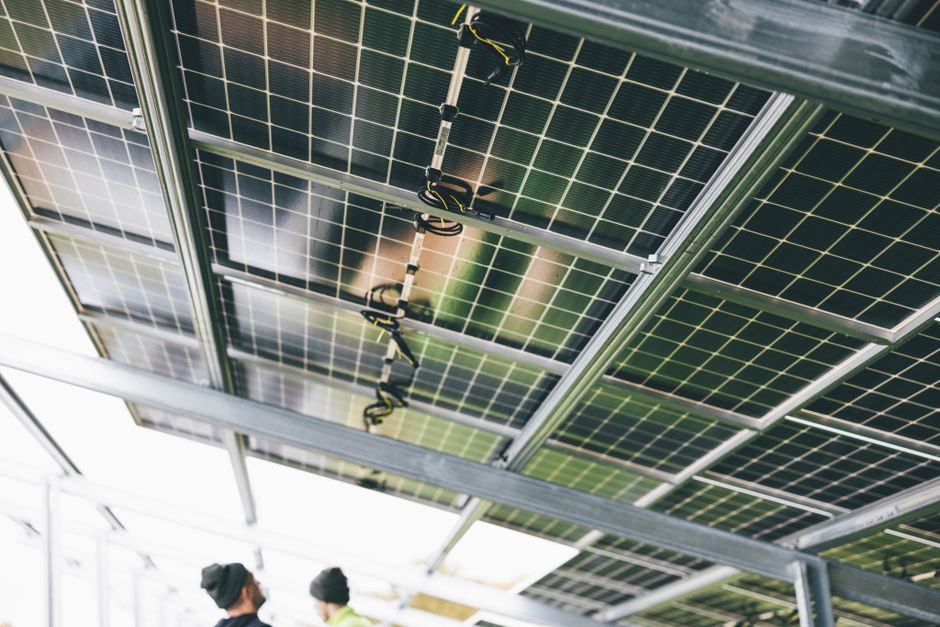
Solar panel OEM contracts in 2026 price monocrystalline modules at US$0.07–0.11/W on Made-in-China supplier listings, with 18,000 W MOQs common on 565–580 W half-cell product lines [S5]. DAH Solar in Hefei, Anhui runs 5 production lines and explicitly lists both OEM and ODM R&D capacity, the clearest signal that Chinese crystalline-silicon suppliers now treat the two models as parallel services, not alternatives [S2].
OEM means the buyer writes the spec — cell type, glass, frame, junction box, backsheet, certifications — and the factory executes. ODM flips that: the factory owns the bill of materials, the buyer brands the result. The choice drives IP, lead time, unit cost, and which IEC 61215 and IEC 61730 test reports can be inherited versus re-issued [S4].
Definition Split: What the Factory Actually Does in Each Model
OEM contract manufacturing is build-to-print: the buying company supplies cell efficiency, dimensions, anodized aluminium frame section, junction box rating, and the factory assembles against that print. Resun Solar's ISO 9001 + ISO 14001 sites in Suzhou ship full module ranges under that model, with TUV IEC 61215, IEC 61730, VDE, CEC, EMC, LVD, and CE certification on the standard product line [S4].
ODM is design-to-sample: the factory proposes a reference design — cell layout, half-cell architecture, anodized aluminium alloy frame — and the buyer brand-labels it, sometimes with minor cosmetic changes. Hebei JY Future New Energy lists 570 W / 580 W / 565 W half-cell modules and 500–650 W anodized aluminium alloy modules as ODM-ready SKUs, with per-watt pricing that competes directly with OEM runs on the same watt class [S5]. For adjacent factory-process reference, see the Solar Panel Manufacturing Equipment: Process Stations, Vendors, Spec Gates process map.
Decision Criteria: When Each Model Pays Back
Use OEM when you already hold certified cell sourcing, need a private mould on the junction box or frame, or must inherit a specific TUV / UL / CEC certificate for downstream subsidy claims. The trade-off is MOQ pressure — Hebei JY Future's OEM 18,000 W minimum on its 565–580 W half-cell line means roughly 31–32 modules minimum, a barrier for distributors but trivial for EPCs running multi-MW tenders [S5].
Use ODM when speed beats IP, when entering a new watt class (for example stepping from 410 W to 580 W half-cell), or when the buyer's engineering team cannot maintain a full BoM. The ODM model lets the factory's R&D absorb the risk of a new cell generation, while the buyer focuses on channel, warranty registration, and inverter pairing. Reference the Solar Panel Process Control: Instrument Stack, Sensor Specs, and Cell-to-Module Loop for the inspection gates that travel with the SKU either way.
Spec-Level Comparison: OEM vs ODM on 4 Buyer Criteria

Four criteria separate the two on the 565–580 W half-cell class that dominates 2026 supply. (1) Unit cost: OEM lands at the floor of the US$0.07–0.11/W window only when the buyer commits palletized volumes; ODM sits mid-window with no volume gate beyond standard container loads. (2) Lead time: OEM needs 4–8 weeks for tooling sign-off and first-article approval; ODM ships from stocked tooling in 2–4 weeks on catalogue SKUs. (3) Certification ownership: OEM buyers can inherit a TUV IEC 61215 / IEC 61730 report only if no BoM change occurs — any cell-source swap forces re-test; ODM buyers take the factory's existing certificate as-is. (4) IP / tooling: ODM tooling belongs to the factory and can be re-used for other buyers; OEM tooling is typically paid for by the buyer and remains exclusive [S5][S4].
The cell-process foundation is identical in both models — Passivated Emitter Rear Contact (PERC) laser scribing, dielectric rear passivation, screen-printed aluminium ohmic contact — because the wafer and cell stage precede the OEM/ODM split. A 6-inch PERC wafer carries roughly 155 laser scribes, each 156 mm long and 40–50 µm wide, on a 1 mm pitch, equating to ~25 m of total scribe length per cell [S1].
Quality, Certification, and Factory-Audit Reality
Certification scope decides which contract model survives a bankable-document review. Resun's TUV IEC 61215, IEC 61730, VDE, CEC, EMC, LVD, and CE stack, plus PI-Berlin PID-free approval, was earned on the factory's reference BOM — so an OEM buyer who changes the junction box brand without notifying TUV will invalidate the certificate [S4]. The same logic applies to UL 61730 and IEC 61701 salt-mist reports; the ODM path is cleaner because the factory has already maintained a single BoM across many brand-label runs.
Factory audit depth follows the same rule: DAH Solar and Hebei JY Future both list ISO 9001, ISO 14001, and ISO 45001 on their supplier profiles, but the audit report that ships with an ODM module is the factory's own report. OEM buyers usually commission a second-party or third-party audit (SGS, TUV, BV) at their cost. For the certification-standards map across IEC, UL, and the factory-audit stack, see Solar Panel Manufacturing Quality Standards: IEC, UL, and Factory Audit Map.
Limitations and Failure Modes of Each Model

OEM fails on three predictable patterns: (1) the buyer's spec contradicts the cell vendor's binning window, forcing downgraded efficiency; (2) the buyer's required certificate is not in the factory's existing TUV file, adding 6–12 weeks for a new test campaign; (3) the buyer's MOQ slips below the factory's production-line efficiency threshold, pushing unit cost above the ODM catalogue price. [S5]
ODM fails when: (1) two competing buyers brand the same ODM SKU, causing channel conflict that the factory's sales team will not arbitrate; (2) the buyer's target market demands a certification the factory's reference BOM does not hold (for example, Japan's JIS C 8990 or Brazil's INMETRO Portaria 140); (3) the buyer needs a frame colour, junction box, or backsheet that is not in the factory's standard ODM catalogue — at which point the project silently converts to a hybrid OEM-on-ODM engagement, with the price and lead time of OEM but only the partial IP rights of ODM [S5][S2].
Buying Workflow: A 5-Node Selection Path
Node 1 — Define the watt class and cell architecture (PERC mono half-cell, TOPCon, HJT). Node 2 — Decide whether the target market inherits an existing TUV IEC 61215 / IEC 61730 report or requires a fresh one. Node 3 — Map MOQ to volume: below ~30 modules, ODM is the only realistic path on Made-in-China; above ~500 modules, OEM unit cost pulls ahead [S5]. Node 4 — Lock the junction box, frame, and backsheet before signing — these are the three BoM lines that drive re-test risk. Node 5 — Audit the factory against ISO 9001:2015 and ISO 14001:2015 evidence, not just the certificate on the supplier profile [S6].
Two trackable signals into the next quarter: the unit-price band on 580 W half-cell SKUs (currently US$0.07–0.11/W on Made-in-China supplier listings) and the number of Anhui / Hebei factories offering parallel OEM + ODM R&D capacity lines — DAH Solar and Hebei JY Future both list this dual-capability configuration as of January 2026 [S2][S5]. Watch the lower edge of that price band; a sustained move below US$0.07/W would indicate TOPCon or HJT oversupply pressuring the PERC half-cell OEM contract terms. Reference the broader equipment-procurement context in the Solar Panel Manufacturing Equipment: Process Stations, Vendors, Spec Gates process map.
For the relevant spec sheets and selection criteria, see additive manufacturing material, alc panel, and hmi panel.