
For sawmill, log-yard, and chip-handling duty in 2026, the engineering-consensus pick is a double-girder top-running bridge crane rated CMAA Class D or E, with 10-30 ton capacity and a 60-120 ft span, per the 2026 AFE Crane selection guide [S5].
Forestry duty sits in a narrow band of CMAA service classes: Class D (heavy service, 10-20 lifts/hr, ~15 ft average lift) and Class E (severe service), with Class C reserved for planer rooms, kilns, and finished-lumber handling where the average load runs 50% of rated capacity and lifts are gentler [S3]. Bohl, TS Overhead, and the broader custom-engineered bridge-crane market routinely quote spans of at least 100 ft and load capacities of 100 tons or more for heavy forestry and lumber-mill work [S6][S7].
Why Forestry Duty Maps to Class D / Class E, Not Class C
Class E (severe service) sits one tier above for continuous heavy-duty production with higher cycle rates, which is the operating profile of a green-chain log deck, a debarker infeed, or a chip-bin loader running two shifts [S3].
Class A (standby/infrequent) and Class B (light service, 2-5 lifts/hr averaging 10 ft) are wrong for almost every forestry cell except turbine rooms and motor rooms; Class C (moderate, 5-10 lifts/hr, 50% average load) fits planer rooms and trim lines where cycle rates and load factors are visibly lower [S3]. Specifying a Class C bridge for a green chain is one of the more common over-spec errors; it under-buys the mechanical duty, accelerates gearbox wear, and voids the design margin the CMAA tables assume.
Single Girder vs Double Girder: The 15-ton / 65-ft Threshold
Single-girder underhung bridge cranes are typically used for capacities up to 15 tons and spans under 60 ft, with smaller enclosed-track systems handling 4,000 lb or less; loads from 2 to 15 tons sit on either patented track or structural I-beam tracks [S2]. Single-girder top-running units in a four-sided box-girder build extend that envelope to spans up to about 80 ft while staying under the 15-ton mark [S2].
A double-girder top-running bridge becomes the right call when span exceeds about 65 ft, lift weight exceeds 15 tons, or the application demands maximum hook height, because the hoist sits on top of the two girders and the hook can be raised between them for greater headroom [S4]. Double-girder top-running layouts are the standard answer for Class D and Class E forestry duty, with typical spans as long as 120 ft and capacities scaling from 10 tons into the 100-200 ton range cited by custom builders [S2][S6][S7].
For a side-by-side decision snapshot:
Single-girder underhung, up to 15 t, under 60 ft span, Class C, planer rooms, trim sheds, finished-lumber stacks. Single-girder top running (box girder), up to 15 t, up to 80 ft span, Class C/D, small sawmill service bays. Double-girder top running, 10-30 t (extendable to 100 t+), 60-120 ft+ span, Class D/E, green chains, debarker infeed, log decks, chip handling.
Top Running vs Underhung for a Sawmill Building
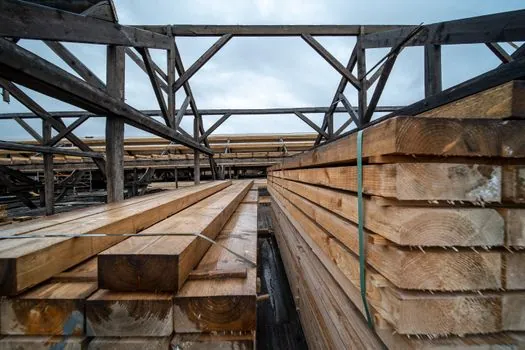
Top-running cranes travel on rails mounted on top of the runway beams and are commonly used for higher-capacity systems; underhung cranes suspend from the bottom of the runway and suit lighter capacities or building structures that cannot carry top-running reactions [S5]. In a forestry plant, the runways usually tie into the main building columns or a freestanding support structure, which is what makes the top-running double-girder layout mechanically clean: end-truck reactions feed directly down the columns with no hung-load tension on the roof steel.
Underhung single-girder systems do have a niche inside forestry: enclosed-track workstation cranes in work cells, finger-jointer feed lines, and packaging end-of-line where the building was not originally designed for crane loads and ceiling-hung runways are the only option [S2][S5]. Patented-track underhung cranes can also interlock with adjoining bridges so a trolley transfers between them, which is useful for narrow mills that need a shared hook path across two short bays [S2].
Capacity, Span, and Service Class by Forestry Cell
A typical green-chain log deck runs a 15-25 ton double-girder top-running bridge at Class D with a 60-100 ft span, sized to lift full-length logs or log bundles off the infeed deck and feed the debarker or sorter bin. Debarker infeed and chipper-feed bridges are usually 10-20 ton Class D units on 50-80 ft spans, where the duty cycle is steady but individual lifts are shorter. A finished-lumber stacker crane inside the planer mill drops back to a 5-10 ton single-girder top-running unit at Class C on a 40-60 ft span, which is the gentlest end of the forestry spectrum. [S2]
For sawmill log yards that need to move between buildings, a gantry crane is often paired with the bridge crane: the bridge handles fixed-bay cells, the gantry handles outdoor log storage with rigid steel legs running on embedded track. The two are not interchangeable; bridge cranes win on heavy fixed-path lifts, while a gantry crane buys mobility and outdoor-rated construction.
When the application is bulk load weighing on the hook, integrating a crane scale between the hook block and the load is standard practice for invoicing truckloads of logs or chips; forestry scale tolerance is usually 0.1% of capacity and the scale body needs an IP65 / outdoor-rated enclosure for yard use.
Common Selection Mistakes in Forestry Crane Projects
Most forestry crane problems come from under-defining the duty before sizing the bridge: teams focus on capacity and span while overlooking how the system will actually be used, which leads to limited hook coverage, missed cycle times, and safety issues around visibility and control [S5]. The 2026 AFE guide calls out five specific failure modes: limited hook coverage or reach, inefficient workflow that pushes operators back to manual handling, systems that miss production speed targets, control or visibility safety concerns, and post-install change orders that cost more than the original crane [S5].
Other recurring errors: specifying Class C where Class D duty actually applies, picking single-girder underhung for a 70 ft log-deck span where the deflection and headroom both become binding constraints, and forgetting that the runway beam is part of the building structure, not the crane scope, which leads to column reactions being added to the structural package after the fact [S2][S5]. For heavy-mill applications, double-girder systems also allow advanced controls, maintenance walkways, and auxiliary equipment that single-girder layouts cannot host [S5].
Standards, Duty Verification, and What to Lock in Before Order
CMAA 70 / 74 / 75 series govern the duty classification that drives mechanical design, and most custom builders will quote to CMAA Class A through F with capacities to 200 tons and spans to 150 ft as a routine envelope [S7]. For European builds, FEM 1.001 / 9.341 and EN 15011 are the equivalent duty and structural references. Outdoor log-yard bridges should be checked for wind-load operating limits and for cold-temperature steel (typically -20°C or -30°C Charpy) when the yard sits in a northern climate.
Before signing a forestry bridge-crane PO, lock in: rated capacity and the heaviest expected load, CMAA class backed by a calculated number of lifts per hour, span measured column-to-column, hook height required for the tallest stack or tallest log, hoist lift and travel speeds, runway reaction loads for the structural engineer, duty environment (indoor / outdoor / wash-down), and the integration plan for any weighing or telecontrol layer such as a crane scale or a pendant-to-radio control retrofit.
Next trackable signal: the 2026 AFE selection guidance and the broader shift toward telescoping and workstation bridge cranes in planer rooms suggest that the 2026-2027 procurement cycle will keep tilting toward double-girder top-running Class D/E units as the default forestry bridge, with single-girder underhung holding only the light-assembly and finished-lumber cells. For the broader forestry equipment spec map, see the concrete batching plant selection guide for forestry roads and yards and the cantilever rack spec map for sawmill and log yards, which cover the matching yard infrastructure and storage layer for a bridge-crane investment.
For the relevant spec sheets and selection criteria, see overhead bridge crane.