
For electrical-installation work, the right oxy-fuel cutter is specified by four gates: seat type, metal thickness, application, and fuel gas, and the process covers 3–300 mm (1/8 in to 12 in) mild steel without any electrical supply [S1][S4].
Oxy-fuel still wins on field portability because it needs no electrical outlet and no air compressor, which matters on a live switchgear room, a cable trench job, or a remote substation build where generators and 110 V receptacles are not yet commissioned [S1][S3].
Spec Gates for Electrical-Field Cutting
For electrical work the spec gates are narrower than for general fabrication: most on-site cuts are cable tray, conduit struts, grounding rod, and mild-steel enclosure plate in the 3–25 mm band, so a single 1/8 in to 1 in tip family covers the majority of jobs [S1].
The seat type is the first hard gate, because mixing a Victor-style seat with a non-Victor tip is the most common cause of oxygen leak at the torch head, and the research flags this as a primary safety failure point rather than a performance issue [S1][S5].
Metal thickness drives the center-hole and preheat-orifice sizing; the same tip used on 6 mm tray will not deliver enough oxygen kerf on a 25 mm grounding-bus plate, and the wrong tip either starves the cut (slag drag) or burns through thin stock [S1][S4].
Fuel Gas Comparison for Site Use
Acetylene delivers flame temperature between 5,600°F and 5,800°F with the shortest preheat time, which suits small-diameter and detail work but is the most expensive fuel and is the worst choice for broad heating [S1].
Propane runs cooler and is more storage-stable, so it is the default field choice for crews who only need a cutting machine for strut, tray, and plate; the trade-off is longer preheat and the need for an injector-style torch on propylene to keep the heat cone tight [S3].
Natural gas produces the lowest flame temperature and the slowest cut, which is rarely justified on a small electrical site; it appears mostly in shops already plumbed for natural gas and is listed here so a buyer can rule it out cleanly [S3].
Tip Size Map Against Mild-Steel Thickness
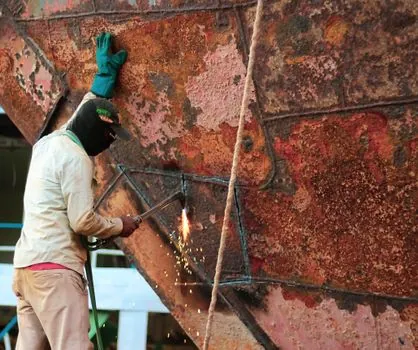
Tip selection is a direct map from thickness to flow: thin sheet (under 6 mm) needs a small tip to prevent burn-through and warping, while thick plate (over 25 mm) needs a large tip that delivers both higher oxygen and higher fuel flow to sustain the kerf [S4].
The practical field rule is to size the tip so the cut can be started and held without puddling the slag, and to use the manufacturer's cutting-tip chart as the binding reference rather than the torch-handle color code alone [S4].
For an electrical-installation toolkit a 1-101-1 style cutting tip covers the 6–25 mm band, and a 4-MFA rosebud heating tip covers shrink-ring, heat-shrink, and bending of up to 13 mm grounding bar without changing cylinders [S5].
Flame Settings and Cut Quality
A neutral flame with equal inner cones, set with and without the oxygen lever pressed, is the verified baseline for clean cut; a carburizing flame (too much fuel) leaves carbon deposits, and an oxidizing flame (too much oxygen) leaves porous, brittle edges [S3].
Preheat is mandatory on mild steel because the material must reach roughly 1,600–1,800°F ignition temperature before the cutting oxygen stream can sustain oxidation, and the same preheat burns off light rust and mill scale that block ignition on outdoor substation plate [S4].
A short, weak flame at the tip is the first diagnostic for a clogged orifice, and the corrective action is to clean with the proper tip cleaner set rather than to increase regulator pressure, which only drives the obstruction deeper [S3].
Electrical-Site Safety Practices
The published 10-step safe setup sequence starts with cylinder inspection, torch check, and flashback-arrestor / check-valve installation before any gas flows, and explicitly requires ventilation because the process consumes oxygen from the work area [S6].
For electrical work the additional layer is clearance: cylinders are stored upright and chained, regulators and hose are kept clear of energized bus bars, and acetylene is never used below ground level in a confined vault because of its wide flammable range [S1][S6].
Personal protective equipment for the operator is a cutting goggles shade, leathers, and a flame-resistant jacket; the same PPE rule applies whether the torch is acetylene or propane because the hazard is the same molten slag and IR/UV flame [S6].
When Oxy-Fuel Loses to Plasma on Site
Oxy-fuel is not the right tool when the cut is stainless steel, aluminum, or copper; those materials do not oxidize fast enough at the preheat temperature, and plasma or carbon-arc wins on cut quality and speed [S3][S4].
Plasma also wins for any cut thinner than about 3 mm, because the heat-affected zone of oxy-fuel on thin sheet warps the edge and is harder to control than a low-amperage plasma arc [S1][S3].
For the steel work that dominates electrical-installation sites, however, oxy-fuel remains the cheaper, more portable, and power-independent default, and it pairs with the same welding and cutting tool the crew already carries for brazing and heating.
What to Verify Before Purchase
Confirm the seat type by torch brand and model, not by color, and confirm the tip chart against the heaviest plate the crew will realistically cut on the worst site (a 25 mm grounding pad is a common real-world max) [S1][S4].
Confirm the fuel-gas decision by job mix: acetylene for detail and fastest preheat, propane for general field cutting and stable storage, propylene only if an injector torch is already on the truck [S1][S3].
Confirm the kit includes check valves or flashback arrestors on both the fuel and oxygen side, a tip cleaner set sized to the purchased tips, and a regulator pair matched to the cylinder connection (CGA 540 oxygen, CGA 510 acetylene in North America) [S5][S6].
Track two signals over the next quarter: any revision to NFPA 51 cut-table limits for on-site acetylene storage, and any shift in riser-cutting machine listings toward propane-injector torches for substation and data-center builds, which would re-rank the fuel-gas choice above.
Related analysis: Oxy-Fuel Cutting Torch Selection for Steel Construction: Spec Gates and Capacity Map.