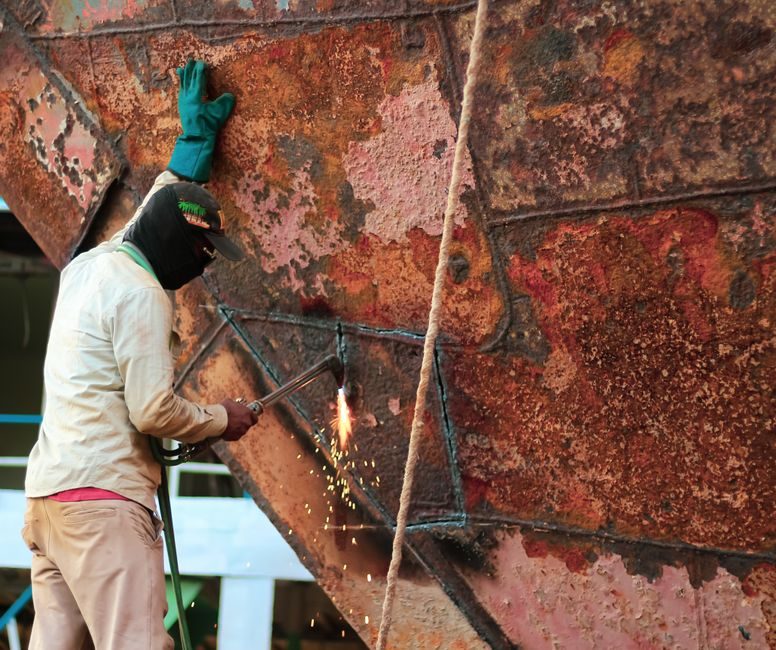
Oxy-fuel torches remain the default thermal cutter for mild-steel plate from 0.5 mm up to 250–300 mm because the process is a pure iron-oxidation reaction, not a melt process, which is why it scales so cheaply to heavy plate [S5].
Working thickness on a modern CNC oxy-fuel gantry reaches 300 mm (United ProArc Master series) with positioning accuracy of ±0.1 mm, while portable CNC frames typically span 1,200–1,600 mm in X and 2,000–5,500 mm in Y at max 2,500 mm/min cutting speed [S2][S3].
Where the process wins — thickness, cost, and equipment simplicity
Oxy-fuel is the lowest-capex thermal cutting route for steel: a torch, regulators, hoses, and a fuel cylinder are all the manual kit needs, and the same torch body fires on acetylene, propane, MAPP, propylene, or natural gas with a matched nozzle [S5].
For structural and shipyard work, the Lincoln Electric EUROTOME 2 bridge delivers a 15 m/min travel speed with 1–4 oxy-fuel torches plus a plasma head and a marking tool, and handles plate from 0.5 mm upward on the same gantry [S1]. Standard rail sections ship in 3 m modules, extendable by 1.5 m or 3 m, so the machine grows with the workpiece rather than the other way round [S1].
Where oxy-fuel fails — material chemistry is non-negotiable
The cut is driven by iron oxidation, so the workpiece must be oxidisable low-carbon steel or wrought iron; stainless, aluminium, copper, cast iron, and high-carbon steel cannot sustain the reaction, and any rust, paint, or mill scale thicker than a thin film must be ground off before piercing [S6].
Cut precision is also coarser than plasma: a wider kerf and a larger heat-affected zone (HAZ) make oxy-fuel impractical for sheet under ~6 mm and for any tolerance tighter than roughly ±0.5 mm without post-machining [S6]. For a side-by-side of plasma against oxy-fuel on thin gauge and non-ferrous work, see the plasma cutter types and classifications spec-map.
Spec-driven comparison: oxy-fuel, plasma, and laser on the four decision axes
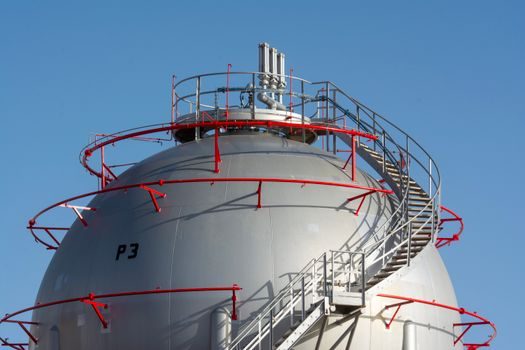
Material range: oxy-fuel covers mild/wrought iron only, plasma cuts all conductive metals, fibre laser handles steel, stainless, and aluminium with the thinnest HAZ [S6].
Thickness range: oxy-fuel 0.5–300 mm, plasma ~0.5–50 mm practical, fibre laser typically 0.5–25 mm on steel [S2][S3][S5].
Tolerance/kerf: oxy-fuel kerf ~1.5–3 mm with a wide HAZ, plasma kerf ~1–1.5 mm with a narrow HAZ, fibre laser kerf 0.1–0.3 mm and minimal HAZ [S6].
Operating cost: oxy-fuel is the lowest per hour on heavy plate because the gas is cheap and consumables are a nozzle, while plasma consumables (electrode + nozzle) and laser assist gas dominate the opex of the other two routes — a 5-year TCO stack for plasma is the right benchmark for any shop weighing the swap.
Process selection by use case
Shipyards, structural-steel fab, and wind-tower shops running 10–300 mm S355/A36 plate are the canonical oxy-fuel use case: a Master-series gantry with X travel up to 7,600 mm, ±0.1 mm accuracy, and optional IHT automatic flame torches is the spec to copy for that duty [S3].
For mixed mild-steel/stainless/aluminium job shops doing plate under 25 mm, a plasma-dominant gantry (Hypertherm HPR-class) with a single oxy-fuel torch reserved for the thick plate is the rational split, and the oxy-fuel cutting machine and dedicated oxy-fuel cutter encyclopedia entries lay out the family differences.
Recycling, demolition, and field scrapping: vision-guided robotic oxy-fuel cells track irregular scrap profiles where hand cutting was the only previous option; the eye-in-hand camera closes a control loop that a human cannot match on a hot, curved edge [S4].
Fuel-gas trade-offs the spec sheet hides

Acetylene gives the highest flame temperature (~3,160 °C) and the fastest cut on thin steel but is the most expensive fuel and the only one that cannot be used above ~1 bar working pressure without instability; propane and propylene trade flame temperature for a lower per-cubic-metre cost and safer storage; natural gas is the cheapest per kilojoule but needs higher flow and a larger preheat nozzle to compensate [S5].
MAPP sits between acetylene and propane on both flame temperature and price, which is why it is the default on many North American structural shops [S5].
Safety, ventilation, and the standards frame a buyer has to check
Oxy-fuel cutting releases UV, NOx, and metal-oxide fume, so a fume-extraction table plus a dust collector is now a standard option on CE-marked gantries, and zoning for acetylene storage follows the explosion-proof electrical equipment framework on the gas-detection side [S3].
For classification of the torch itself (hand vs machine vs heavy-duty), the oxy-fuel cutting torch types guide pairs with the riser-cutting-machine entry for foundry-side removal work. CE conformity on a CE-marked gantry covers the electrical and gas-train safety chain but does not certify cut quality, which remains an ISO 9013 tolerance band set by the buyer [S3].
Selection rules a process engineer can apply in five minutes
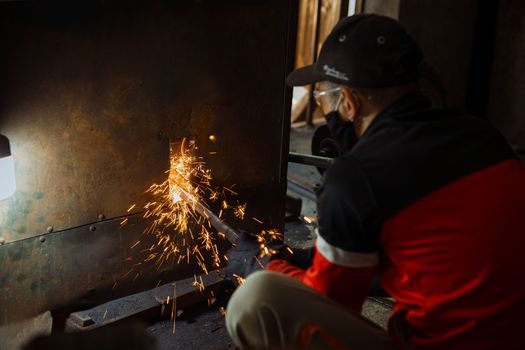
Pick oxy-fuel if: the workpiece is mild or wrought iron, the thickness is above 6 mm, the tolerance is ±0.5 mm or looser, and the cut length is large enough to justify a gantry's footprint [S5][S6].
Pick plasma if: the workpiece includes stainless, aluminium, galvanised, or painted mild steel, thickness is below ~25 mm, or the cut involves small holes, internal contours, or stacked sheets [S6].
Pick laser only if: the duty is thin-gauge (<6 mm) stainless/aluminium/carbon steel, tolerances are below ±0.1 mm, and the shop can justify the higher per-hour consumable cost — industrial-gas selection logic behind the cut profile is laid out in the industrial gas pros and cons spec map.