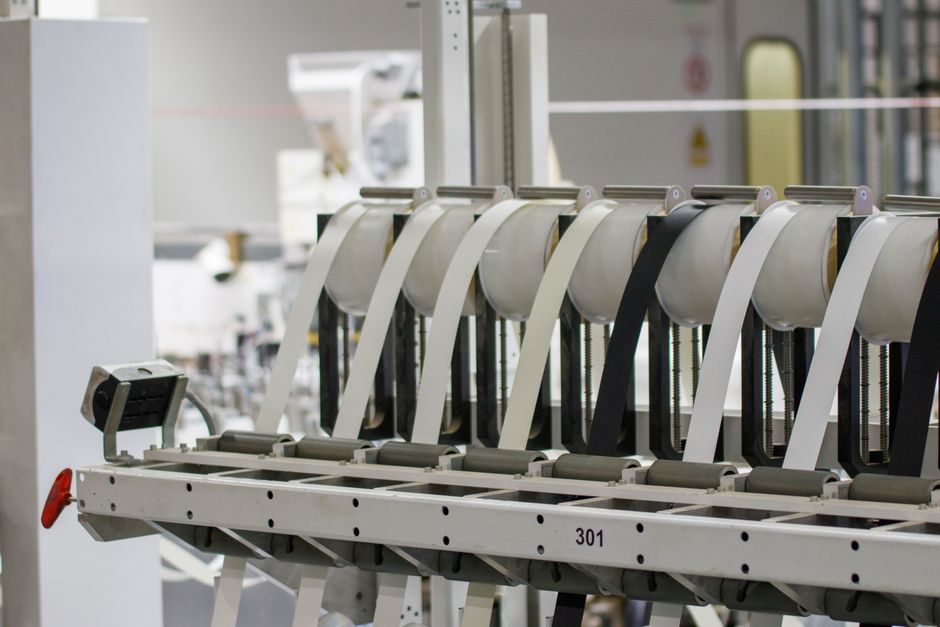
A 2026-spec lithium-ion cell line runs four sequential stages — electrode fabrication, cell assembly, formation cycling, and aging — with each step generating the defect signatures (voids, agglomerates, dendrites, SEI anomalies) that machine-learning analytics platforms such as Machinery Analytics and Exensio Battery are now built to catch [S1][S2].
Both vendors position their platforms at the same three pressure points: electrode microstructure inspection via SEM/TEM/optical microscopy, time-series tool monitoring up to 1500 channels at roughly 4 GB/day, and image-feature quantification (active material, binder, voids, agglomerations, texture) for batch-level particle-size density functions [S1]. For an engineer evaluating line equipment, the data layer is now as decision-critical as the coater, calendar, or stacker hardware it sits behind.
Electrode Coating, Drying and Calendering: Where 80% of Scrap Originates
Machinery Analytics lists active-material, binder, void, agglomeration and high-texture segmentation in optical microscopy images as the primary electrode-level defect classes their ML pipeline auto-classifies, with feature-size density functions generated per image or per batch [S1]. PDF Solutions extends the same defect taxonomy into its Exensio Battery module set, which markets dedicated Electrode Quality Monitoring & Control and Defect Management sub-modules rather than a single dashboard [S2].
Coater dryer length and calender line-load are the two mechanical parameters most often cited as drivers of electrode density variation; the analytics layer treats them as multivariate inputs against which defect density is regressed, not as standalone setpoints. For broader coverage of the upstream precursor chain that feeds these coated electrodes, see the lithium hydroxide and cell capacity spec bands breakdown.
Cell Assembly: Stacking, Winding and the Welding Spec Window
Cell assembly is dominated by electrode-to-tab and tab-to-busbar joining, where the Industry 4.0 analytics stack from battery pack smart manufacturing covers ultrasonic and laser welding current/force windows in detail. After winding or stacking, the cell enters dry-room electrolyte filling; the dewpoint window (typically below −40 °C) is monitored as a time-series channel by FDC platforms at rates up to 4 GB/day per the Machinery Analytics spec sheet [S1].
Exensio Battery advertises Tool-to-Tool Matching as a standalone module, which addresses chamber-to-chamber offset in formation and aging — a defect class invisible without cross-tool normalization [S2]. Bosch's semiconductor plant, cited publicly, evaluated and selected the mæstria FDC product after benchmarking market alternatives, a signal that the same vendor's analytics layer is being adopted outside fabs [S2].
Formation, SEI Formation and Aging

Formation cycling is the highest-cost-per-cycle step in cell manufacturing because every cell must be slowly charged and held at low C-rates to grow a stable solid-electrolyte interphase. Exensio Battery quantifies the gain from analytics-driven formation control as 50% faster yield learning and 50% fewer quality excursions, against an 80% reduction in data-wrangling effort across the broader Exensio platform [S2]. These figures are vendor-published, not industry-benchmark, so they should be read as platform capability claims rather than cell-line yield baselines.
Aging — the days-to-weeks storage period at controlled temperature and state-of-charge — is the final yield gate, and the channel count for time-series anomaly detection (up to 1500 channels and 4 GB/day in the Machinery Analytics spec) was sized explicitly for this stage's high-channel-count data streams [S1]. For QA-side standards and supplier-tier signals that gate shipment from this step, the Lithium Battery QA Stack 2026 piece is the natural reference.
Sodium-ion and Alternative Chemistries on the Same Line
Sodium-ion cells share the four-stage architecture (electrode, assembly, formation, aging) but diverge on the dry-room dewpoint, current-collector substrate, and formation C-rate window — see the sodium-ion cell manufacturing map for the 2026 spec bands. Because the inspection instrumentation (SEM, optical microscopy, X-ray tomography) is chemistry-agnostic, vendors like Machinery Analytics advertise the same image-analysis pipeline for both Li-ion and Na-ion lines [S1].
For a peer reference on a non-battery high-volume line, the GPU manufacturing QA stack covers fabless-fab test-and-yield architecture that shares the same FDC + YMS analytics split, useful for engineers cross-mapping control theory between semiconductor and battery lines. Likewise, the Industry 4.0 process-plant spec view and CPU process-control instrumentation pieces frame the PLC and sensor stack that battery plants now specify in greenfield 2026 builds.
Selection Criteria: What the Engineer Should Spec on the Data Layer
For a 2026 cell-line build, the data-layer decision criteria reduce to four numbers and one process question. First, channel count per tool — Machinery Analytics markets support for 1500 channels at 4 GB/day per system, which sets the upper bound for a single formation cabinet's FDC feed [S1]. Second, image-modality coverage — SEM/TEM, optical microscopy, and X-ray tomography should all be ingestable into one platform, as Machinery Analytics lists all three as supported input types [S1].
Third, integration footprint — Exensio markets 50+ data-format ingestion (FDC, test, assembly, packaging) and both on-prem and cloud deployment, a useful yardstick when comparing against greenfield MES choices [S2]. Fourth, deployment tier — Machinery Analytics publishes three price tiers: small-business at $1,000/month, proof-of-concept at $10,000+ per project, and enterprise on a volume-based quote that includes custom ML models, on-prem/AWS connection, and live access to cloud-hosted databases [S1]. The process question to answer first: will the line run Li-ion only, or is sodium-ion dual-chemistry throughput planned for 2027 — because the analytics layer must be qualified against both sets of formation voltage windows before procurement.
Limitations and Failure Modes of Analytics-Driven Cell Lines
Vendor-published yield-learning gains (50% faster) and quality-excursion reductions (50% fewer) are reported against the platform's own baseline, not against an industry-wide reference cell, so they should be treated as upper-bound claims pending third-party audit [S2]. The ML models themselves are opaque to operators — Machinery Analytics flags "anomalies" and "recurring anomalies" via time-series classifiers but does not publish detection sensitivity or false-positive rate per defect class [S1].
On the data side, 4 GB/day at 1500 channels saturates standard historian storage within weeks, so retention policy and tiered cold-storage cost are the hidden opex line items not visible in the $1,000/month small-business tier [S1]. For nickel-based precursor lines that feed directly into NMC/NCA cathode production, the nickel spec stacks and nickel cost breakdown pieces are the upstream inputs an engineer should map before locking the electrode-coating acceptance window.
Standards, Sourcing and Trackable 2026 Signals

No single IEC or ISO standard governs the full battery-cell manufacturing flow end-to-end; instead, cell-level testing is anchored to UN 38.3 transport, IEC 62660 series for performance, and IEC 62133 for portable cells, while manufacturing-equipment vendors reference SEMI standards for cleanroom and vacuum-tool interfaces. PDF Solutions' CONNECT 2026 conference is publicly announced on its homepage as the next vendor-side industry gathering for FDC/YMS users, a trackable date for engineers evaluating roadmap disclosures [S2].
Two further signals to watch: first, the PDF Solutions Exensio Battery module roadmap (Electrode Quality Monitoring & Control, Defect Management, Tool-to-Tool Matching) is publicly listed but pricing and module-license terms are quote-only [S2]. Second, Machinery Analytics' enterprise tier is gated behind a "contact us" quote, so procurement benchmarks will only emerge from peer RFQ data [S1]. Engineers should treat both as platforms whose 2026 line-cost numbers are not yet public, and anchor capex decisions on per-cell inspection-cycle time and per-defect-class detection rate rather than on published yield-improvement percentages.
For component-level specifications, see additive manufacturing material, load cell, and load cell module.