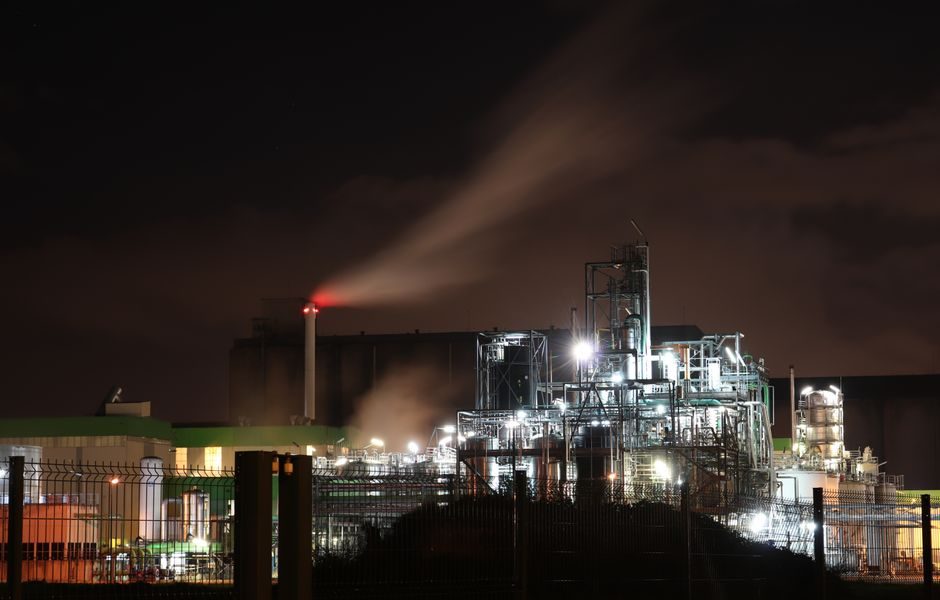
Petrochemical production technology centres on three thermochemical cores — steam cracking of naphtha/ethane to make ethylene and propylene, catalytic reforming of naphtha to make BTX aromatics, and polymerisation of those monomers into polyolefins — with each train needing tight mass-balance, temperature and pressure control.
Process licensors (steam crackers, polyethylene/PP loops) and automation vendors such as Yokogawa position plant-wide production management systems between planning and shop-floor execution to optimise scheduling against volatile raw-material prices [S1]. Petrochemical producers carry a wide product mix, so the control layer is sized to thousands of I/O and hundreds of motors and industrial valves per train.
Feedstock Slate and Core Conversion Routes
Feedstock selection defines the whole plant: ethane crackers maximise ethylene yield (≈80% selectivity) with minimal co-products, while naphtha crackers yield roughly 30–35% ethylene, 15–20% propylene and 10–15% butadiene plus a C4+/pyrolysis gasoline stream routed to aromatics extraction. Refinery-integrated petrochemical complexes feed catalytic reformer off-gas (C5–C9) and FCC gasoline to BTX recovery. [S1]
Integrated chains from C1 to polymer deliver higher margin than standalone units: LUKOIL's petrochemical block runs homopolymers, random copolymers and impact copolymers of polypropylene, with the underlying technology supporting more than 70 PP grades compliant with Russian and international quality standards [S3]. That product proliferation is what forces producers to run APC and recipe management on top of the base DCS.
Reactor Types and Operating Windows
Steam crackers operate furnace outlet coils at 780–900 °C with very short residence time (≈0.1–0.5 s) to favour olefin kinetics over secondary cracking, followed by transfer-line exchangers and primary fractionator trains. Polyethylene reactors split into three families: gas-phase fluidised-bed (Unipol-type), solution-phase and slurry/Ziegler-Natta or metallocene slurry loops, each with characteristic pressure ratings of 10–40 bar for LDPE high-pressure autoclave, 20–40 bar for LLDPE gas-phase, and 30–70 bar for HDPE slurry. [S2]
Loop PP reactors run at 30–40 bar and 60–80 °C with bulk liquid propylene, while gas-phase PP (Novolen-type) operates closer to 20–35 bar and 70–90 °C. These windows are why the pressure transmitter count on a single polyolefin train can exceed 600 — every catalyst feed line, slurry circulation leg and product discharge drum needs a stable, HART-over-4–20 mA signal into the DCS.
Separation, Compressor and Pump Train
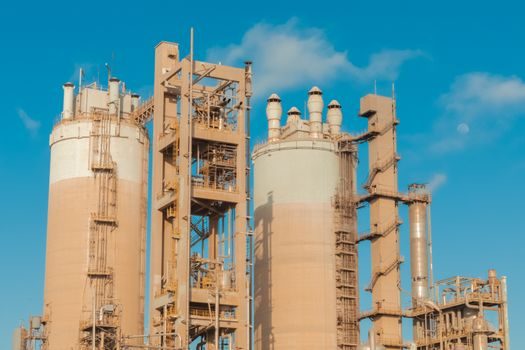
Cracked-gas compression is the most energy-intensive step in olefins: five-stage centrifugal compressors typically raise suction pressure from ≈0.4–0.6 barg to 35–45 barg, with interstage cooling, caustic wash for H2S/CO2 removal and a cold section (demethaniser at ≈−90 to −100 °C) using ethylene/propylene refrigerant cascades. Product fractionation columns — deethaniser, depropaniser, debutaniser and C2/C3 splitter — set the recovery and purity of each olefin cut. [S3]
Rotating equipment reliability drives plant uptime, and the coupling between the flow meter inventory (Coriolis on liquid polymer, ultrasonic or vortex on steam/hydrocarbon vapour, differential-pressure on feed, and thermal mass on flare gas) and the centrifugal compressor anti-surge loop is where process licensors invest the heaviest control engineering hours. Per LUKOIL's downstream block, more than 70 polypropylene grades can be produced by varying catalysts, comonomer feed and reactor temperature/pressure windows inside these separation and finishing trains [S3].
Control and Optimisation Stack
Petrochemical DCS platforms carry 5,000–15,000 tags per process unit; a full integrated site routinely exceeds 100,000 tags. APC layers model-predictive control on top of the DCS for key inferentials (ethylene yield, propylene-to-ethylene ratio, polymer melt index) and feed the production-management system that bridges planning and manufacturing for optimal scheduling [S1].
Field instrumentation must hold up in hydrogen-rich, ethylene-rich and high-temperature environments, so the pressure sensor spec sheet usually shows NACE MR0175 compliance for sour service, dual-seal construction, and IEC 60079 zone 1/2 certification for hazardous-area classification. For polymerisation reactor control, redundant pressure measurements and high-temperature (≥200 °C) heat-traced impulse lines are standard practice, with the loop reactor differential pressure driving slurry-circulation mass balance.
Standards, Materials and Quality Targets
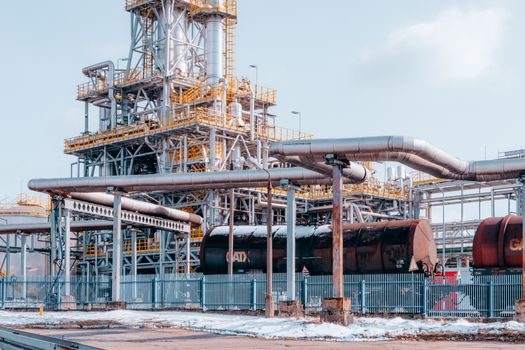
Material selection is governed by NACE MR0175 for sour hydrocarbon service, ASME B16.34 for industrial valve rating and API 610 for pumps, with piping to ASME B31.3. In cracking service, the high-temperature coil material transitions from 25Cr-35Ni (HK) centrifugal cast to 35Cr-45Ni (HP) as decoking severity increases. [S4]
For polyethylene/PP quality, off-spec material is typically reprocessed through an extruder purge, and the melt index (ASTM D1238) is the primary release-test variable; producers such as LUKOIL list product compliance with GOST and ISO/EN standards for polymer grades exported to more than 30 countries [S3]. Research output on the field is tracked in journals such as the Journal of Petroleum Exploration and Production Technology (ISSN 2190-0558, 2024–2025 SCIE, LetPub score 7.4) [S2], which captures peer-reviewed process and reservoir integration work relevant to upstream-downstream integration.
Who the Technology Suits, and Where It Fails
Petrochemical production technology fits operators with stable feed access (ethane, naphtha, NGL, or refinery off-gas), a downstream polymer customer base, and capital budgets above the USD 1 billion cracker threshold. It is the wrong tool for short-batch specialty chemicals where reaction chemistry, not continuous cracking, is the value driver. [S1]
Failure modes are recurring and well-documented: coking in cracker radiant coils (forced decoke cycles every 30–90 days), fouling in transfer-line exchangers, polymer melt-fouling in extruder dies, and compressor surge events. The mitigation is APC on surge valves, redundant pressure transmitter on compressor discharge, and a real-time yield-inferential model that operators trust. Plants without those layers typically run 5–8 percentage points of nameplate capacity below their licence-guaranteed baseline.
2026 Selection Criteria and Comparison
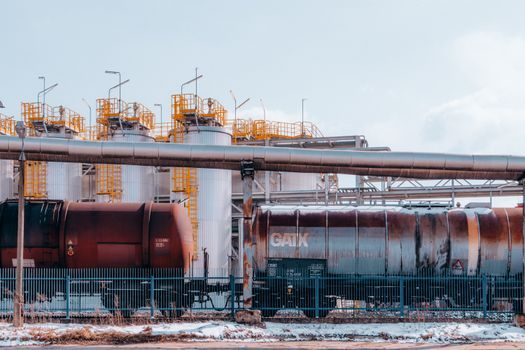
When picking a new petrochemical train in 2026, four criteria govern: (1) feedstock flexibility (ethane-only vs naphtha-plus-LPG); (2) energy intensity (GJ/t ethylene, where modern mixed-feed crackers target 18–22 vs legacy 28–32); (3) product slate diversification (PE/PP, EO/EG, butadiene extraction); (4) integration with the PLC-level safety system, typically SIL-2/3 per IEC 61511 on the cracking furnace burner management and the compressor anti-surge path. [S2]
Gas-phase vs slurry polyethylene is a clean comparison: gas-phase (Unipol) scores lower capex and simpler operation, slurry (Hostalen/CX) scores higher melt-index flexibility and higher-density grades; metallocene catalysts can be dropped into either but raise comonomer costs. For monomers, olefins-from-methanol (MTO/MTP) is an option for coal-to-chemical sites but loses its cost edge at naphtha prices below ≈USD 600/t.
Watch-Nodes and Trackable Signals
Three signals are worth tracking: (a) licensor announcements of electrified crackers and e-furnace pilots (currently at demonstration scale, not commercial); (b) regional polymer grade proliferation counts (LUKOIL already runs more than 70 PP grades in commercial production [S3]); (c) integration of open-process automation OPC UA over TSN replacing traditional fieldbus on new grassroot builds, which directly affects how a pressure sensor or flow meter ships with a vendor's EDD/PA-DIM file.
For sourcing context, see how the same engineering logic flows into adjacent bulk-process plants: LNG Production Technology: Process, Trains, and 2026 Sourcing maps the comparable liquefaction-train instrumentation load, while Tank Container Selection 2026: 5 Spec Gates for Chemical, Food and Fuel Cargo is the downstream reference for shipping petrochemical polymers into ISO tank containers.