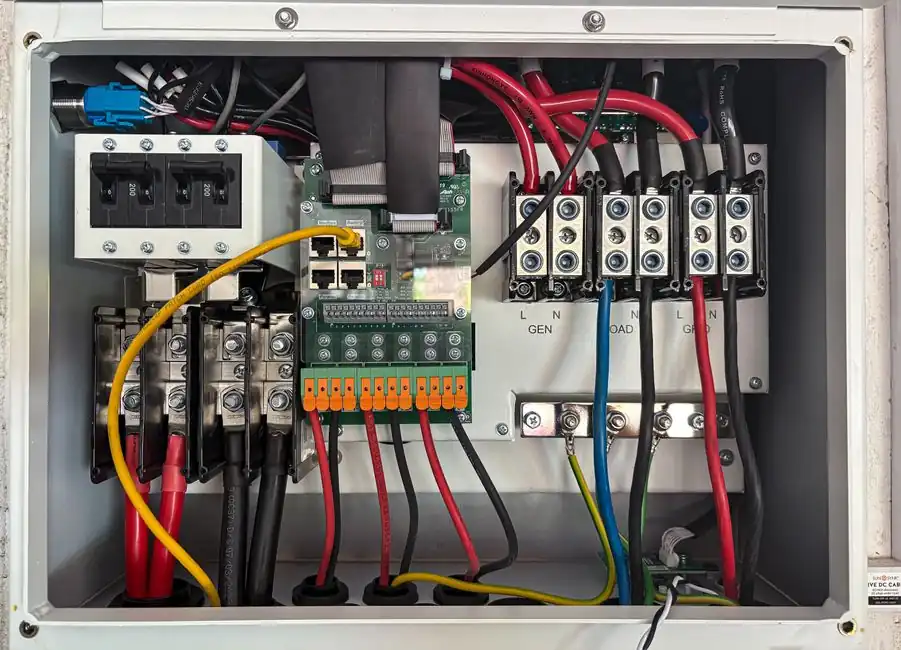
A correctly tuned PID loop drives HVAC damper, valve, and variable-speed-drive actuators to a temperature, pressure, or flow setpoint by continuously combining proportional, integral, and (optionally) derivative corrections, with PID described as the most common feedback method when precision and accuracy matter [S1].
The same closed-loop block sits at the heart of any HVAC controller, comparing a sensor reading to setpoint, computing an error, and reissuing an actuator command every scan [S3][S5]. Choosing the right device and the right PID variant is what separates a stable 22 degC zone from one that swings 3 degC under load.
What a PID controller actually does in an HVAC loop
A PID controller receives the process variable from a temperature, pressure, or flow sensor, subtracts setpoint to form the error, and outputs a corrective signal to an actuator such as a damper motor, control valve, or variable-speed drive [S3]. The proportional term reacts to the current error magnitude, the integral term accumulates past error to remove the steady-state offset that proportional-only control leaves behind, and the derivative term damps the response by reacting to the rate of error change [S3][S5].
Because HVAC setpoints are tight (often +/-0.5 degC in comfort air, tighter in cleanroom and process cooling), the integral term is the workhorse that pulls the loop onto setpoint; proportional alone typically leaves a residual offset the size of the proportional band [S3][S5]. For background on the controller category, see the PID controller reference page.
PI vs full PID: when derivative helps and when it hurts
Derivative control is sensitive to measurement noise from sensors, which makes a full PID loop unsuitable for HVAC processes where that noise cannot be controlled, and a PI loop is the safer default in those cases [S3]. In practice, derivative gain is most useful on fast loops (discharge-air pressure, chilled-water differential pressure) and is commonly disabled or set to zero on slow temperature loops where thermistor self-heating and A-D quantisation dominate the noise floor [S3].
Choosing between PI and PID on a single loop is a tuning decision, not a hardware one: most industrial HVAC controllers expose all three terms and let the integrator disable D [S1][S3]. A frequently cited heuristic from control practitioners is that pumping and HVAC pressure loops tend to stay on PI, while flow and certain air-handling cascades can benefit from a small derivative contribution [S2].
Selection criteria that actually move the loop
Three hardware-side criteria dominate HVAC PID selection: input/output type, scan/update rate, and integration with the building automation stack [S1][S5]. On input, universal controllers accepting thermocouple, RTD, 0-10 V, 4-20 mA, and pulse cover virtually all HVAC sensor families, eliminating the need for separate transmitters [S5]. On output, relay, triac, 4-20 mA, and pulse-width-modulation outputs must match the actuator (relays for contactors, 4-20 mA for modulating dampers and valves).
Form factor also matters on retrofit jobs: 1/16 DIN panel-mount units (about 48 mm front face) and DIN-rail modular units fit inside most air-handling-unit control panels, and NEMA 4X/IP66 front ratings are specified for washdown zones such as food-process cleanrooms [S5]. For related sensor-side context, the temperature controller reference covers the closely matched temperature-control hardware used at the zone and AHU level.
Comparing the main HVAC PID architectures on 4 criteria
The table below lines up the three PID architectures a building engineer is most likely to specify against four practical decision criteria, all grounded in the Eaton and DwyerOmega HVAC controller guidance [S1][S5].
Standalone panel-mount PID (e.g. 1/16 DIN with universal input): best for retrofit on a single air-handling-unit or cleanroom zone; pros include NEMA 4X/IP66 fronts, self-tune, and Modbus RS-485 [S5]; cons include higher unit cost per loop and limited native BACnet/Modbus points compared with a full BAS controller.
BACnet/Modbus building-automation-system controller (e.g. Johnson Controls Metasys PID application): best for new plant builds and large campuses; pros include native scheduling, alarming, and trending; cons include more complex commissioning and the need for a head-end [S7].
Variable-speed-drive-integrated PID: best for fan and pump arrays; pros include elimination of an external loop and direct 0-10 V / 4-20 mA feedback; cons include limited loop count per drive and derivative being generally disabled on temperature loops [S3].
Real use cases and what each one demands

For supply-air temperature control, the loop typically runs in PI mode with a 10-30 second sample period and a 0.5-2 degC proportional band, accepting the slow thermal mass of the coil; the integral time constant is then tuned to remove offset within 5-10 minutes [S3][S5]. For chilled-water differential-pressure control, the loop is faster, and a small derivative contribution plus a PI outer loop on supply temperature (cascade control) is the typical architecture, since the inner pressure loop is largely noise-free compared to a thermistor [S3].
For variable-air-volume box control, the actuator is a flow-tracking damper driven by a 0-10 V signal, and the PID is often embedded in the BAS controller, with the BAS exposing the loop for trending via BACnet/IP [S7]. For related process-side hardware that often sits one tier upstream, the motion controller reference covers the actuator and drive coordination used on larger AHU and chiller plant systems.
Failure modes, limits, and what PID cannot fix
PID cannot fix a loop that is incorrectly instrumented: a poorly placed temperature sensor downstream of a mixing plenum, a pressure sensor spanning a partially closed isolation valve, or a flow sensor with insufficient straight pipe upstream will produce an error signal the loop can chase forever [S3]. It also cannot compensate for actuator nonlinearity such as a sticky valve that needs a deadband added to the output stage.
Integral wind-up is the most common PID tuning failure in HVAC: when a setpoint change saturates the actuator, the integrator keeps accumulating error and produces a large overshoot on setpoint recovery, which is why most modern controllers expose an integral clamp or anti-windup mode [S1][S5]. A 470 Hz sampling rate is quoted on a compact 1/16 DIN PID family for fast loop work, but most HVAC scans at 1-10 Hz are sufficient given the slow thermal time constants involved [S5].
Standards, sourcing, and a 2024-2026 research signal

HVAC controllers are commonly listed under UL 916 (energy management equipment) and carry CE/EMC conformity, while communication between devices is governed by BACnet (ASHRAE 135) and Modbus (Modbus Organization) protocols, with no specific ISO/IEC standard governing the PID tuning parameters themselves [S1][S5][S7].
Research published in 2024 on air-conditioning PID tuning used an IBK-IFNN (improved bacterial foraging optimisation combined with an improved fuzzy neural network) algorithm to optimise PID gains, reporting it outperformed baseline fuzzy neural network tuning on the same simulated air-conditioning benchmark; the work is indexed on ScienceDirect but has not (as of 2026-09-05) produced a documented commercial controller revision tied to it [S4]. A separate Johnson Controls Metasys release 10.2 PID help guide documents the closed-loop maths and is a useful commissioning reference for engineers working on a Metasys front-end [S7].
On the field side, the Smokedaddy Pellet Pro PID shows how the same PID hardware family is now reaching non-HVAC thermal-control markets, a signal that compact PID hardware is becoming commoditised even as the tuning problem remains project-specific [S6]. For complementary field installation hardware, the HVAC oxy-fuel torch spec gate guide covers fabrication-side tool selection that runs alongside HVAC control-panel work.