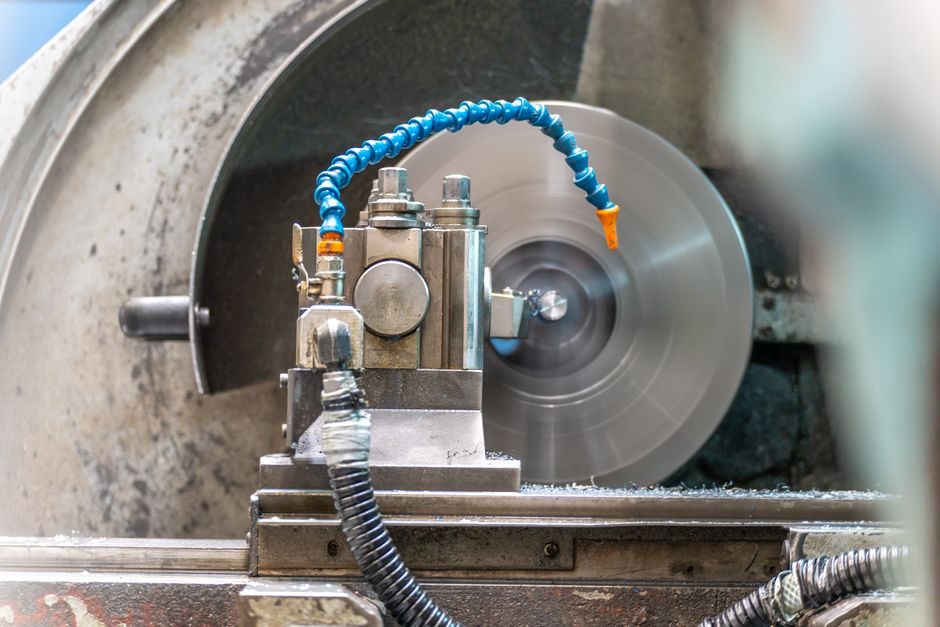
A pillow block bearing is a mounted bearing unit built from an insert bearing (commonly a self-aligning ball bearing with a spherical outer race) seated in a solid cast-iron, pressed-steel, stainless-steel, or polymer housing, with bore sizes standardized from 12 mm (SAP201) to roughly 75 mm (UCP215) [S2][S5][S6].
Classifications in OEM catalogs from NSK, MISUMI, and igus use four axes: housing footprint (P pillow, F square flange, FC round flange, FL two-bolt diamond flange, T take-up, C cartridge), insert/ball series (UC, SA, SB, UK, UCFL, UCT), housing material (gray iron, ductile iron, pressed steel, stainless AISI 304/420, tribopolymer), and sealing/precision grade (P0/P6/P5 open or double-sealed) [S1][S5][S7][S9]. For a full primer on the broader bearing-unit family, see the pillow block bearing encyclopedia entry.
Housing Footprint: P, F, FC, FL, T, and C Geometry Map
Housing shape is the first selection filter because it determines shaft orientation, bolt pattern, and axial load capacity on the driven machine frame [S5][S7]. The vertical "P" (pillow / plummer block) footprint is the default for through-shaft drives on conveyors, fans, and agricultural rollers; the UCP2xx series covers bores 12–75 mm with cataloged masses from 0.65 kg at UCP201 up to roughly 7 kg at UCP215 [S2][S5].
Two-bolt square flanges (UCF), four-bolt square flanges (UCFC), round/oval flanges (UCFL), and diamond two-bolt flanges (FL) suit perpendicular-shaft applications where the unit bolts to a vertical face; the UCFL210 example pairs a 50 mm bore insert with a round-flange casting for agricultural machinery [S4][S5]. Take-up (T) and cartridge (C) housings add slotted frames or threaded adjuster nuts for belt-tensioning and shaft-end support respectively, and pressed-steel "P" housings ship as thin-gauge economy variants for light-duty OEM lines [S5][S7].
Insert Bearing Series: UC, SA, SB, UK, and the Spherical Outer Race
Almost every pillow block uses a deep-groove ball bearing insert with a spherical (concave) outer race, which lets the inner assembly self-align inside the housing by 2°–3° and absorb shaft deflection or mounting-surface error [S5][S6][S9]. Series prefixes encode the geometry: UC and UCP are inch-spaced 200-series inserts; SA and SB are metric 200/300-series equivalents with a set-screw collar; UK units use an adapter sleeve (tapered bore) for mounting on plain shafting without set screws [S2][S5].
Typical spec values anchor the range: a SAP201 ships as 12 × 32 × 125 mm at 0.65 kg with P0/P6/P5 tolerance and an open seal [S2]; a UCP208 measures 40 mm bore, 80 mm OD, 49.2 mm width at 1.9 kg, and is widely double-sealed for washdown duty [S4]. For comparison against other self-aligning designs (pillow blocks, flange cartridges, rod-end sphericals), see the self-aligning bearing types comparison.
Housing Materials: Gray Iron, Ductile Iron, Pressed Steel, Stainless, Polymer

Cast iron dominates the market because it damps vibration and handles radial load well, with gray iron and ductile iron listed as the standard housing alloys and GCr15 high-carbon chromium steel as the default insert race material [S2][S7]. Pressed-steel housings are a low-cost, thin-gauge alternative aimed at OEM batch production and lighter load envelopes, while cast stainless (AISI 304/420) versions are specified for food, beverage, and marine service where wash-down chemicals attack standard carbon-steel housings [S7][S8][S9].
Polymer housings (PBT, PA66, or igus tribopolymer) form a growing niche where lubrication-free, corrosion-immune, electrically insulating, or hygienic-white requirements override load capacity; igus markets these explicitly as an alternative to cast metal for low-RPM, light-duty shafts [S9]. Sealing options scale with material: open type is standard for the SAP201, while double-sealed (2RS) contacts are common on UCP207/UCP208 agricultural and wash-down units [S2][S4][S5].
Bore Series, Tolerance Class, and Sealing Selection
Bore progression is the single most useful catalog key: UCP201 = 12 mm, UCP202 = 15 mm, UCP203 = 17 mm, UCP204 = 20 mm, UCP205 = 25 mm, UCP206 = 30 mm, UCP207 = 35 mm, UCP208 = 40 mm, UCP209 = 45 mm, UCP210 = 50 mm, UCP211 = 55 mm, UCP212 = 60 mm, UCP213 = 65 mm, UCP214 = 70 mm, and UCP215 = 75 mm [S5]. Each step roughly doubles the previous dynamic load rating because the ball complement grows with bore, so a UCP215 typically carries several times the radial load of a UCP205 at the same rotational speed.
Tolerance class is normally P0 (ABEC-1 equivalent) for general machinery; P6 and P5 grades are reserved for machine-tool spindles and higher-RPM fans, while P4 is a specialty upgrade for grinding spindles [S2]. Locking method is a related decision: set-screw collars (most UC and SA series) are cheapest but slip under heavy reversing loads; eccentric locking collars suit one-directional drives; adapter-sleeve UK series deliver the strongest grip on plain shafting but add cost and length [S2][S5].
Application Fit: Where Each Type Earns Its Slot
Pillow block (P) units are the workhorse for through-shaft conveyor idlers, agricultural rollers, and low-RPM fans because the vertical pedestal takes radial load and tolerates misalignment between coupled shafts [S5][S6]. Square and round flange units (F, FC, FL) appear where the shaft enters or exits a housing wall perpendicularly — packaging machinery, textile rollers, and gearbox input shafts are typical fits [S5][S7].
Take-up (T) housings slot into belt-tensioning assemblies on conveyors and elevators; cartridge (C) units cap the shaft end on long span supports; pressed-steel housings are the standard pick for HVAC fans and OEM white-goods lines where cost per unit matters more than heavy-duty ratings [S5][S7]. Polymer pillow blocks carve out a third lane — light-duty, lubrication-free, hygienic, or submerged service — and an inspection of casting tolerance is the first step before installing any mounted bearing to spec.
Comparison: Cast-Iron P vs Pressed-Steel P vs Polymer P vs Stainless P
On four common decision criteria — dynamic load rating, corrosion resistance, mass, and unit cost — the four dominant pillow-block families line up as follows. Cast-iron P units (UCP200 series in gray or ductile iron) set the baseline: highest load rating per bore, moderate corrosion resistance unless painted, 1.9 kg at UCP208, and a mid-range price band [S2][S4][S7].
Stainless cast housings (304/420) match the load envelope of gray iron yet add full corrosion immunity for wash-down, food, and chemical plants, with a price premium of 2× to 3× over standard cast iron [S7][S8]. Polymer pillow blocks (igus igubal class) sacrifice the most load capacity — typically one to two UCP bore sizes below their metal equivalents — but win on self-lubrication, chemical resistance, and silent operation, with the lowest mass and a competitive price point at low quantities [S9]. Mount the wrong family on a high-RPM, high-shock line and you trade a $20 housing for a $2,000 unplanned shutdown.
Failure Modes, Limits, and Specification Triggers
The three most common field failures are seal breach followed by abrasive contamination, set-screw slip on reversing or high-torque shafts, and housing cracking from misalignment beyond the 2°–3° self-aligning limit of the insert [S5][S6][S9]. Each one has a specification trigger: double-sealed 2RS inserts for dust and splash zones, adapter-sleeve UK series for reversing drives, and a flexible coupling or self-aligning spacer when shaft-to-housing misalignment is known to exceed the insert envelope [S2][S5].
Operating-temperature limits depend on seal and lubricant: standard nitrile 2RS seals run −20 °C to +110 °C, fluoroelastomer seals push to +180 °C, and polymer pillow blocks extend the high end to roughly +200 °C while remaining stable down to −40 °C [S9]. For cast-iron units, the practical speed ceiling is set by the ABEC-1/P0 tolerance and the grease fill rather than the housing — most UCP2xx inserts top out near 3,600 rpm on a 50 mm bore, dropping as bore grows. Inspect the cataloged limiting speed before specifying, and remember that "self-aligning" describes the bearing, not the shaft — neither housing forgiveness nor grease life replaces good alignment practice.
Trackable signals for the next buying cycle: bore-series expansion beyond UCP215 into 300-series inserts for heavier conveyors, broader use of stainless 304 castings in F&B plant retrofits, and a steady migration of low-RPM agricultural frames from cast iron to polymer housings as tribopolymer formulations extend their load envelope [S8][S9]. Buyers evaluating the precision-bearing sister product (used in spindles and metrology) can compare side-by-side with general mounted units via the pillow block bearing reference page.
For the relevant spec sheets and selection criteria, see aac block, and block brick.