
A 2026 product listing on Made-in-China.com shows PVC power cord pricing at US $1.10-1.20 per piece at a 1,000-piece MOQ from a Diamond-member manufacturer [S3]. A separate Japan-market PSE-rated cordset is quoted at US $1.95 with a 3,000-piece MOQ and stated monthly capacity of 1,000,000 pieces [S4]. These two reference points bracket the low end of the commodity cordset market.
At the other extreme, niche and ruggedized assemblies price far higher: a 2024 eBay listing for an AST slim USB keyboard/mouse power-cord bundle sat at US $29.95 [S5], and TrekPower's 2026-08 site lists heavy-duty ETL-certified RV power cords starting at US $95 [S6]. For appliance-replacement parts, iFixit shows a single LG-branded power-cord assembly at US $15.95-16.95 in 2026 [S7]. The spread — under US $2 to nearly US $100 — is set by application, certification, and build, not by the cord itself.
What the Price Actually Buys: Standards and Connector Patterns
Every cordset price is anchored to a connector standard. North American NEMA 5-15P (15 A, 125 V, three-prong grounded) and NEMA 1-15P (ungrounded two-blade) are the dominant plug patterns for consumer and light-commercial loads, while appliance-side terminations almost universally follow IEC 60320 (C13/C14 for computers and monitors, C7/C8 for figure-8 TV/laptop leads, C19/C20 for higher-current IT equipment) [S1]. The NEMA designation encodes configuration, current/voltage rating, and whether the device is a plug (P) or receptacle (R), so a buyer comparing two seemingly identical cords is really comparing how each was evaluated against the same [S1] NEMA and IEC 60320 construction, temperature, and pull-test requirements.
Wire gauge (AWG) and jacket compound govern current-carrying capacity and flex life. UL letter codes such as SPT (lamp cord), SVT, SJT, and SO mark the insulation, conductor count, and voltage rating, and appear stamped on every finished jacket [S1]. Where the cord enters the connector, a strain-relief boot absorbs flex and pull-out forces — a small component that, per the same reference, "is responsible for a large share of real-world cord failures" [S1].
Cost Driver 1: Conductor, Jacket, and Gauge
Copper conductor cross-section is the single largest material cost. PVC jacketing (SVT/SJT) is the low-cost default; rubber, neoprene (SO/SOW), or TPE jackets for outdoor or cold-flex duty add 20-40% to the jacket cost alone. [S1]
For a PVC-jacketed 3-core 18 AWG cordset at 1,000-piece MOQ, the published 2026 range of US $1.10-1.20 per piece [S3] effectively sets the floor for any cord above commodity grade. A consumer-grade 18 AWG replacement cord for a major-appliance OEM part (the LG COV34805614 type) lands in the US $15-17 range as a single-piece, brand-channel SKU rather than a bulk import [S7] — illustrating that channel, warranty, and brand premium can multiply the underlying cord cost by an order of magnitude.
Cost Driver 2: Certification, Region, and Plug Pattern
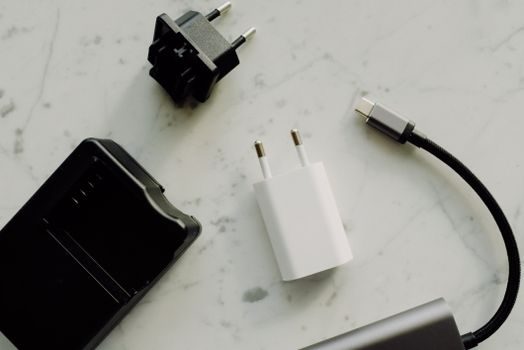
Regional safety marks move the price more than gauge does. A PSE-certified 125 V Japan-plug cordset is published at US $1.95 at 3,000 MOQ [S4] — roughly 60-75% above the unbranded PVC equivalent — reflecting both the Japanese certification overhead and the dedicated plug tooling.
For industrial and outdoor duty, ETL listing (the NRTL equivalent of UL) is the marker buyers see on TrekPower's RV cords, which start at US $95 for heavy-duty models [S6]. That price reflects 10 AWG or larger conductors, weather-resistant jackets, and the cost of maintaining the certification on a low-velocity product. The reference taxonomy of standards at the top of any quote — NEMA, IEC 60320, UL, CSA, NFPA 70 (US National Electrical Code) [S1] — should be mapped one-to-one against the destination market before the buyer evaluates any unit price.
Cost Driver 3: Volume Tier, MOQ, and Tooling
Volume tiering is steep. The 1,000-piece MOQ on the PVC cordset [S3] versus the 3,000-piece MOQ on the Japan PSE cord [S4] versus single-piece retail for an OEM replacement at US $15.95-16.95 [S7] is the same cordset carrying very different price tags. Suppliers amortize injection-mold tooling for the plug and connector bodies across the run; a custom over-mold on a non-standard strain relief can add US $2,000-5,000 in tooling, recovered only at five-figure unit volumes.
For comparison with adjacent electrical equipment, a selector switch or isolation transformer sees the same amortized-tooling effect at the low-voltage end of the bill of materials, where connector standardization dominates the per-unit cost more than the conductive core.
Criteria Comparison: Three Cordset Tiers Side by Side

Putting the cost drivers into a comparison the procurement desk can quote: a commodity PVC/NEMA 5-15P cordset at 1,000 MOQ sits at US $1.10-1.20 per piece, 18 AWG, CCC only [S3]; a region-certified (PSE Japan) cordset at 3,000 MOQ prices at US $1.95 per piece, dedicated plug tooling, monthly capacity 1,000,000 pieces [S4]; a heavy-duty outdoor/RV cordset with ETL listing starts at US $95, large-gauge conductors and weatherproof jacket [S6]. On cost, the commodity tier wins; on certification scope, the PSE and ETL tiers are the only legitimate choices; on ruggedness and current, only the RV-tier cordset is fit for purpose above 15 A outdoor service.
For readers cross-referencing the connector-side specifications, the power cable encyclopedia page covers the conductor, jacket, and AWG vocabulary used above, and the broader cordset taxonomy is mapped in the same power cable reference family. Buyers specifying instrumentation-side terminations should also review the power meter entry, since many metering cordsets are built to the same IEC 60320 C13/C14 pattern but require additional isolation and labeling.
Use Cases and Application Fit
Office IT and consumer electronics overwhelmingly use IEC 60320 C13/C14 (and C7/C8 for low-power devices), paired with a NEMA 5-15P plug on the wall end — a configuration whose cordset cost tracks the commodity PVC range above. Industrial machinery, welding equipment, and RV/marine sites move to SO/SOW rubber-jacketed cordsets with twist-lock NEMA configurations (L5-30P, L14-30P) and dedicated over-molds, which are the products sitting in the US $50-150 band typified by TrekPower's US $95 starter [S6].
Appliance OEM replacement — exemplified by the LG COV34805614 cord sold through the iFixit channel at US $15.95-16.95 [S7] — sits in a separate channel: a single-piece retail SKU carrying the appliance-maker's brand, warranty, and reverse-logistics cost, which is why a $2 commodity cord becomes a $16 part once it ships under an appliance part number.
Limitations, Failure Modes, and Sourcing Risks
The most common cordset failure is at the strain-relief interface, where repeated flexing work-hardens the copper strands until one or two break, raising resistance and heating at the terminations [S1]. Sub-spec cordsets that skip the strain-relief boot or use thinner-than-rated jackets may pass a bench test but fail in months. Procurement should reject any cordset whose catalog page does not state the conductor cross-section, the jacket UL code, and the certification mark, and should require lot-traceable test reports for any build above 1,000 pieces.
For adjacent equipment on a quote sheet, comparing the cordset line item against an electricity meter or voltage transformer BOM, the same four-line cost stack applies: conductors and jacket, regional certification, MOQ and tooling, and channel/brand premium. Apply the same criteria to keep the comparison clean.
Total Cost of Ownership Beyond Unit Price
Unit price is roughly half the TCO picture. A US $1.20 cordset that fails a strain-relief pull test in service costs multiples of its purchase price in downtime, return logistics, and warranty handling; a US $95 ETL-listed RV cord that survives a decade of outdoor flexing is the cheaper cord on a per-year basis. Energy loss is small for cordsets (carrying 120/240 V line voltage rather than instrumentation-level signals), so the dominant TCO drivers are certification compliance, failure rate, and the labor cost of any field replacement. [S1]
For projects with a mixed electrical bill of materials, a power transformer or static VAR generator cordset line item is typically < 1% of the equipment cost, but it is also the most often under-specified item on the datasheet — the place to apply the same connector-pattern discipline used for the major equipment. As a trackable next step, watch the Q4 2026 IRENA renewable-cost update [S8] for any upstream signal on copper and polymer pricing, which moves PVC-jacketed cordset floors by single-digit percentages each quarter.
Detailed specification references: locking assembly.