
For a 2026 industrial buyer, an electricity meter is no longer a one-line "kWh box" — it is a sensor node that must be picked by phase count, current-access method, accuracy class, and bus protocol, then matched to its enclosure and CT family.
The market in 2026 lists at least 88,143 meter-box SKUs from 5,184 suppliers on a single B2B platform, with single-phase CT-operated PCBs in the US$11 range and 4-position outdoor stainless distribution boxes in the US$66 range [S3][S5]. Selection discipline starts with the four-way split below.
Four Buyable Families by Phase, Access, and Protocol
Single-phase direct-connect meters (230 V, 5(60)A class) dominate residential retrofit at US$5-20 and are typically the entry SKU on procurement lists [S3]. They are unsuitable for any load above ~80 A because the meter base becomes the only conductor — past that point the right pick is a three-phase CT-operated meter with ../1A or ../5A current transformers, a configuration that pushes the meter's own burden down to <0.5 VA per phase.
Three-phase direct meters (3×230/400 V, 5(100)A class) sit in the US$30-90 band and are common in small commercial panelboards; the same form factor in CT-operated form (../5A) costs US$60-150 with added CTs. Smart three-phase meters with M-Bus, Modbus RTU/TCP, or LoRa add 30-80% to the bare meter price and live in the US$45-400 band [S1]. Panel-mounting variants (96×96 mm or 72×72 mm cut-out) are a sub-family used inside machine control cabinets where the meter doubles as a local readout, not a billing register.
Smart metering kits from European OEMs in 2026 bundle certified load-profile recording, M-Bus level converters that fan out to 250 slaves, and LoRaWAN concentrator compatibility — EMU's M-Center data logger family is one such product line offered by a Swiss/German supplier established in 1989 [S1]. Buyers reading "smart" labels should always check whether the meter is MID-certified (Measuring Instruments Directive, EU) for billing, or only CE-marked for sub-billing/energy-monitoring duty.
Selection Criteria: Phase, Current, Class, Protocol, Form Factor
Five binding gates decide the SKU before brand is discussed: (1) phase count — 1ph 2-wire vs 3ph 4-wire; (2) current access — direct (≤100 A) or CT-operated (../1A or ../5A secondary); (3) accuracy class — Class 1 (1%) or Class 0.5S (0.5%) for revenue-grade billing; (4) protocol — pulse/S0, M-Bus (wired, EN 13757-2/3), Modbus RTU on RS485, Modbus TCP, LoRaWAN, or wM-Bus; (5) form factor — DIN-rail (35 mm, 1-6 modules wide) for switchboard mounting vs panel cut-out vs wall-mounted IP66 enclosure. [S1]
A common 2026 pitfall is specifying an M-Bus meter for a PROFIBUS-PA or Foundation Fieldbus network — those are digital fieldbuses that do not carry the 36 V M-Bus master signalling, so the meter will not register on the segment. A safer default for greenfield plants in 2026 is a Modbus RTU meter on RS485, daisy-chained with twisted-pair shielded cable, terminating at a gateway that lifts the data to BACnet/Modbus TCP for the BMS layer [S1]. For tenant sub-metering in multi-tenant buildings, M-Bus remains the workhorse because a single M-Bus master can address up to 250 meters over 1-2 km of two-wire cable, dramatically cutting commissioning time versus running individual RS485 drops to each apartment.
CT selection is its own gate: a 100/5A CT paired with a ../5A meter is the most common industrial pairing, but accuracy class matters — a Class 0.5S meter paired with a Class 3 CT is only Class 3 in practice. For loads above 400 A, split-core CTs (clip-on) become the practical choice because they install without breaking the busbar, though their phase-angle error is typically 30-60 minutes worse than solid-core CTs of the same ratio.
Criteria-Based Comparison of the Four Main Types
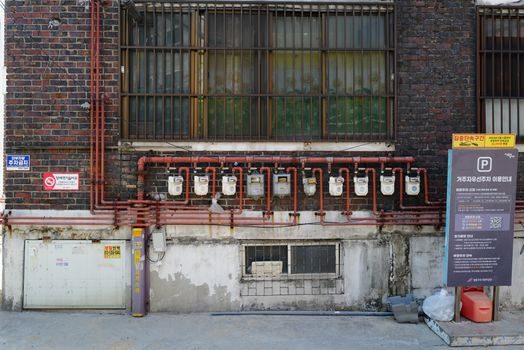
Side-by-side against five real decision criteria, the four families line up as follows. Direct single-phase electronic meters (US$5-20, Class 1, pulse/S0 output) fit residential retrofits and small offices, but lack three-phase energy and reactive metering. Three-phase direct meters (US$30-90, Class 1, often pulse + RS485) cover small commercial panelboards up to 100 A per phase and are the cheapest route to three-phase kWh data. CT-operated three-phase meters (US$60-150 plus CTs, Class 0.5S available, RS485/Modbus common) are the only honest pick above 100 A and for any revenue-grade billing where MID or ANSI C12.20 applies. DIN-rail smart meters (US$45-400, Class 1, M-Bus/Modbus/LoRa) layer communication on top of either direct or CT hardware and are the workhorse for sub-billing, energy-monitoring, and ISO 50001 energy-management programs where data has to leave the switchboard. [S1]
Quick numeric anchors: single-phase CT-operated modules such as the JSY-MK-163T sit at US$11/piece for 5-piece MOQ and read 100 A via split-core CT [S5]. A 3-phase 4-wire anti-theft metering joint box (DFY-1B) is US$15-18/piece at 10-piece MOQ [S3]. A 4-position outdoor stainless distribution box (700×550×160 mm, 0.8/0.8 mm steel) is US$66/piece at 1-piece MOQ with VDE and CCC certification [S3]. An ABS-paneled 400×300×220 mm enclosure for electronics inside is US$31-32 at 100-piece MOQ [S3].
Who It Is For — and Who Should Pick a Different Tool
Specifying a CT-operated three-phase meter is the right call for any plant feeder above 100 A, for any tenant sub-billing loop, and for any ISO 50001 energy review where Class 0.5S or better is the audit gate. Specifying a direct-connect three-phase meter is the right call for a workshop subpanel under 100 A where the goal is "see what each machine draws" rather than bill tenants. Specifying a single-phase DIN-rail meter is the right call for a lighting panel or a server-room PDU strip. [S1]
Who should not pick the mainstream CT-operated three-phase meter: anyone powering DC loads (PV strings, battery banks, DC traction) — those need a DC meter or a DC-CT/ shunt, not an AC CT meter. Likewise, anyone needing harmonics measurement (THDi, THDu per IEEE 519) should pick a power-quality analyzer or a multi-function meter with harmonic orders 2-15 minimum, not a basic kWh register. Finally, anyone needing a billing-grade meter in the EU must check the MID (2014/32/EU) certificate number on the meter body and on the EU declaration of conformity — a CE mark alone is not enough for revenue billing.
Enclosure, IP Rating, and Field Reliability Data

Enclosure selection follows the meter selection, not the other way around. Outdoor wall-mounted meter boxes for utility service entrances are typically IP66 stainless or powder-coated steel at 0.8-1.5 mm thickness, with gland plates top and bottom; 2026 sourcing lists show 700×550×160 mm 4-position units at US$66 [S3]. Indoor DIN-rail enclosures typically need only IP30-IP40 and live inside the switchboard cabinet.
Reliability evaluation of installed metering fleets is governed by IEC TR 62059-21:2002, which sets the methods for field-data collection, classification, and statistical analysis of meter dependability (failure rates, mean time to failure, defect classification) [S7]. Buyers evaluating a vendor's claimed MTBF should ask for a field-data summary compliant with this technical report, not a lab-only figure. For OEM quality work, paired IEC 62053-21/22 (static AC active energy meters, Class 1/2 and 0.2S/0.5S) and IEC 62053-23 (reactive energy) testing on a calibration bench such as those listed at US$9,800/set for heat/water meter test benches is the de-facto acceptance gate before deployment [S8].
Sourcing Channels, MOQ Reality, and Verification Trail
For 2026 procurement, available sourcing channels include: (1) direct OEM via China B2B platforms such as Shenzhen Jiansiyan Technologies Co., Ltd. (5-piece sample MOQ) and other listed suppliers showing 10–100 piece MOQs for meter boxes and components [S3][S5]; (2) European branded vendors such as EMU Metering, which markets power meters made in Switzerland and offers OEM and distributor arrangements, with product lines including certified load-profile meters and M-Bus, TCP/IP, RS485, and LoRa communication interfaces [S1]; (3) local distribution panel builders for small-quantity retrofits where lead-time can outweigh unit price considerations.
MOQ reality in 2026: meter boxes MOQ 1-100 pieces for stainless, 100,000 pieces for some aluminum/precision-machined enclosures; CT-operated PCB modules MOQ 5 pieces; three-phase joint boxes MOQ 10 pieces [S3][S5]. Buyers should always cross-check the supplier's audit status (Audited Supplier badge on Made-in-China), the certification list (VDE, CCC, ISO9001:2000, CE are common; MID is the EU billing gate) [S3], and — for revenue-grade orders — request a sample test report from an accredited lab rather than relying on a factory self-declaration.
Limitations, Failure Modes, and What to Verify On-Site
Common 2026 failure modes in the field: (1) CT polarity reversal on installation, which shows up as negative kWh on commissioning and is the single most common cause of "the meter is broken" tickets; (2) phase-sequence errors on three-phase CT-operated meters that cause the meter to read zero or near-zero total power despite per-phase loading being correct; (3) M-Bus short-circuits caused by damaged two-wire runs, which collapse the entire bus segment — a single M-Bus repeater or short-circuit isolator is cheap insurance; (4) harmonic-induced meter error where a Class 1 meter on a VFD-heavy feeder can under-read by 2-4% on switched-mode loads, so specify a meter tested to IEC 62053-21 with explicit wide-band error limits, or move up to Class 0.5S. [S1]
For analog reference against panel instrumentation and clamp-on verification, a clamp meter is the standard commissioning tool, while a conductivity meter plays no role in AC metering but is often co-sourced for water-utility SCADA packages. For signal and control wiring adjacent to the meter, understanding linear guide standards is irrelevant, but checking the meter's counter-meter pulse-output isolation rating (typically 27 V DC, 27 mA) against the downstream counter input is essential to avoid soldering a meter to a dead PLC input on day one.
Verification trail every buyer should keep: meter serial number, MID/ANSI certificate number and expiry, CT ratio and polarity test result on commissioning, firmware version, and a baseline pulsed-output check against a reference counter meter for at least one full load cycle. For plant retrofit projects where the meter feeds a relay module or a remote I/O module on the same RS485 trunk, confirm the meter's Modbus register map against the gateway's polling list before energizing, because a 32-bit float-vs-int register mismatch is the third most common field issue after polarity and phase-sequence errors.