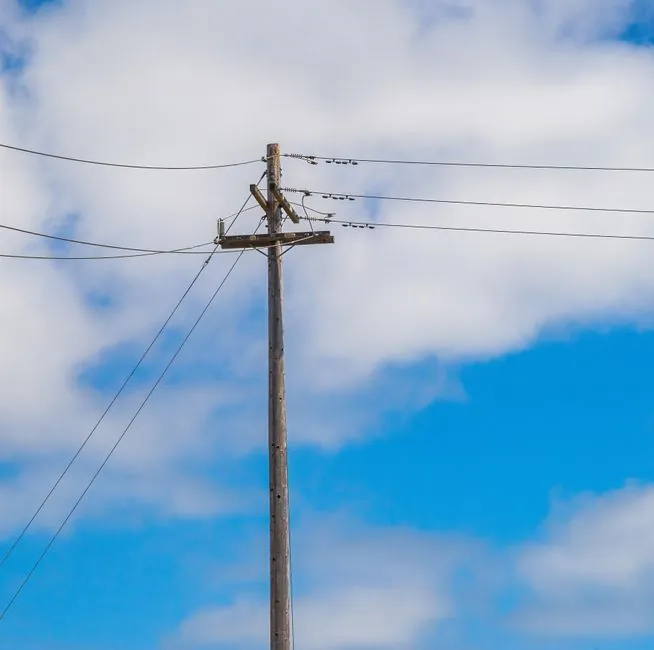
A credible power grid bill of materials breaks the system into five functional layers (generation step-up, HV transmission, sub-transmission, distribution, and customer-side service) and lists every long-lead and standards-bound item inside each one, from large power transformers to LV drop conductors [S1][S4].
The U.S. lower-48 grid comprises three major interconnections, with HV transmission lines spanning thousands of kilometers and LV distribution adding millions of miles of conductor to reach end users [S2]. The transformer and switchgear assembly sits at the top of every BOM because it determines interface voltage, short-circuit duty, and protection coordination for everything downstream.
Generation-Side BOM Items: Step-Up Transformers and Plant Switchgear
Every central-station block starts with a generator step-up unit (GSU) that lifts generator output to the HV bus, typically in the 230–765 kV class for bulk transmission interfaces in North America [S2].
Generation-side BOM line items almost always include the GSU transformer, generator circuit breaker, surge arresters, neutral grounding equipment, station service transformers, and ISO-phase bus or isolated-phase bus duct between the generator and the GSU [S1][S4]. Per the U.S. Office of Electricity, the Transformer Resilience and Advanced Components Program explicitly funds GSU and large power transformer hardening, including solid-state power substation development, so utilities writing long-cycle BOMs are now tracking those programs as risk hedges [S1]. On the European side, generation connection points sit on VHV/HV lines whose purpose is to minimize line losses over long distances, with meshed HV networks ensuring cross-border energy exchange [S4].
HV Transmission BOM: Conductors, Towers, and Series Compensation
HV transmission BOMs are dominated by conductor, tower steel, foundation hardware, insulator strings, and right-of-way materials, and the cost of these items sets the capex envelope for any new corridor [S2][S4].
Higher voltage reduces long-distance losses, which is the engineering reason U.S. transmission sits at 230 kV and up while distribution sits below 35 kV [S2]. For a typical 400 kV double-circuit lattice line, a BOM for one kilometer will list bundled 954 kcmil ACSR or ACSS conductor, glass or composite long-rod insulators, OPGW or shield wire, grounding rods, and vibration dampers; in series-compensated corridors, the BOM also adds capacitor banks, MOV arresters, and bypass switches [S4]. The U.S. grid's millions of miles of LV lines for distribution are entirely separate from these HV BOMs and are sourced against different conductor and pole standards [S2].
Substation BOM: Power Transformers, Protection Relays, and Busbar
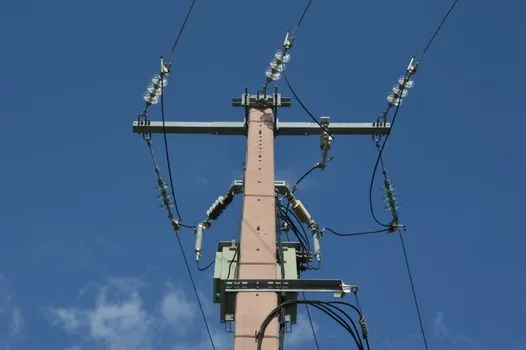
The substation is the BOM node with the highest unit cost per item, and it is where power cable and busbar assemblies, protection relays, and instrument transformers converge [S1][S2].
Substations either step voltage up for transmission or step it down for distribution, and the BOM must specify which side of that interface each item is on [S2]. A 230/69 kV transmission substation BOM typically includes one or more oil-immersed power transformers with on-load tap changers, a busbar scheme (single bus, main-and-transfer, or breaker-and-a-half), circuit breakers rated for the site's short-circuit MVA, disconnect switches with grounding blades, current and voltage transformers for metering and relaying, and a protection-and-control panel populated with distance, differential, and breaker-failure relays [S1][S4]. Grid Enhancing Technologies (GETs) programs specifically call out dynamic line rating, power-flow control devices, and supporting analytical software as BOM-adjacent items that can defer or replace new transmission builds [S1].
Distribution BOM: Step-Down Transformers, Reclosers, and LV Drop
Distribution-level BOMs are volume-driven: a single utility procurement can specify thousands of identical pad-mount or pole-top transformers, each with a defined kVA, BIL, and impedance [S2][S4].
European distribution grids operate radially in rural areas and radially-with-loops in urban areas, with the LV portion connecting household and small commercial loads [S4]. A practical distribution BOM covers three-phase and single-phase distribution transformers (typically 25–2500 kVA), vacuum or SF6 reclosers, sectionalizers, fused cutouts, surge arresters, LV junction cabinets, service drop cable, and meter sockets [S2]. Unlike HV transmission, distribution grids are not meshed because the cost and operational complexity of LV mesh structures is uneconomic, so the BOM reflects radial protection logic rather than backup line redundancy [S4].
Standards and Sourcing Discipline for the BOM
A defensible grid BOM is not a parts list; it is a list of items pinned to a voltage class, a short-circuit duty, and a named standard, with the most expensive items (large power transformers, HV breakers) carrying the longest lead time [S1][S2].
DOE's Grid Systems and Components division groups BOM-relevant R&D into three lines: Transformer Resilience and Advanced Components, Microgrids, and Grid Enhancing Technologies, and a working BOM should map each major line item to at least one of those programs to flag funding or demonstration opportunities [S1]. On the sourcing side, generation capex and T&D capex split the delivered cost of electricity roughly evenly, with retail at under 5% of the bill, so BOM weight should track that same generation/T&D ratio rather than retail hardware [S5]. For off-grid or microgrid subsections of the BOM, the same logic applies at smaller scale: LiFePO4 banks sized at 10–30 kWh, hybrid inverters, and 6–12 PV modules at 300–400 W each form the canonical block [S3]. Microgrid BOMs are the next growth node per the Office of Electricity's program line, and they pull in the same transformer, protection, and lighting and lamps hardware used in distribution plus added storage and inverter blocks. Track the OE Transformer Resilience program's next funding round and any RFI on solid-state power substation components as the two highest-leverage signals for the 2026–2027 procurement cycle.