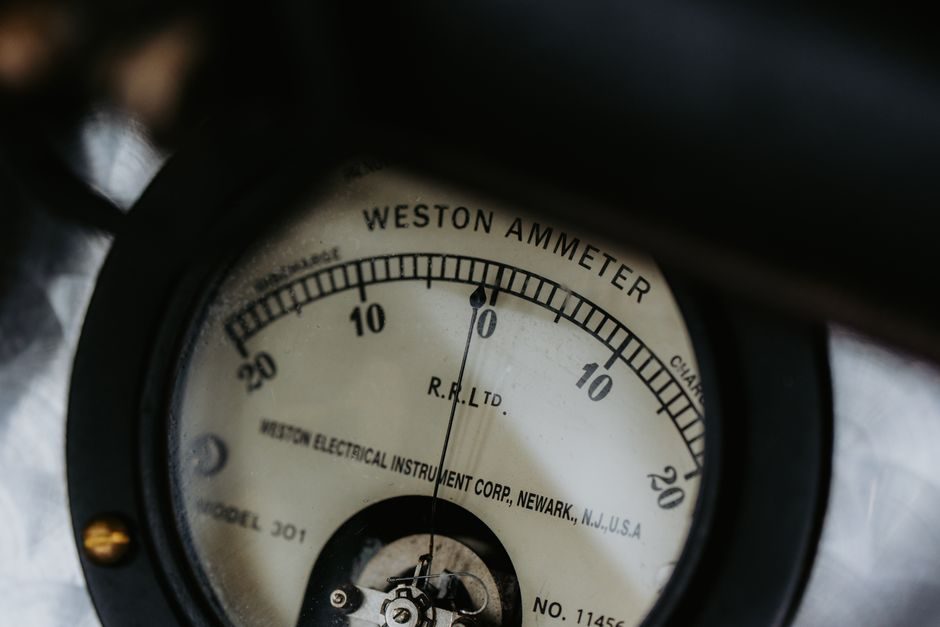
Industrial and bench power meters in 2026 list from US$4.15 per piece at 500-unit MOQ for basic CE-marked panel electricity meters to US$2,000+ for professional electronic power analyzers, with a portable plug-socket watt/voltage/amps meter running US$4.80-9.70 across 1-5,000+ piece breaks per a Made-in-China supplier listing dated 2026-07-13 [S3][S4]. The spread is governed by accuracy class, sensing technology, I/O protocol stack, and certification scope, not by enclosure color.
Procurement teams in 2026 are typically comparing four meter families on the same RFQ: CE panel electricity meters (sub-US$10 at volume), plug-socket energy monitors (US$4-10), benchtop optical and electrical power meters (US$1,000-5,000+ for dual-channel units with 10 kHz acquisition), and multifunction power analyzers for three-phase plant metering. Each family has a distinct cost driver stack and a distinct total-cost-of-ownership profile, which is why a per-unit price without a spec sheet is misleading.
Four Power Meter Families and Their 2026 Price Bands
Panel-mount CE electronic power meters — the bottom tier — list from US$4.156 at 500-piece MOQ from a Zhejiang trading supplier, advertised for power monitoring of machinery with CE approval [S3]. Plug-socket energy meters with watt, voltage and amps readouts list at US$9.70 for 1-499 pieces, US$7.20 for 500-4,999 pieces, and US$4.80 at 5,000+ pieces from a Guangdong manufacturer with a stated 50,000-piece weekly capacity and Shenzhen port terms [S4]. The drop from US$9.70 to US$4.80 across volume tiers is roughly a 50% discount, which is the typical break point at which a custom OEM housing becomes more cost-effective than off-the-shelf.
Professional electronic power analyzers sit in a different band entirely, with a Beijing-based supplier listing a CE-certified advanced electric power measurement meter at US$1,500-2,000 per unit at 1-piece MOQ [S3]. Benchtop optical power meters — for laser and fiber-optic test — are priced at the top of the band: Newport's 1936-R/2936-R series run 250 kHz sampling with femtowatt-level resolution, and the benchtop line delivers 10 kHz time-stamped data acquisition with sub-picowatt noise on photodiode detectors [S1]. Optical benchtop pricing is not visible in the public catalog, but the ILX Lightwave fiber-optic power meter spec — ±2.5% accuracy, less than ±0.01 dB repeatability, 800-1650 nm wavelength — sets the engineering bar that drives the price up [S1].
Cost Driver Stack: What Moves the Price
Five variables dominate the bill of materials on a power meter quote: sensing element, accuracy class, isolation/insulation, protocol stack, and enclosure. Sensing element cost scales with the meter's class: shunt resistors for class 0.5S-1.0 industrial meters are cheap; current transformers and Hall-effect sensors with the linearity required for 0.2S bidirectional energy metering add measurable cost. Accuracy class drives calibration time, not just the sensor — every additional 0.1S class step typically adds a calibration cycle on a reference standard. [S1]
Protocol stack is the second-largest lever. A bare analog 4-20 mA output on a panel meter costs essentially nothing; adding Modbus RTU over RS-485 adds a UART, isolation, and a small protocol license; adding a multifunction power meter feature set — harmonic analysis up to the 63rd, waveform capture, event logging — drives the processor from an 8-bit MCU to a 32-bit ARM class part and adds firmware development cost. A CE mark on a basic panel meter does not bundle EMC, LVD, and RoHS test reports into the unit price; on a US$4.15 panel meter those reports are amortized across the manufacturer's volume, while on a US$1,500 analyzer they are line-itemed into the quote. ATEX/IECEx explosion-proof variants are not in the public CE listings and would push pricing into a separate tier.
Optical benchtop meters compound the driver list. Newport's benchtop catalog shows 7-inch touchscreen units with 10 kHz acquisition, 5 analog and 5 digital filter settings, and plug-and-play detector compatibility [S1]. Femtowatt-level resolution and 250 kHz sampling on the 1936-R/2936-R series are achieved through custom analog boards, not off-the-shelf ADC parts, which is why the optical benchtop price band sits 1-2 orders of magnitude above the panel meter band [S1].
Volume Tier Mechanics and MOQ Economics

The plug-socket watt meter volume curve on Made-in-China (US$9.70 / US$7.20 / US$4.80 across 1 / 500 / 5,000 piece breaks) is a textbook three-tier volume discount [S4]. Below 500 pieces the unit carries stock and packaging overhead; 500-4,999 is the run-of-mill production tier; 5,000+ triggers a dedicated production slot and amortizes tooling over a longer run. The 50,000-piece weekly capacity figure signals that the supplier is running injection molding and SMT in parallel — the variable cost per unit is dominated by BOM, not labor [S4].
Below 500 pieces, an importer is paying for the supplier's idle time and packaging line, not for the meter. For buyers needing 1-200 units, the smarter move is to pay the US$9.70 small-tier price and skip the negotiation — the savings on a 50-piece order rarely justify the email exchange. For 1,000+ unit runs, the right question is not "what is your price" but "what is your tooling amortized into the unit," because the housing, the LCD window, and the calibration fixture are one-time costs that small buyers pay per unit but large buyers pay once.
Spec-First Buying: The Right Order of Comparison
Engineers should rank candidate power meters on four axes before price enters the conversation: accuracy class and burden, protocol and I/O count, environmental ratings (operating temperature, humidity, IP rating), and isolation voltage. Class 0.5S is the typical industrial spec; class 0.2S is the revenue-metering spec; class 1.0-2.0 covers sub-billing and tenant metering. A US$4.15 panel meter will land in the class 1.0-2.0 band; a US$1,500 analyzer in class 0.2S or better, with harmonic analysis up to at least the 50th order as standard. [S3]
Protocol is the second axis. Modbus RTU over RS-485 is the default; Modbus TCP, PROFIBUS, and PROFINET are add-on cards; IEC 61850 is the substation protocol. Buyers on plant DCS should specify IEC 61850 support on the power meter RFQ; buyers on building management should accept Modbus TCP; buyers on legacy SCADA should accept Modbus RTU. Adding wireless IoT (LoRaWAN, NB-IoT) is a separate line item and a separate certification cost, and should not be assumed bundled in the panel meter price.
For plant builds in 2026, the Power Meter Selection Criteria and the Power Meter Buying Guide lay out the same class, topology, protocol, and environment framework. Buyers who lock the spec sheet before opening price discussions consistently get lower per-unit cost than buyers who start with a budget number and back-fit specs.
Total Cost of Ownership: What the Sticker Price Misses
Sticker price is roughly 40-60% of the five-year cost on a permanently installed panel meter. The remaining components are: installation labor (current transformer shorting blocks, voltage taps, dedicated breaker), calibration (annual on revenue-grade meters, every 2-3 years on industrial class), communication infrastructure (RS-485 cabling, gateways, switch ports), and downtime risk. A US$4.15 panel meter with a 0.5% reading error over a year on a 500 kW load is more expensive than a US$50 class 0.5S unit when the energy cost is tallied. [S3]
Benchtop optical meters invert the cost ratio: the unit is the dominant cost, calibration is included in the detector spec, and the lifetime is bounded by detector technology rather than electronics. Newport's benchtop units are plug-and-play with calibrated optical sensors across low-power, laser-power, laser-energy, and specialty detector families (PEPS power-and-position, LIAD lock-in amplifier detectors) [S1]. The right total-cost question for a benchtop is "which detector family will cover the next 3 years of measurement campaigns" — locking the meter and detector to a single supplier ties the buyer to that supplier's detector roadmap.
Failure Modes and Sourcing Pitfalls to Avoid
The most common sourcing failure on a panel meter RFQ is buying a US$4.15 unit for a revenue-metering or sub-billing application. The meter's CE mark covers safety, not revenue-grade accuracy; revenue-grade certification (MID, ANSI C12.20 class 0.2) is a separate test and a separate unit. The second most common is buying a meter without specifying CT polarity and direction — bidirectional meters for solar PV need explicit reverse-energy handling, and unidirectional meters will silently under-record. The third is buying a meter with a non-isolated RS-485 port and then discovering ground loops when the meter is mounted in a switchgear cabinet alongside VFDs. [S3]
For optical benchtop meters, the most common failure is buying a meter and detector from different suppliers expecting plug-and-play. Newport and ILX Lightwave (both under the MKS umbrella) are explicitly not cross-compatible per the manufacturer's own product page [S1]. A buyer who picks a Newport 1936-R benchtop and an ILX OMM-6810B detector on price will get a non-functional stack, and the cost of returning one of the units typically exceeds the savings.
2026 Procurement Signals and Watch-Items

Three signals are worth tracking through the rest of 2026. First, the Made-in-China CE panel meter category is densely populated at the US$4-10 band with 500+ active SKUs as of the 2026-06-13 catalog snapshot — pricing pressure on the bottom tier is high, and buyers should treat any quote above US$8 at 500-piece MOQ as overpriced [S3]. Second, optical benchtop pricing is consolidating around Newport/ILX/MKS, Thorlabs, and Gentec-EO; the smaller Chinese entrants in fiber-optic test (typically 800-1650 nm InGaAs detectors) are pricing 30-50% below the ILX line and worth a parallel RFQ for non-revenue-grade lab use. Third, the multifunction power meter category is being pulled toward edge analytics — buyers should expect firmware-defined features (harmonic export limits, PQ event classification) to land as no-cost updates on 2026-vintage hardware and as paid licenses on 2024-vintage hardware.
Spec-level background on the components involved: linear guide.