Power meter procurement reduces to four independent decision points: metrology class per IEC 62053-22, current-input topology, digital protocol stack, and enclosure IP rating, with a fifth gating item being the tariff or billing regime the meter feeds [S1][S2].
Wholesale listings on platforms serving industrial buyers carried 111 distinct power-meter SKUs in the 220 V/110 V direct-connect class as of 2026-08-02, alongside CT-operated three-phase units and a separate category for optical/fiber power meters, confirming that selection, not availability, is the bottleneck [S2].
Metrology Class and What Each Tier Actually Buys
Class 0.2S and 0.5S meters are specified when the meter's kWh register is part of a billing chain, cross-tenant sub-metering, or a regulatory loss-accounting path, and class 1.0/2.0 covers everything downstream of a billing-grade instrument [S1]. IEC 62053-22 defines the accuracy envelope per active/reactive energy register, and it is the standard that auditors will ask for by name, not a generic "high accuracy" claim [S1].
A common error on 2026 procurement is over-specifying 0.2S on a non-billing feeder because the vendor catalogue makes the price gap look small in dollar terms, but the recalibration interval and CT burden of a 0.2S meter roughly double the lifetime cost, so 0.5S is the realistic default for sub-billing and 1.0 for plant monitoring [S1][S2]. If the meter feeds a tenant cost-allocation or utility settlement, 0.2S is non-negotiable; if it feeds an HMI trend, 1.0 is the right floor.
Current-Input Topology: CT-Primary vs Direct Connect
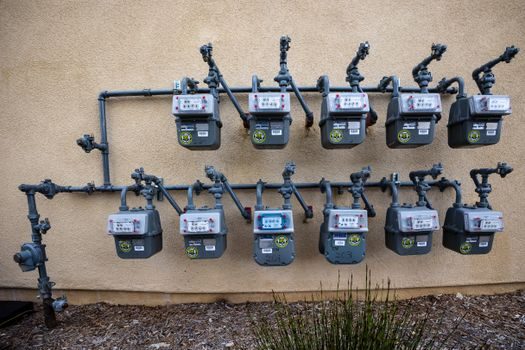
Direct-connect meters are typically rated to 100 A continuous, 120 A maximum, on single-phase 220 V or three-phase 380-480 V supplies, with a captive wiring terminal block and a defined torque value on the lugs [S2]. This is the cheapest path for small commercial loads and residential sub-metering, and it is what dominates the 111-SKU wholesale pool observed on 2026-08-02 [S2].
CT-operated meters use external current transformers with a fixed 5 A or 1 A secondary, and the meter's burden must be lower than the CT's rated burden to avoid saturation in the measurement band, typically stated as ≤0.5 VA per phase at 5 A for class 0.5S work [S1]. A multifunction power meter in CT mode is the right pick for any feeder above 100 A, any retrofit where the busbar cannot be broken, and any installation downstream of a 3-phase molded-case breaker above 160 A frame.
Protocol Stack: Modbus, DLT/645, BACnet, M-Bus
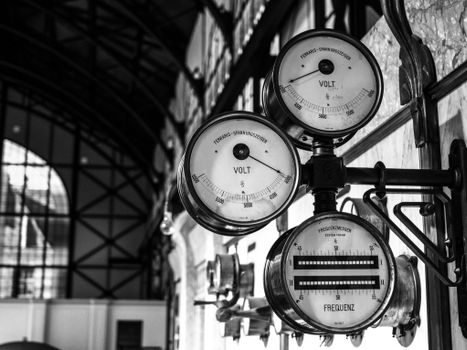
Modbus RTU over RS-485 is the workhorse for plant SCADA, with a 32-node bus limit per trunk without a repeater, and it is the default protocol on virtually every Chinese-made industrial power meter in the 2026 wholesale pool [S2]. Modbus TCP over Ethernet is the same register map wrapped in TCP/IP, used where the meter lands on a plant LAN.
DLT/645 is the Chinese national protocol for utility-grade revenue meters, required when a state-grid entity owns the meter, and it is the only stack that will pass a Chinese utility acceptance test. BACnet MS/TP and BACnet/IP are mandatory when the meter hands off to a building-management system, and M-Bus is the European default for heat/utility sub-metering tied to a集中抄表 system. Mixing two protocols on the same physical RS-485 bus without a repeater is a field-failure pattern; keep one protocol per trunk.
Environmental and Mechanical Envelope
Indoor panel-mount meters are typically IP54 from the front face and IP20 at the rear terminal block, which is sufficient for a switchgear cubicle but not for an outdoor feeder pillar [S1][S2]. Outdoor or washdown locations require IP65 on the front face, a UV-stable polycarbonate bezel, and operating temperature down to -25 °C with a non-condensing humidity envelope.
For any installation within 50 m of a variable-frequency drive, a switching contactor, or a thyristor rectifier, specify an EMC class B (industrial) meter and confirm the vendor test certificate lists IEC 61000-4-4 burst and IEC 61000-4-6 conducted-RF immunity data, not just a generic CE mark [S1]. For hazardous-area zones, the meter itself is rarely Ex-rated; the power transformer and the cabling carry the rating, and the meter sits in the safe area.
Side-by-Side Comparison: Direct-Connect vs CT-Operated vs Optical
Direct-connect single-phase 220 V meters are the cheapest at roughly one-tenth the unit cost of a class 0.5S three-phase CT-operated unit in the 2026 wholesale pool, but they cap at 100 A and are not retrofittable to an existing feeder without breaking the line conductor [S2]. CT-operated three-phase meters cover 5 A to 6000 A primary via CT ratio selection, support class 0.2S through 1.0, and retrofit cleanly but add CT cost, burden matching, and shorting-block discipline to the install.
Optical power meters, sold on the same wholesale channels as a separate product family, measure light power in dBm or watts across a calibrated wavelength range and have no role in electrical billing, despite sharing a name with the electrical category; they are a fiber-OTDR/test instrument and should not be conflated with revenue metering [S3]. A common procurement mistake is to accept an electrical power meter with an unspecified harmonic-measurement range; if the load includes VFDs or LED drivers, the meter must publish THD and individual harmonic magnitude up to at least the 31st harmonic per IEC 61000-4-7.
Who Should NOT Pick the Cheapest Direct-Connect Unit
If the meter feeds a regulatory billing path, a tenant allocation in a commercial building, or any load above 100 A, a direct-connect single-phase 220 V unit is the wrong class, the wrong topology, and the wrong certificate chain, and the savings over a 0.5S CT-operated unit are typically recovered inside the first disputed bill [S1][S2].
Equally, a class 0.2S meter on a non-billing plant feeder is a wasted spec, because the recalibration cost and CT burden dominate the lifecycle. A multifunction power meter at class 0.5S with CT inputs and Modbus RTU is the realistic default for industrial feeders; a class 1.0 direct-connect unit is the right floor for office and lighting sub-metering; and 0.2S belongs only where a third party pays or is paid against the register.
Commissioning and Audit Trail
For revenue-grade or sub-billing meters, the procurement spec should require a vendor-issued test certificate with a traceability chain to a national metrology institute, the CT ratio as a configuration parameter, and a sealed pulse-output or optical port for on-site verification against a portable reference standard [S1]. Lock the meter's firmware version on the purchase order; mismatched firmware between identical model codes is a documented field-failure cause when a SCADA poll returns unexpected register maps.
For the cabling between CT secondary and meter, follow the same routing rules as any low-level signal loop, keeping CT secondary runs physically separate from VFD output cables and using twisted, shielded pairs; the instrumentation cable selection logic for a CT loop is closer to a 4-20 mA signal cable than to a power cable, and a one-metre parallel run with a VFD output is enough to corrupt class 0.5S readings. For a high-accuracy bench or lab reference of contact resistance in the meter's wiring, see the micro-ohmmeter selection logic, which uses the same burden and accuracy discipline.