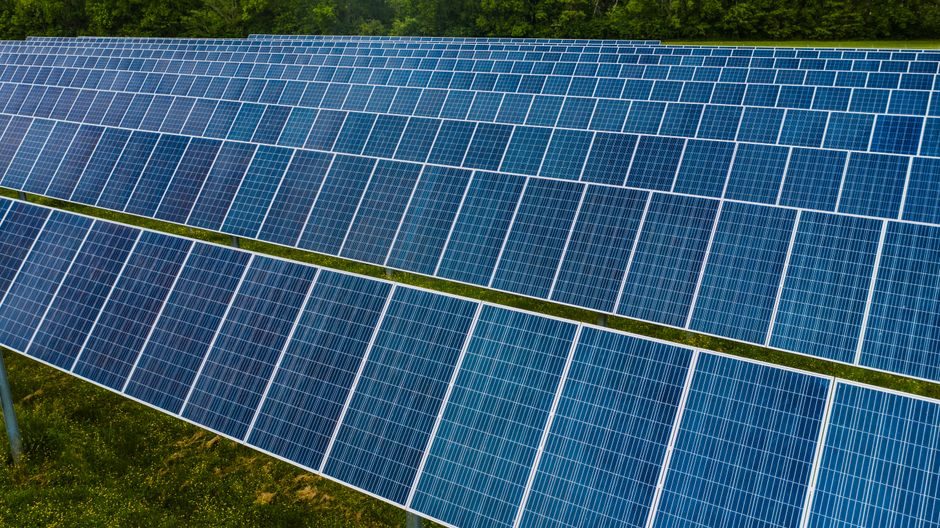
Solar PV capacity needed for a 1.5–2 °C pathway is on the order of 60 TW cumulative by 2050, with up to 4.5 TW of new build required every year — a manufacturing step-change from the ~700 GW peak installed at end-2020, and the foundation of every credible 2026 supply-shortage discussion [S2].
On 10 June 2026 Descartes Underwriting extended parametric wind coverage to Nextpower solar power plants, citing growing "straight-line wind" losses at PV project sites as a distinct, rising peril class for the asset side of the market [S1]. Read together, those two data points define the 2026 risk envelope: a structurally under-supplied upstream (materials, polysilicon, aluminium frames, inverters) sits behind a physically exposed fleet, with the gap between the two filled by insurance and by design choices made at procurement.
Raw-material demand: aluminium, silver and polysilicon set the floor
Reaching 60 TW of PV by 2050 requires a multi-decade build at ~4.5 TW/yr, and every GW of crystalline-silicon module drags a fixed mass of aluminium (frames, mounting structures), silver (front-side metallisation), and metallurgical-grade silicon through the supply chain [S2]. The 2022 Nature Sustainability assessment quantified this aluminium demand risk explicitly and concluded that, under business-as-usual module designs, PV alone could displace a non-trivial share of global primary aluminium supply if terawatt-scale deployment proceeds without alloy or framing redesign [S2].
The bottleneck is not theoretical: polysilicon price spikes, silver paste tightness, and aluminium extrusion capacity have all forced module OEMs into allocation cycles within the past four years. The 2022 Nature paper on globalised solar PV supply chains shows that a fragmented, localised supply chain would erase a measurable fraction of the historical cost-curve savings the industry is still relying on, which means any "friend-shoring" tariff adds a verifiable cost-per-watt penalty to a system whose LCOE is already being squeezed by interest rates [S5]. For a 2026 procurement engineer, the operational read-through is simple: frame alloy, rail section, and string-inverter semiconductor content need second-source qualification before PO release, not after a disruption.
Climate-physical risk: wind, hail and soiling are now a board-level peril
Descartes Underwriting's 10 June 2026 product launch is a leading indicator of how underwriters are re-pricing PV: the trigger is real-time wind speed data captured at project sites, with the policy responding to "straight-line" (non-tornadic, non-cyclonic) high-wind events that historically fell below named-peril thresholds [S1]. For EPCs, this closes a long-standing gap where utility-scale PV was structurally under-insured against derecho-type and outflow-boundary events.
The risk re-pricing cascades back into the specification: trackers and fixed-tilt structures have to be rated to higher gust speeds, module clamps to higher uplift loads, and DC string architectures to higher open-circuit voltage margins so a partial-shutdown event does not push Voc above inverter maximums. The 2017 stochastic-optimization study in Annals of Operations Research already framed the engineering problem as a Conditional Value-at-Risk (CVaR) minimisation over load, generation, and performance uncertainty — the 2026 update is that the performance-uncertainty distribution has a heavier right tail than the 2017 baseline assumed [S6].
Balance-of-system exposure: inverters, transformers and the electronics tier
PV risk in 2026 is not just panels: the balance-of-system (BOS) layer — string and central inverters, medium-voltage transformers, DC combiners, dc power supply units for tracker motors and SCADA cubicles, and the auxiliary switching power supply rails inside plant controllers — is a parallel supply chain with its own allocation cycles. Semiconductor allocation in 2022–2024 rippled into PV inverter lead times, and any 2026 event that re-tightens IGBT or SiC MOSFET supply will land first on solar before it lands on EV or drives channels. [S1]
The 2019 Springer chapter on PV manufacturing system design flagged that the supply chain must be coordinated end-to-end (wafer, cell, module, BOS) to be sustainable at low cost [S3]. In practice, this means a 2026 EPC should treat the inverter OEM and the pressure transmitter vendor that monitors tracker hydraulic lock-out with the same dual-source discipline: one qualified alternative qualified on the datasheet, not promised on a sales call. Designers building 1500 V DC plant controllers should also confirm that the pressure sensor on the tracker hydraulic manifold and the flow meter on the cooling loop of central inverters share a common spares philosophy, because a 1-week inverter shutdown is cheap and a 1-week tracker fleet shutdown across 200 MW is not.
Sourcing policy: localisation vs globalisation cost trade-off
The 2022 Nature paper on global solar PV supply chains developed a two-factor learning model and assessed the cost savings arising from the free flow of capital, talent and innovation in the globalised module supply chain [S5]. A localisation push (tariffs, local-content rules, IRA-style tax credits tied to domestic assembly) measurably raises cost and slows the cost-curve.
For 2026 spec writers, the actionable read is a comparison frame rather than a number: <strong>(a)</strong> lowest LCOE on a globalised BOM, with exposure to a single geopolitical disruption; <strong>(b)</strong> regional dual-source for cells + modules, ~3–7 % cost penalty, halve the disruption tail; <strong>(c)</strong> full local-content assembly, 10–20 %+ cost penalty (the Nature 2022 model range), near-zero import risk but slower cost-down [S5]. The 2020 S&P Global Essential Podcast on Tyson Foods and meat supply disruption is the cautionary analogy: a 1-plant event translated into national retail shortages because the chain had been optimised to a single node [S4]. PV in 2026 is structurally less concentrated than beef processing was in 2020, but the policy levers that delivered the cost curve (free-flowing polysilicon, free-flowing aluminium, free-flowing inverters) are precisely the ones now being re-regulated.
Comparison: 2026 PV risk levers and what each one moves
The main options a 2026 specifier can move are: <strong>module sourcing strategy</strong> (single-OEM lowest $/W vs dual-OEM regional vs local-content) — primary lever on tariff/polysilicon risk; <strong>tracker structural rating</strong> (standard 60 m/s gust vs upgraded 70+ m/s) — primary lever on straight-line-wind peril flagged in the Descartes June 2026 launch [S1]; <strong>inverter architecture</strong> (centralised string inverters vs distributed string) — primary lever on semiconductor-allocation risk; <strong>insurance and risk-transfer layer</strong> (parametric wind cover added to the policy suite) — primary lever on residual catastrophic loss. The 2022 Nature paper on globalised supply chains shows that, of these, the sourcing lever has the largest expected LCOE impact; the 2017 CVaR study shows that the structural and architecture levers have the largest expected loss-reduction impact [S5][S6]. A 2026 spec that addresses only LCOE will under-insure the asset; a spec that addresses only risk will over-pay per watt.
Specification actions and trackable 2026 signals
The related Solar Panel Supply Chain 2026 brief covers the price-split detail between new-build and second-hand modules, and the Wind Turbine Industry 2026 piece maps the parallel sensor and safety re-spec happening on the wind side of the renewables book. Trackable 2026 signals to watch: any further parametric-wind product launches from climate-insurance carriers beyond Descartes, any polysilicon or silver-paste allocation notice from the top-five cell makers, and any 2026 H2 tariff or local-content rule amendment in the EU, US, or India that would shift the cost-curve assumptions modelled in the 2022 Nature paper [S1][S5].