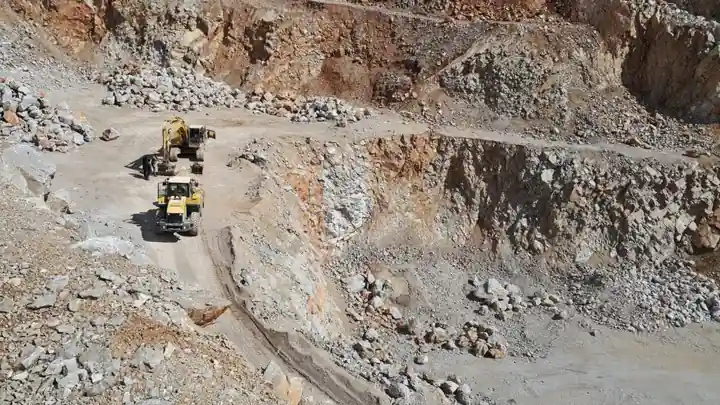
Quarry duty forces three non-negotiable spec gates on any aerial work platform: rough-terrain chassis, working height matched to the highest active bench face, and a platform capacity that covers personnel plus tooling without borderline loading [S1][S6].
A quarry is not a warehouse aisle. Haul roads are unsurfaced, gradients routinely hit 15 to 20 percent, and dust plus rockfall make sealed electric masts impractical, which is why diesel or hybrid 4x4 articulated booms dominate primary-face access [S6]. For broader context on the equipment class itself, see the aerial work platform encyclopedia entry.
Quarry-specific operating envelope
Active bench heights in hard-rock quarries commonly sit between 8 m and 25 m, which puts 12 m to 28 m working-height AWPs in the primary selection band; below 10 m a towable boom lift is wasted, above 30 m the cycle time on a single bench becomes uneconomic versus a staged crawler crane [S6].
Ground pressure and tyre choice matter as much as height. Standard turf tyres load at roughly 30 to 50 kPa and will not survive a shot-rock bench, so quarry-spec units run foam-filled or solid industrial tyres rated for puncture resistance on fragmented limestone and granite [S1]. A 4x4 rough-terrain chassis with oscillating front axle and at least 300 mm of ground clearance is the realistic minimum; 2-wheel-drive units bind on the first wet haul-road corner [S6].
Articulated boom vs straight boom vs scissor
For irregular quarry faces with overhanging ledges and bench corners, an articulated boom with two or three knuckle points out-reaches a straight telescopic boom by 3 to 5 m of horizontal reach at the same platform height, because the knuckle folds up and over the obstruction rather than reaching past it [S1].
Straight telescopic booms win on long, clean face shots where the operator needs maximum outreach at full height without re-positioning, but they need a 6 m to 8 m swing radius and cannot tuck under a low overhang. On flat crusher and load-out pads, diesel scissor lifts with 1.5 m to 2.5 m wide platforms and 500 kg to 1000 kg capacities carry two technicians with tooling, and they cycle vertically in 30 to 45 seconds, faster than any boom for repetitive truck-loading or conveyor inspections [S1][S6].
Drivetrain and power on quarry sites
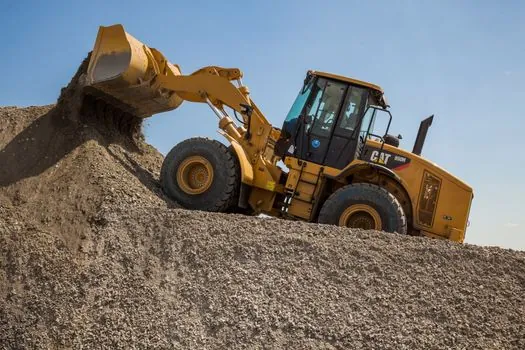
Diesel remains the default prime mover for outdoor quarry AWPs because of dust, fume venting, and the absence of charging infrastructure at remote faces, but Tier 4 Final / Stage V after-treatment adds roughly 150 kg to 300 kg of unit weight and raises the price of a 16 m rough-terrain articulated boom by 12 to 18 percent over a Stage IIIA equivalent [S6].
Hybrid diesel-electric units are now specified where quarries sit inside air-quality regulated zones, and they let the engine shut down at height for low-noise trim work near residential boundaries. Pure battery-electric AWPs are restricted to indoor crusher houses, control rooms, and screening buildings where charging is feasible, and a single 8-hour shift typically needs a 48 V or 80 V battery pack of 300 Ah to 500 Ah capacity [S6].
Safety and standards gates
EN 280 and ANSI A92.20 govern the design and safe-use rules for mobile elevating work platforms, including the requirement for overload sensing at the platform, tilt interlocks typically set at 4 to 5 degrees, and an emergency lowering valve that works with the engine off [S1].
For quarry duty, secondary gating comes from the site rules: a deadman foot switch on all controls, a secondary guarding device (SGUD) such as a sleeve or rail system on boom lifts working over crusher chambers, and a documented daily pre-use inspection covering limit switches, hydraulic hoses, and outrigger pad integrity. Operating near bench edges, the platform must be set back at least the height of the bench from the edge, or two times the height if no positive barrier is in place [S1].
Sourcing, lead time, and used market
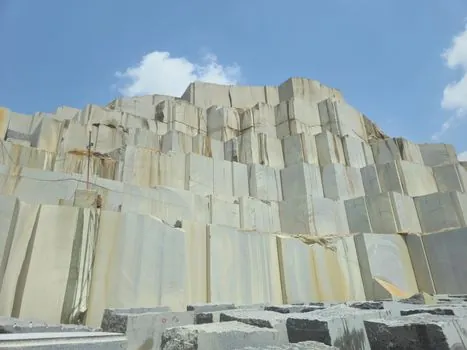
Lead time on a new 16 m to 20 m rough-terrain articulated boom from Chinese OEMs such as Mantall (Nantong), Hangzhou Sivge, or Yangzhou Yixiang typically runs 30 to 60 days ex-works, with European-built equivalents from Haulotte and similar Tier 1 makers at 90 to 150 days [S3][S5][S6][S8].
Rental is the cheaper route for short bench campaigns. U.S. rental inventories tracked by Absolute E-Z Up and similar suppliers list 40 ft (12 m) to 60 ft (18 m) rough-terrain articulated booms in the 4,000 to 8,000 USD-per-month range, and a telehandler-style boom in the 6,000 to 12,000 USD-per-month band, with a 12 to 24 month rental-purchase option common for quarry operators scaling production [S2]. Used 5 to 8 year old Tier 1 diesel booms with 2,000 to 4,000 hours typically resell at 35 to 50 percent of original list, and Haulotte, JLG, and Genie dominate the secondary market because parts and service networks are well established [S6].
What NOT to specify in a quarry
Push-around vertical masts, even dual-mast aluminium units that pass through a standard doorway in retracted mode, are rated for indoor slab use and are not built for haul-road shock loads; specifying one to reach a 6 m quarry face invites a structural failure within the first quarter [S7].
Slab electric scissor lifts have low ground clearance (typically 100 to 150 mm), non-marking tyres, and no differential lock. They are correct inside a screening building or weighbridge enclosure, wrong on a haul road, and a wrong spec on this class of machine is one of the most expensive mistakes a quarry procurement officer can make because the unit will be scrap within a year [S1].
Decision summary by application
Primary face drilling and scaling: 16 m to 28 m 4x4 diesel articulated boom with foam-filled tyres, 230 kg platform capacity, and 4-degree tilt interlock. Crusher and conveyor inspection: 10 m to 14 m diesel scissor lift on rough-terrain chassis, 500 kg to 1000 kg capacity, 4x4. Control room and indoor maintenance: 8 m to 12 m slab electric scissor, 300 kg capacity, 80 V battery, non-marking tyres. Mobile work needing long horizontal reach along a clean face: 20 m to 38 m straight telescopic boom on 4x4, with a 6 m to 9 m outreach envelope [S1][S6].
For a deeper look at the differences between quarry and underground mining duty, the aerial work platform selection for mining operations reference covers methane-purging and EX-rated variants. Quarry sites that double as aggregate plants sometimes share fleet platforms with on-site concrete and steel work, where a truck crane selection for urban infrastructure brief maps the load charts the boom lift must clear.